Leaked ConnectWise Credentials Used to Access 173 Microsoft 365 Tenants
Leaked ConnectWise credentials were reportedly used in an active attack to log into 173 Microsoft 365 tenants, highlighting the reach of MSP supply-chain credential abuse. The incident reinforces the importance of credential rotation, MFA and resilient AI content workflows that do not depend on a single account or service.

Table of contents
An Active Attack Reached 173 Microsoft 365 Tenants
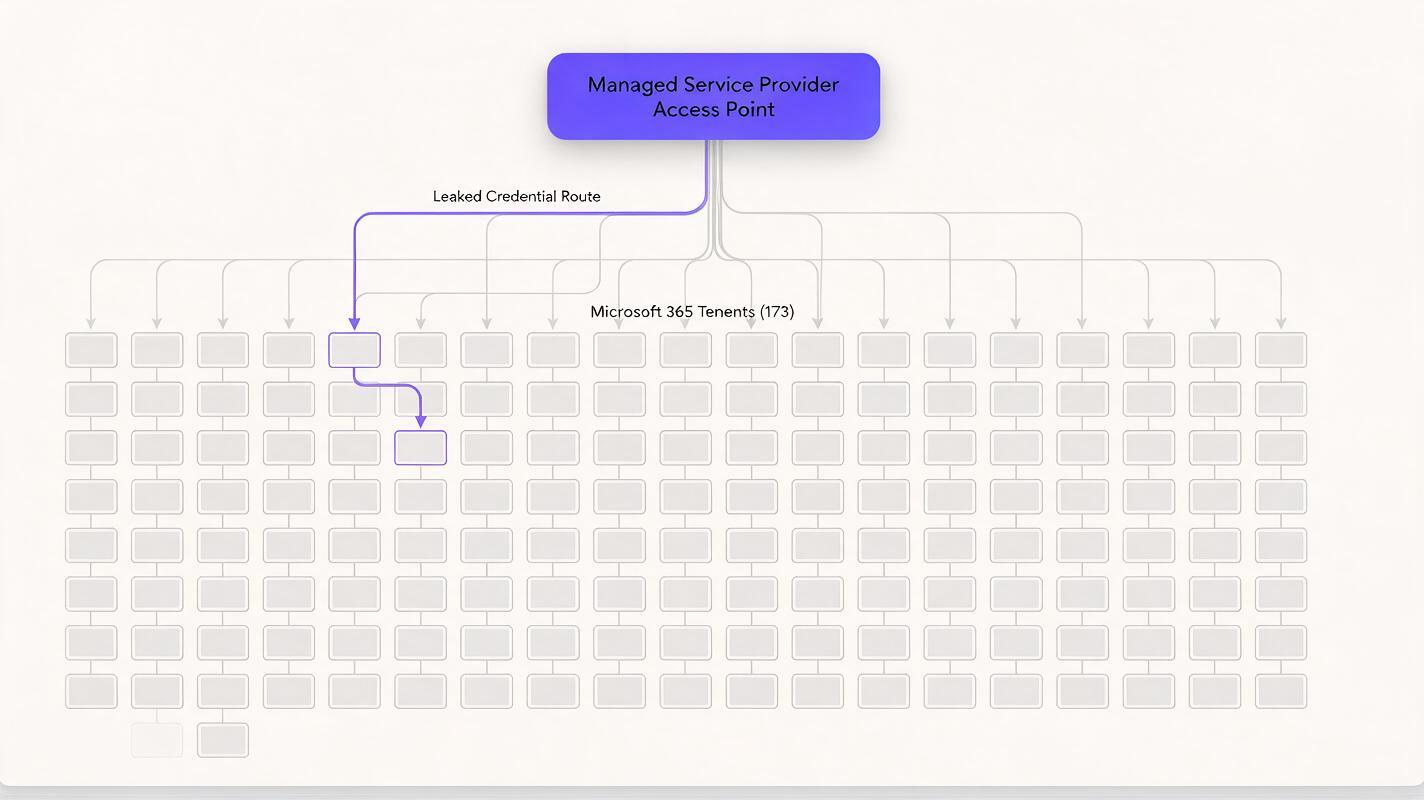
Leaked ConnectWise credentials were reportedly used in an active attack to log into 173 Microsoft 365 tenants, according to a security report published on October 17, 2026. The event was characterized as MSP supply-chain credential abuse, meaning access associated with a managed service provider became the route into a much wider collection of customer environments.
The scale is the defining detail. Rather than affecting only one account or organization, the reported credential exposure created a path to 173 separate Microsoft 365 tenants. The prescribed response is direct: affected organizations should rotate credentials and enforce multi-factor authentication, or MFA.
For content teams, the incident is a reminder that an AI workflow depends on more than the model producing text, images or video. Account security, shared documents, approvals and access to production assets can all influence whether work continues safely and reliably.
The central lesson: credentials connected to shared administrative access can create risk across many otherwise separate environments.
Why MSP Credential Abuse Has Such a Wide Reach
A managed service provider may support multiple customer organizations. That operating model can make administration more efficient, but it also concentrates access. When valid credentials are leaked and abused, an attacker may be able to reach several managed environments without attacking every customer independently.
The ConnectWise incident illustrates this multiplier effect. The reported activity involved logins to 173 Microsoft 365 tenants, not merely attempts against a single isolated account. It therefore belongs in a broader discussion about supply-chain exposure: security can depend on the controls maintained by organizations and by the service relationships connecting them.
Credential abuse also differs from a purely technical software flaw. A login made with leaked access can resemble authorized activity at the authentication boundary. That makes credential hygiene, access restrictions and strong identity verification particularly important.
| Reported element | Why it matters |
|---|---|
| Leaked ConnectWise credentials | Valid access information became the reported route into customer environments. |
| 173 Microsoft 365 tenants | The incident extended across many separate organizational accounts. |
| MSP supply-chain abuse | A shared service relationship amplified the potential reach of the exposure. |
| Credential rotation | Replacing exposed access information helps invalidate leaked credentials. |
| MFA enforcement | An additional authentication requirement reduces reliance on credentials alone. |
Credential Rotation and MFA Are the Immediate Priorities
The security guidance attached to the report emphasizes two actions: rotate credentials and enforce MFA. Credential rotation matters because a leaked password, token or other access secret can remain useful until it is changed or invalidated. MFA adds another authentication requirement so that possession of one credential is not necessarily enough to complete a login.
These controls should cover more than obvious employee accounts. In a managed environment, teams should pay close attention to accounts associated with administration, integrations and third-party access. The incident’s supply-chain dimension shows why an organization’s identity-security review should account for external service relationships as well as internal users.
For an editorial or media team, access reviews can also clarify who truly needs permission to view source materials, edit scripts, approve campaigns or distribute finished work. Reducing unnecessary privileges limits the number of accounts that can affect an entire production pipeline.

What the Incident Means for AI Content Production
Modern content operations often combine an ai assistant, cloud documents, shared storage, communication services and publishing accounts. If access to a central business environment is disrupted, the problem can move rapidly from security operations into everyday production.
A team may still have its creative concept while losing convenient access to briefs, drafts, review comments or approved assets. AI automation can accelerate production, but it does not remove the need for controlled access and recoverable project records. Faster output is useful only when the underlying workflow remains trustworthy.
Teams can reduce operational fragility by keeping approved briefs and final assets organized, separating draft creation from publication authority, and maintaining clear human approval for external distribution. These practices do not change the facts of the ConnectWise attack; they address the practical question of how a creative operation can remain controlled when an account or connected service must be investigated.
Model Access Is Only One Part of Reliability
AI model selection often focuses on output quality, speed or suitability for a particular format. Security incidents reveal another dimension: the reliability of the surrounding account and service ecosystem.
If a production process depends on one identity provider, one administrative relationship and one creative tool, an access problem can interrupt the entire chain. A more resilient arrangement separates source material, generation, review and publication so that one compromised connection does not automatically control every phase.
This matters when using an ai script writer for planning or an ai video generator for visual production. Generated content should still pass through deliberate review, asset management and publication controls rather than moving automatically from a prompt to a public channel.
Building a More Resilient AI Workflow With MagicBoat
MagicBoat provides a unified environment for AI creation, helping teams work across creative capabilities without building every project around a scattered collection of disconnected tools. This can support continuity when organizations are reviewing third-party access, changing credentials or reassessing which services belong in their production process.
A practical content pipeline can keep the factual brief separate from model-generated drafts, preserve approved language and require human review before publishing. For news-related work, this structure also helps teams distinguish confirmed reporting from interpretation. In this case, the confirmed core is narrow but significant: leaked ConnectWise credentials were reportedly used to access 173 Microsoft 365 tenants, and the recommended response includes credential rotation and MFA.
MagicBoat’s value in that environment is not a claim that a creative platform replaces identity security. It is the ability to centralize more of the creative process while teams maintain appropriate controls around accounts, source material and final distribution. Fewer unnecessary handoffs can make an ai workflow easier to understand, audit and recover.

Security Should Shape AI Automation Decisions
The ConnectWise report shows why automation should be evaluated according to the authority it receives, not only the time it saves. An automated system that can draft a script presents a different level of risk from one that can access private documents, change shared files or publish externally.
Content teams can preserve the efficiency of AI while keeping sensitive actions under human control. Draft generation, visual exploration and alternate versions are natural candidates for assisted production. Account administration, access changes and public release deserve stricter review.
This distinction becomes increasingly important as ai agent systems connect to more business services. The broader the connection, the more carefully teams should consider credentials, permissions and the consequences of unauthorized access.
Keep Creation Moving Without Ignoring Account Risk
The reported access to 173 Microsoft 365 tenants turns credential security into a business-continuity issue as well as a technical one. Rotating exposed credentials and enforcing MFA are the immediate priorities identified in the report. Beyond that response, organizations can use the incident to examine how third-party access and shared administration affect their own production environment.
For teams that want to consolidate AI creation while retaining deliberate review, try these models for free and build a workflow in which generation, approval and publication remain clearly separated.
Key Takeaways
- Leaked ConnectWise credentials were reportedly used to log into 173 Microsoft 365 tenants.
- The event was identified as active MSP supply-chain credential abuse.
- Credential rotation and MFA enforcement are the principal response measures stated in the report.
- AI content pipelines should separate generation from account administration and publication authority.
- A centralized, model-flexible creative environment can reduce unnecessary tool fragmentation while preserving human review.
Keywords
connectwise credentials, microsoft 365 tenants, msp supply-chain attack, credential rotation, multi-factor authentication, ai workflow, ai automation