What Is Data Center Load Cutting? Savings and Grid Risk | MagicBoat
Reuters reported on November 18, 2026, that some U.S. data centers are reducing electricity consumption during peak grid hours to lower capacity and transmission fees. NRG estimates that one large Texas facility could save about $33.4 million annually by avoiding a single critical peak hour, raising questions about who ultimately pays for grid expansion.
Table of contents
Data Center Load Cutting Is Becoming a Major AI Cost Strategy
Some U.S. data centers are reducing their electricity draw during peak grid hours to lower capacity and transmission fees, Reuters reported on November 18, 2026. Utility company NRG estimates that one large Texas facility could save about $33.4 million per year by avoiding a single critical peak hour, showing how a brief operational adjustment can have significant financial consequences.
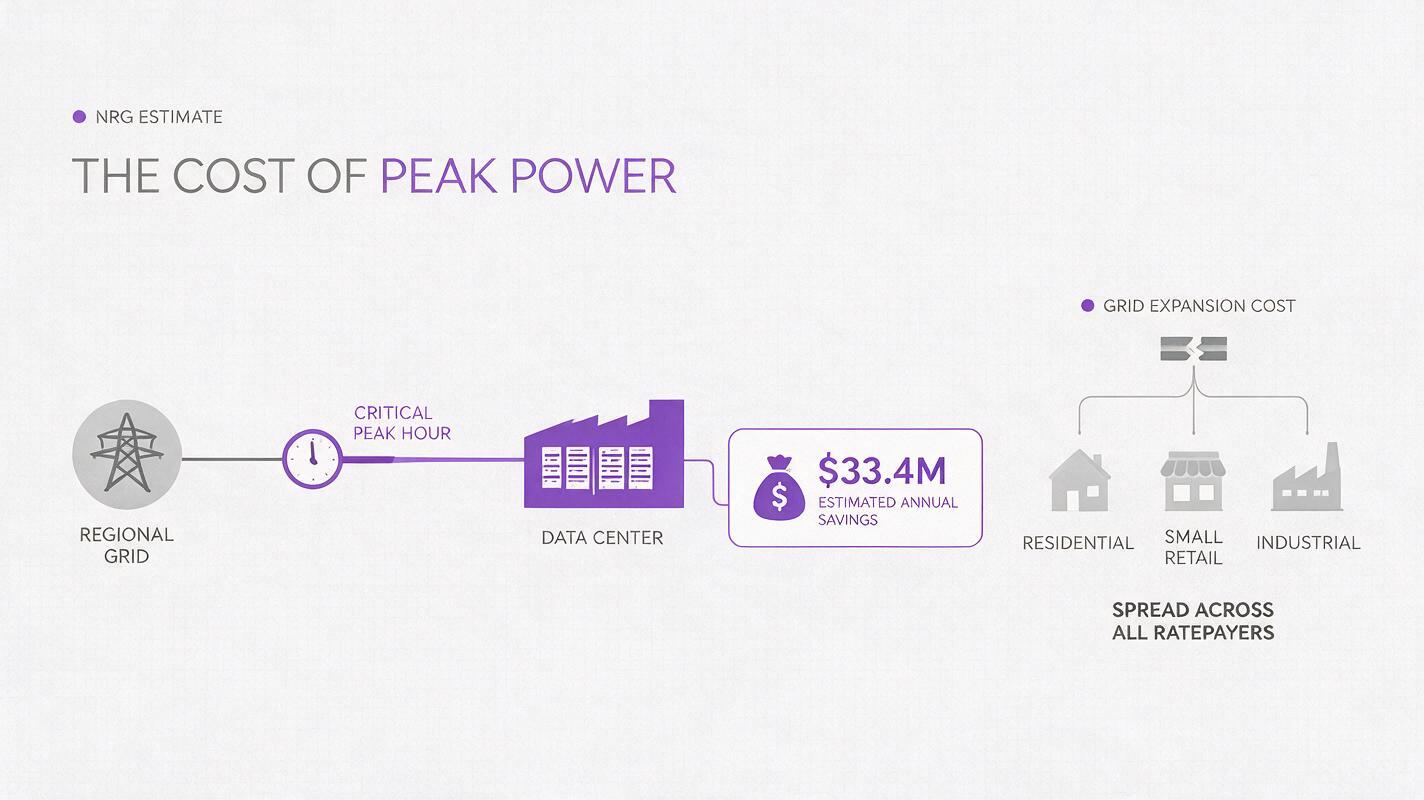
The strategy matters beyond one electricity bill. According to the November 18 Reuters report, the savings remain private while part of the expense of expanding the surrounding grid can remain socialized across other ratepayers. That imbalance is emerging as a regulatory flashpoint as AI infrastructure places new demands on regional power systems.
For AI video and image creators, this is an infrastructure story with practical consequences. Cloud availability, operating costs and service reliability affect every ai video generator and other cloud-powered creative service, even when the underlying electricity market is invisible to the user.
What Happened in the Peak-Hour Power Strategy
Reuters reported on November 18, 2026, that some U.S. data centers are cutting their electricity draw during peak grid hours. The stated financial objective is to reduce capacity and transmission fees rather than permanently reduce overall computing demand.
NRG supplied the report’s central estimate: one large data center in Texas could save approximately $33.4 million annually by avoiding a single critical peak hour. The $33.4 million figure is an NRG estimate reported by Reuters, not an independently verified saving from a named facility.
The report did not disclose the facility’s identity, operator, electrical capacity or exact tariff arrangement. It also did not disclose how much workload would need to be delayed, shifted or curtailed during the critical period. Those omissions make it inappropriate to treat the estimate as a universal saving available to every data center.
NRG’s November 18 estimate indicates that avoiding one critical peak hour could be worth about $33.4 million annually to one large Texas facility, but the underlying site and tariff details were not disclosed.
The key distinction is between temporary load management and a permanent reduction in AI infrastructure. Reuters described facilities reducing draw during peak grid periods; it did not report that the affected operators were abandoning data-center expansion or permanently taking computing capacity offline.
Why the $33.4 Million Estimate Matters
Capacity and transmission charges are designed around the infrastructure required to serve periods of unusually high electricity demand. The Reuters report shows why data-center operators have a strong incentive to minimize their recorded demand during critical grid periods: the potential annual saving can be far larger than the value of electricity avoided during the hour itself.
| Reported item | Figure or status | Source and date |
|---|---|---|
| Estimated annual saving for one large Texas facility | About $33.4 million | NRG estimate reported by Reuters, November 18, 2026 |
| Critical period avoided | One peak hour | Reuters, November 18, 2026 |
| Named data-center operator | Not disclosed | Reuters, November 18, 2026 |
| Facility power capacity | Not disclosed | Reuters, November 18, 2026 |
| Exact capacity and transmission tariff | Not disclosed | Reuters, November 18, 2026 |
| Workload affected during curtailment | Not disclosed | Reuters, November 18, 2026 |
The estimate also illustrates why peak-hour behavior is likely to receive regulatory attention. Reuters reported on November 18 that the financial benefits of cutting demand can accrue to the individual facility, while grid-expansion expenses remain shared more broadly. That creates a policy question: if a large consumer can sharply reduce its own assessed charges, how should the cost of infrastructure built partly to accommodate that consumer be allocated?
The Reuters report did not identify a proposed regulation, penalty or new tariff. The issue should therefore be understood as an emerging regulatory conflict rather than an enacted policy change.
The Private-Savings and Public-Cost Debate
The central tension is not whether data centers should manage their power use. Reducing consumption during a strained grid period can support system stability. The conflict concerns whether the resulting fee structure fairly reflects the long-term infrastructure required to connect and serve very large facilities.
According to Reuters on November 18, the operator can capture the saving from avoiding a critical hour while grid expansion costs remain socialized. Households and other electricity customers could therefore face political pressure over bills even when a data center has optimized its own peak-hour charges.
Several important figures remain undisclosed in the report, including the share of grid investment attributable to the Texas facility, the amount assigned to other ratepayers and the facility’s total annual electricity expense. Without those figures, the $33.4 million estimate demonstrates the scale of the incentive but does not establish the final cost borne by households.
This distinction is important for responsible commentary. The November 18 report identifies a potential distribution problem; it does not provide enough information to calculate a household bill increase or determine whether a particular operator is underpaying.
How Load Cutting Could Affect AI Services
Reuters did not identify which computing workloads were reduced during peak periods, so there is no basis to claim that a particular AI model, customer service or creative platform was interrupted. Load management can potentially involve scheduling flexible computing around constrained periods, but the operational method used by the Texas facility was not disclosed.
For AI companies, the commercial challenge is balancing electricity-cost optimization with dependable inference capacity. An ai agent or ai assistant may be integrated into a continuous business process, while an AI image or video workload may involve bursts of compute demand. If infrastructure operators alter available power during critical periods, scheduling and capacity planning become more important even when end users never see the underlying energy decision.
The report therefore reinforces a broader reliability principle: creative teams should avoid designing an entire production process around a single invisible dependency. A resilient ai workflow should preserve project assets, prompts and intermediate outputs so work can continue if one service becomes congested or unavailable.
What This Means for AI Content Creators
Creators do not need to monitor Texas electricity tariffs to produce an image or video. They should, however, recognize that cloud-based creation depends on physical infrastructure whose cost and availability can change with grid conditions, financing and regulation.
A production team using an ai image generator can reduce workflow risk by keeping reusable prompts, reference assets and exported results organized outside any single generation session. The same principle applies to an ai video workflow: separate the creative plan from the availability of one model or infrastructure provider.
MagicBoat supports that resilience by bringing multiple creative capabilities into one account. This can make it easier to continue experimenting when model availability, generation capacity or project requirements change, rather than rebuilding a production process around a different standalone service.
The November 18 Reuters report does not establish that peak-hour load cutting has caused creator-facing outages. Its importance lies in revealing the financial incentive behind infrastructure decisions: NRG’s estimated $33.4 million annual saving is large enough to influence how operators plan power use, capacity and future facilities.

Bottom Line
Data center load cutting is an electricity-cost strategy under which some U.S. facilities reduce demand during peak grid hours to lower capacity and transmission fees, according to Reuters on November 18, 2026. NRG estimates that one large Texas facility could save about $33.4 million annually by avoiding a single critical peak hour, although the facility, tariff and operational details were not disclosed.
The larger issue is who pays for the grid built around expanding AI demand. Private operators may retain peak-fee savings while wider infrastructure expenses remain shared, creating a likely regulatory dispute over household bills and fair cost allocation.
For creators, the practical response is flexibility rather than speculation. Keep prompts and assets portable, preserve completed outputs and use a platform that can support more than one creative path. You can try these models for free and build a more adaptable content workflow in MagicBoat.
Key Takeaways
- Reuters reported on November 18, 2026, that some U.S. data centers cut electricity draw during peak grid hours to reduce capacity and transmission fees.
- NRG estimates that one large Texas facility could save about $33.4 million per year by avoiding one critical peak hour.
- The facility name, power capacity, tariff structure and affected workloads were not disclosed.
- The savings are private, while Reuters reported that grid-expansion costs can remain socialized across other ratepayers.
- The report identifies an emerging regulatory flashpoint but does not describe an enacted rule or quantify household bill increases.
- AI creators can reduce operational exposure by keeping assets portable and maintaining a flexible, multi-capability workflow.
Keywords
data center load cutting, peak grid fees, AI data center costs, Texas electricity grid, AI infrastructure, ai workflow, AI content creation