DeepSeek Launches New Open-Weight Model and Search API
On October 18, 2026, DeepSeek announced a new open-weight AI model and a dedicated search API, expanding the growing ecosystem of open generative AI tools. The release comes amid a broader industry shift toward open-weight models, with recent launches from OpenAI, Meta, and Mistral increasing competition and choice for users. For content creators, open-weight models and integrated search capabilities offer greater customization, cost efficiency, and access to up-to-date information for timely content production.

Table of contents
DeepSeek Launches New Open-Weight Model and Search API
On October 18, 2026, DeepSeek expanded its generative AI portfolio with two new releases: a cutting-edge open-weight AI model and a dedicated search API, marking the latest entry in the fast-growing open AI ecosystem.
The announcement arrived amid a packed week of AI industry news, including CNBC’s analysis dividing the AI market into winners and bystanders, and Apple’s decision to ban deepfake generator apps from the App Store. Initial reports of the DeepSeek releases have not disclosed full technical or commercial details: the open-weight model’s parameter count, benchmark performance, licensing terms, and general availability timeline remain unconfirmed, as do the search API’s pricing, rate limits, and feature scope.
Even with limited initial details, the dual release signals DeepSeek’s continued investment in accessible, flexible AI tools — a trend that is reshaping the competitive landscape for both AI providers and end users.
What We Know About the New DeepSeek Releases
While full specifications have not been publicly revealed, the two announced products address distinct but complementary needs in the AI tool ecosystem. Here’s a breakdown of what each offering brings to the table, based on initial reporting.
The Open-Weight Model
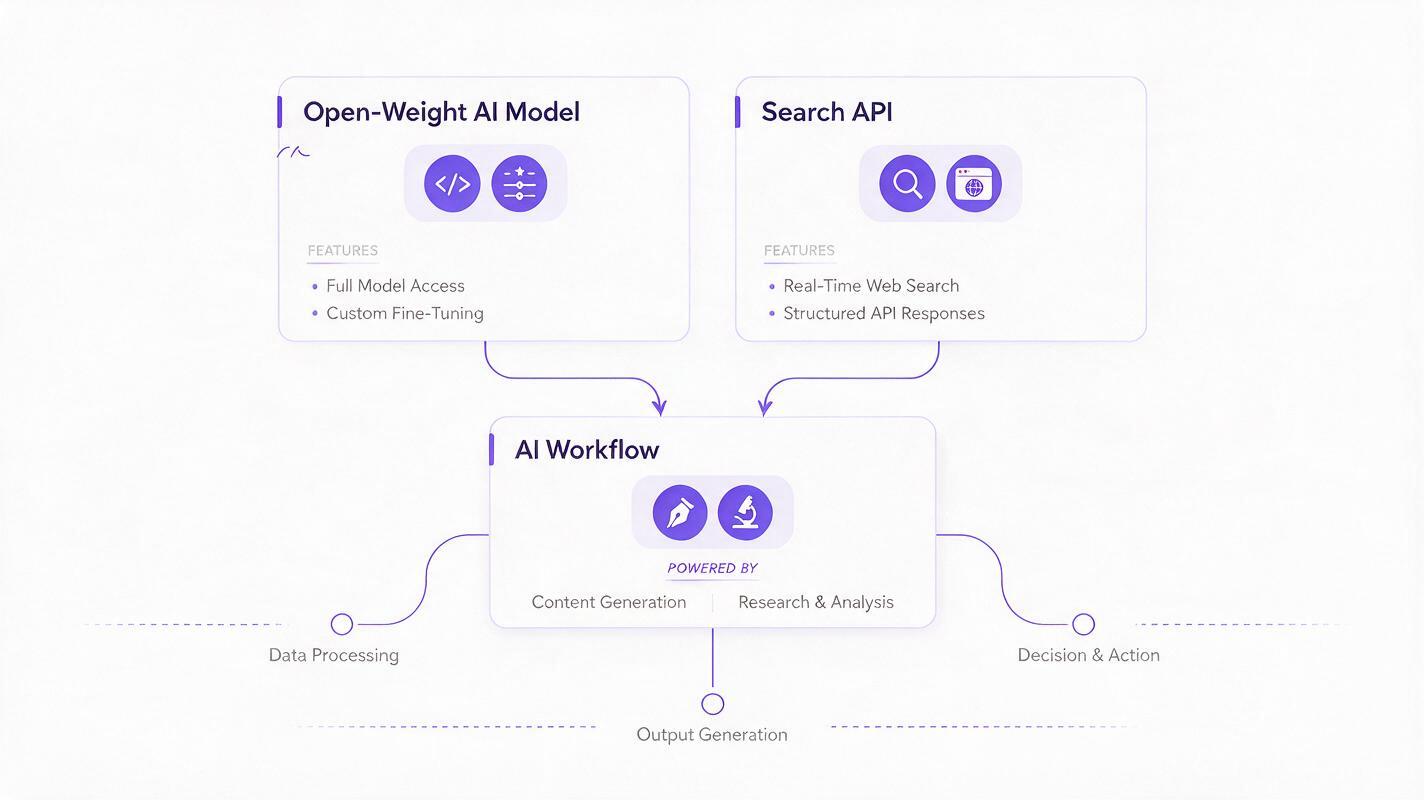
Open-weight AI models differ from closed, API-only models in that users can download the full model weights, self-host the model on their own infrastructure, fine-tune it on custom datasets, and modify its code to fit specific use cases. This stands in contrast to closed models like OpenAI’s GPT-6 or Anthropic’s Claude 3.5, which can only be accessed through provider-hosted APIs with no ability to customize the underlying model.
DeepSeek has established itself as a notable player in the open-weight AI space with previous releases that have performed competitively against leading closed models on common benchmarks. The new model is expected to build on that track record, though concrete performance metrics have not yet been released.
The Search API
The dedicated search API is designed to integrate real-time web search capabilities directly into AI workflows, allowing models to access up-to-date information that falls outside their training data cutoff. This is a critical feature for use cases that require current, accurate information, such as news writing, market research, and fact-checking.
By pairing an open-weight model with a native search API, DeepSeek is positioning its toolkit as an end-to-end solution for developers and creators who want both the flexibility of open models and the utility of live web access — without needing to build and maintain separate search integrations themselves.
Context: The Accelerating Open-Weight AI Shift
DeepSeek’s announcement is far from an isolated event: it is part of a broader industry-wide shift toward open-weight AI models that is rapidly changing the competitive dynamics of the AI market.
Just one day after DeepSeek’s announcement, on October 19, 2026, OpenAI unveiled its own GPT-OSS-120B and GPT-OSS-20B open-weight models, marking the company’s first major foray into open-weight model releases. Earlier in the month, on October 16, Meta announced Muse Spark Open, an 81.6B-parameter open-weight mixture-of-experts (MoE) model released alongside a partnership with Apple to optimize the model for Mac devices. Mistral also launched its Mistral Large 4, a 1T-parameter open-weight MoE model, on October 6, 2026, and Aleph Alpha released its Kolibri open-weight model on October 3, 2026.
This flurry of open-weight releases aligns with industry analysis from October 16, 2026, which concluded that Google and Meta’s combined frontier AI push has ended the absolute market lead long held by OpenAI and Anthropic. Open-weight models from providers like DeepSeek, Meta, and now OpenAI are further fragmenting the market, giving users more options than ever before and putting pressure on closed-model providers to justify their pricing and feature sets.
What This Means for Content Creators
The growth of open-weight models and integrated search tools has tangible, practical benefits for content creators across every niche, from YouTube creators to social media marketers to independent filmmakers.
First, open-weight models offer unprecedented customization options. Creators can fine-tune the model on their own existing content to match their unique brand voice, writing style, or niche focus, resulting in more consistent, on-brand output than generic closed models can deliver. For teams producing large volumes of content, self-hosting open-weight models can also reduce long-term costs, as there are no per-token API fees once the model is deployed — a major advantage for creators working with tight budgets.
Second, integrated search APIs eliminate the manual research step that often slows down content production. Instead of switching between browser tabs to fact-check claims, look up recent events, or research trending topics, creators can pull up-to-date information directly into their AI workflow. This makes it faster and easier to produce timely, accurate content, from short-form social media videos about breaking trends to long-form explainers on current events. For visual creators, pairing search insights with an ai video generator lets you turn researched facts into engaging visual content in minutes.
Finally, the expansion of the open-weight ecosystem reduces vendor lock-in risk. When creators rely on a single closed model provider, they are vulnerable to sudden price hikes, model retirements, or service outages that can disrupt their workflow. Open-weight models give creators the flexibility to switch between hosting providers, model versions, or even entirely different model families without rebuilding their entire content pipeline.
Of course, managing multiple AI tools, API keys, and model deployments can be overwhelming — especially for creators who would rather spend their time making content than troubleshooting technical setup. A multi-model AI platform like MagicBoat simplifies this by bringing together a wide range of AI tools under one account, so you can access both open and closed language models, text to video generation, image creation, and search-enhanced workflows without managing separate integrations. If you’re ready to explore how multi-model AI can level up your content workflow, try these models for free and see what you can create.
Key Takeaways
- DeepSeek announced a new open-weight AI model and dedicated search API on October 18, 2026, expanding the fast-growing ecosystem of open generative AI tools.
- Open-weight models offer creators greater customization, cost efficiency, and control over their workflows compared to closed, API-only model alternatives.
- Integrated search APIs help creators access real-time, up-to-date information for fact-checking, trend research, and timely content production across all formats.
- The broader industry shift toward open AI models is increasing competition and choice, ending the absolute market lead of early frontier providers like OpenAI and Anthropic.
- Multi-model AI platforms like MagicBoat simplify access to a mix of open and closed AI tools, so creators can focus on making content instead of managing multiple services and deployments.
Keywords
deepseek open weight model, ai news, ai tools, search api, open source ai, generative ai, ai content creation