Deno Team Joins Cloudflare as Deno Deploy Heads to Workers
The Deno team has joined Cloudflare, while Deno Deploy will shut down in six months and migrate toward Workers. The transition, which also includes a move for the JSR registry, highlights why AI production teams need portable assets and resilient workflows.
Table of contents
Deno’s Cloud Platform Is Entering a Major Transition
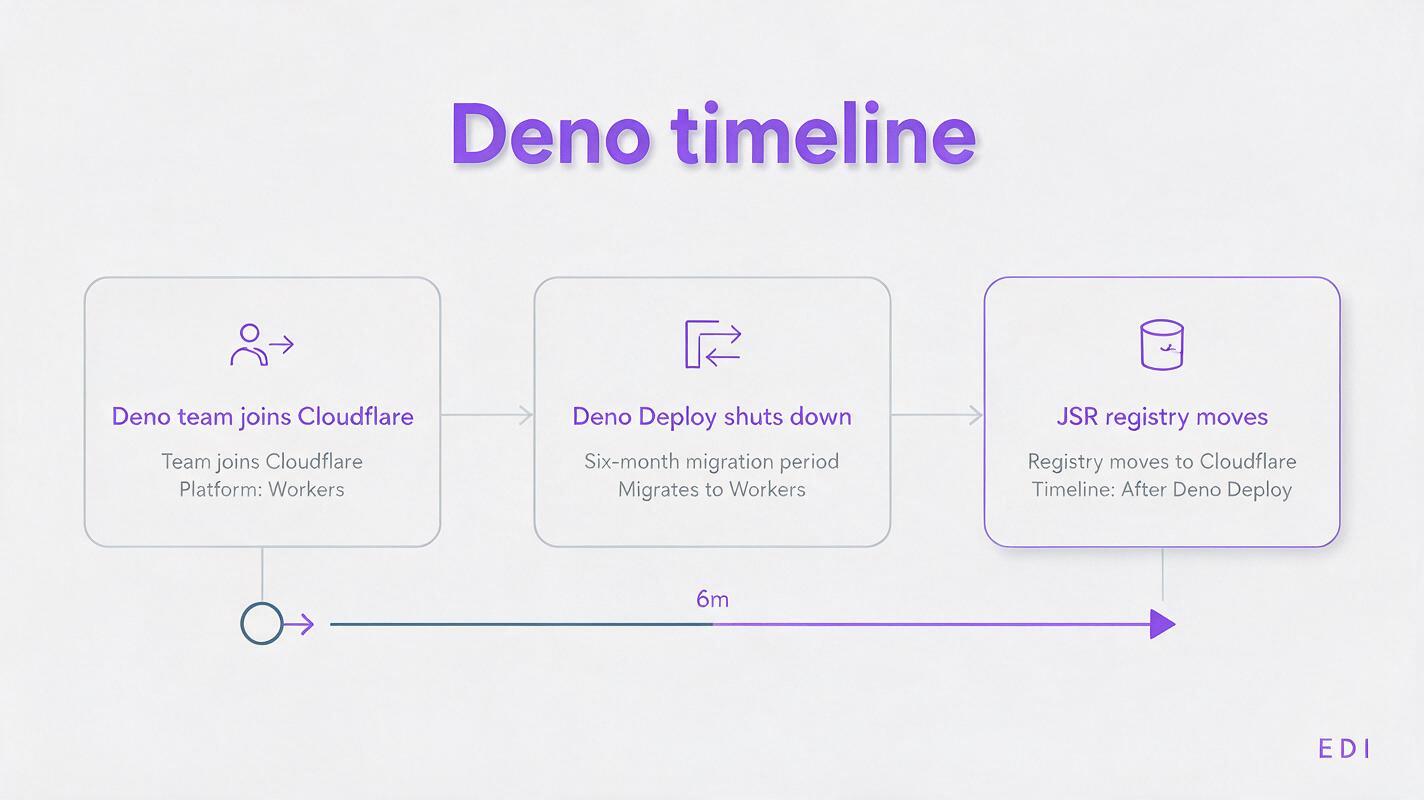
On October 9, the Deno team announced that it had joined Cloudflare, bringing together two significant names in web development infrastructure. The announcement also set a clear timeline for an important product change: Deno Deploy will shut down in six months, with users migrating to Workers.
The change extends beyond Deno Deploy. The JSR registry is moving as part of the transition, making the news relevant to developers who rely on Deno’s broader package and deployment ecosystem. The combination of a team move, a service shutdown, a migration window, and a registry transition makes this more than a conventional corporate announcement.
For teams building AI-assisted content systems, the news is a reminder that the infrastructure surrounding an ai agent can change even when the creative objective remains the same. Scripts, assets, prompts, approvals, and output records become more valuable when they can survive a platform migration.
What the Deno and Cloudflare Announcement Includes
The October 9 announcement contains three connected developments:
- The Deno team has joined Cloudflare.
- Deno Deploy will shut down in six months. Its users are expected to migrate to Workers.
- The JSR registry is moving. This adds a package-distribution consideration to the deployment transition.
Each part affects a different layer of software operations. The team change concerns organizational ownership, the Deno Deploy closure concerns application hosting, and the JSR move concerns the location and continuity of a registry used by development projects.
A six-month migration window gives teams time to respond, but it also places a deadline around auditing applications, dependencies, scheduled activity, and connected services.
The announcement does not mean every workflow must be redesigned. It does mean that teams using Deno Deploy should identify which parts of their operation are tied directly to that environment and which parts already exist as portable files, configurations, or external records.
Why Infrastructure Changes Matter to AI Production
AI production is often discussed in terms of models, prompts, and generated media. In practice, a working ai workflow can also depend on scripts that prepare inputs, route jobs, store metadata, trigger reviews, or deliver approved outputs. Hosting changes can therefore affect an AI operation without changing the model itself.
Consider an ai video workflow that receives a creative brief, prepares scene descriptions, generates visual options, records human feedback, and exports an approved result. If its routing or automation layer depends on a service scheduled to close, the team needs to preserve the creative state before changing the infrastructure beneath it.
The same principle applies to an ai assistant used for campaign planning or an ai automation system that distributes content. The valuable unit is not merely the running application. It is the collection of reusable inputs and decisions around it:
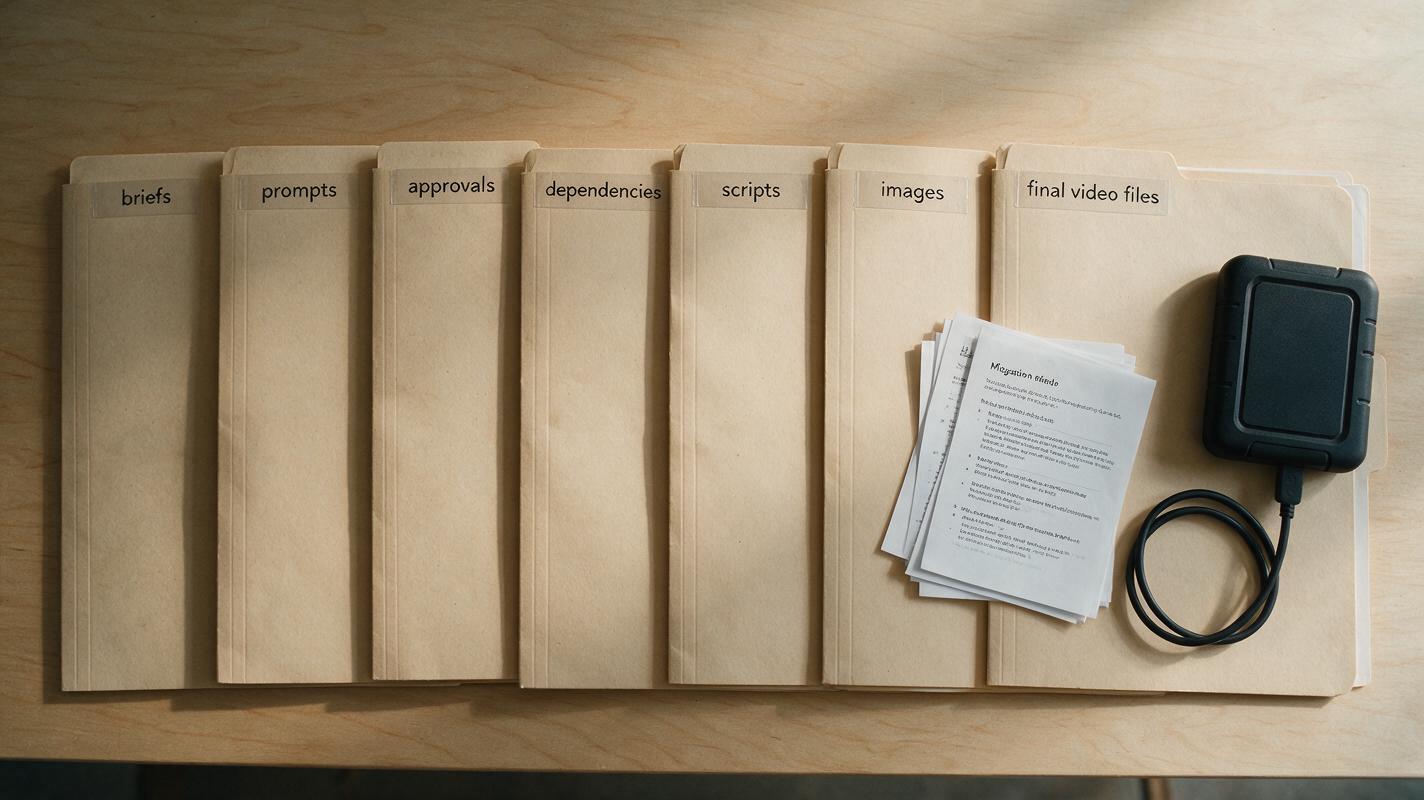
- Approved briefs and source material
- Prompt versions and model selections
- Generated images, scripts, audio, and video
- Review comments and publication decisions
- Dependency and package records
- Exported deliverables in accessible formats
When those materials remain readable outside one hosting service, the production team has more freedom to adapt its technical environment.
Portability Is a Creative Reliability Feature
The Deno Deploy timeline illustrates an important distinction between application availability and creative continuity. A hosted application can move, close, or change ownership. A well-organized production archive can remain useful throughout that transition.
For content teams, portability begins with separating durable creative materials from temporary execution infrastructure. A campaign brief should not exist only inside an automated process. A final script should be available independently from the service that generated or routed it. Visual references and approved outputs should have clear names, versions, and ownership.
| Production element | Continuity concern | Portable record |
|---|---|---|
| Creative brief | Context can be lost during migration | Exported brief with objectives and constraints |
| Prompt library | Automation may contain the only copy | Versioned prompt files |
| Generated media | Links may depend on one environment | Locally controlled image, audio, and video files |
| Human approvals | Decision history may be fragmented | Review log naming the approved version |
| Packages | Registry movement can affect dependencies | Dependency inventory and project configuration |
This approach does not eliminate migration work. It reduces the chance that infrastructure work will force a creative team to reconstruct decisions that have already been made.
Human Review Should Remain Outside Fragile Automation
An ai agent may coordinate several activities, but publication authority should remain explicit. Infrastructure transitions are a useful moment to inspect where approval occurs and whether an automated service can perform irreversible actions without review.
A resilient arrangement keeps generation, evaluation, and release distinguishable. An AI system can draft a script or prepare visual concepts, while a named human reviewer determines whether those materials are accurate, suitable, and ready for distribution.
That separation also makes a migration easier to validate. Teams can compare outputs before and after the infrastructure change without allowing the new environment to publish automatically. If behavior differs, reviewers can pause delivery while preserving the underlying campaign assets.

MagicBoat Keeps Creative Work Closer Together
Infrastructure changes are easier to manage when the creative side of production is not scattered across unnecessary services. MagicBoat gives content teams a unified place to develop scripts and media, including access to an ai script generator and an ai video generator.
That does not remove the need to manage external hosting or package dependencies. It can, however, reduce fragmentation across the content-production layer. Teams can focus on preserving briefs, prompts, review decisions, and finished media while technical owners handle changes to deployment infrastructure.
A multi-model creative environment also supports workflow flexibility. If one model, integration, or connected service becomes unavailable, the team can retain the production objective and evaluate another available option rather than rebuilding the campaign from nothing.
What Teams Should Preserve During the Six-Month Window
The announced six-month period gives Deno Deploy users a defined horizon for examining what their applications contain. For AI-related systems, that review should include both technical dependencies and creative records.
- Document which production activities currently run on Deno Deploy.
- Identify packages connected to the JSR registry.
- Export briefs, prompts, media, and review records from automated processes.
- Keep publication approval under identifiable human control.
- Validate migrated workflows before reconnecting distribution channels.
- Retain a readable archive of the last approved output from the existing environment.
The central lesson is not that cloud infrastructure is unreliable. It is that change is a normal property of the platforms supporting digital work. Portability gives creative teams a practical response.
Key Takeaways
- The Deno team joined Cloudflare in an announcement dated October 9.
- Deno Deploy will shut down in six months, with migration toward Workers.
- The JSR registry is also moving as part of the transition.
- AI production teams should preserve creative assets separately from temporary hosting infrastructure.
- Human approval and portable records help maintain continuity during technical changes.
- To consolidate script and media production, try these models for free on MagicBoat.
Keywords
deno cloudflare, deno deploy, cloudflare workers, jsr registry, ai workflow, ai automation, ai video workflow