Disney+ Rivals Season 2 Returns With Three-Episode Drop
Disney+ revived Rivals Season 2 after a nearly six-month pause by releasing episodes 7, 8 and 9 together on November 11. The unusual return strategy, weekly rollout and already-ordered third season offer a useful case study in sustaining serialized drama momentum.
Table of contents
Disney+ Brings Rivals Season 2 Back After a Long Pause
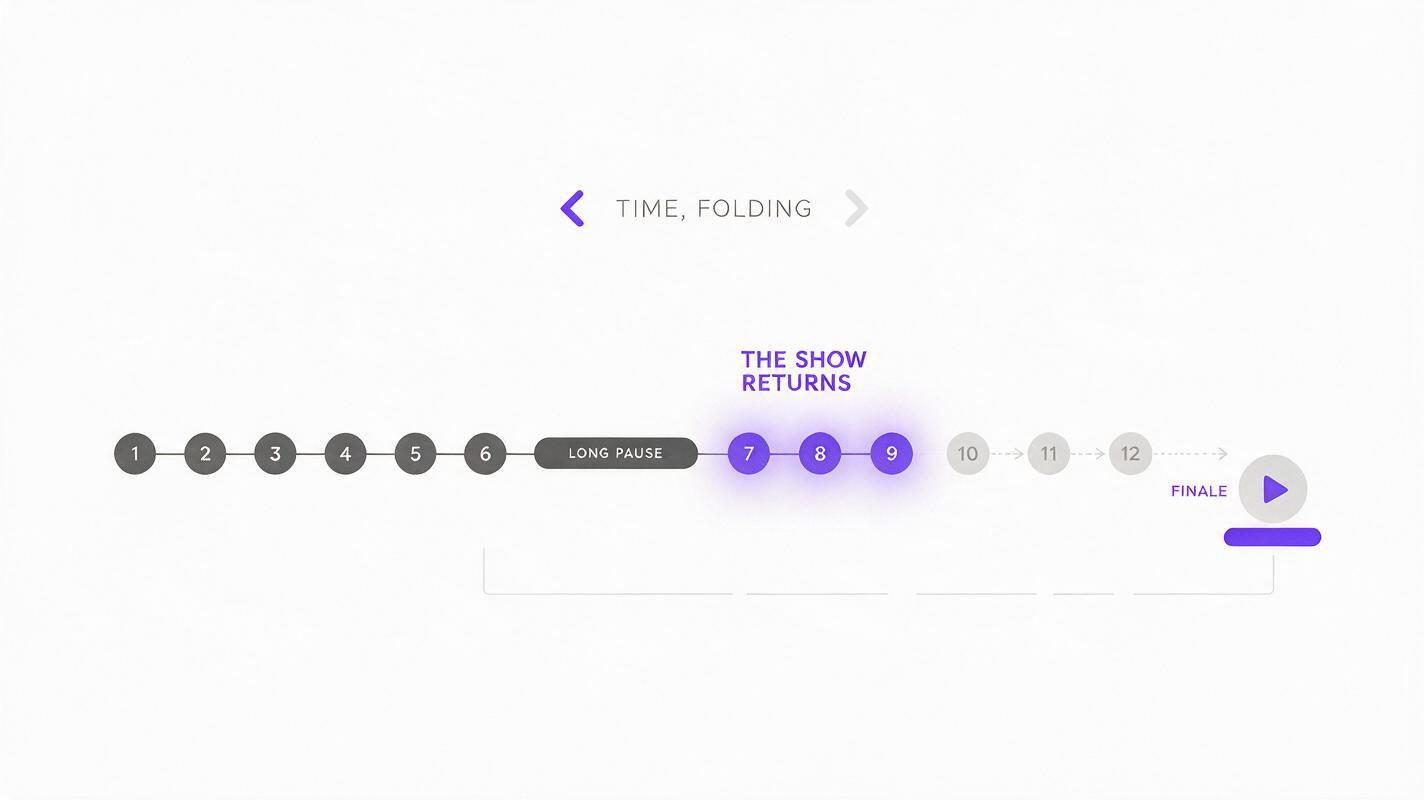
Disney+ brought Rivals Season 2 back on November 11 by releasing episodes 7, 8 and 9 simultaneously. The three-episode drop ended a pause of nearly six months following the cliffhanger in episode 6, which concluded the season’s first part after its May premiere.
The return does not mean the entire season is now available. After the initial bundle, Disney+ is shifting Rivals back to weekly Wednesday releases. The 12-episode season is scheduled to conclude on December 2, giving the platform several more weeks to sustain discussion around the series rather than letting the comeback become a single-day event.
Adapted from Jilly Cooper’s Rutshire Chronicles, the drama features an ensemble that includes Alex Hassell, Nafessa Williams, Emily Atack, David Tennant, Aidan Turner, Hayley Atwell, Rupert Everett, Danny Dyer, Katherine Parkinson, Lisa McGrillis and Bella Maclean. Digital Spy awarded the returning episodes a five-star review and highlighted their revenge-driven twists.
The series also has a future beyond this rollout. Disney+ ordered a 12-episode third season in June 2026, reducing the uncertainty that often surrounds a split-season return. For content makers, the combination of a cliffhanger, a bundled comeback and a weekly finish demonstrates how release structure can become part of the storytelling strategy.
Why the Three-Episode Return Matters
A long midseason interruption creates a basic audience challenge: viewers must remember characters, conflicts and unresolved plotlines before they can become invested again. Releasing only one episode after almost half a year could leave the return feeling slight. Dropping three episodes gives the audience a larger block of story and creates enough material for renewed conversation.
The approach combines two familiar streaming models without committing fully to either one. The November 11 bundle offers an immediate viewing event, while the subsequent Wednesday schedule preserves anticipation through the December 2 finale. That hybrid structure can serve several objectives at once:
- Restore narrative momentum: Three episodes provide more room to reconnect viewers with the ensemble and the episode 6 cliffhanger.
- Create a visible comeback: A multi-episode release feels more substantial than an isolated installment after a long break.
- Extend attention: Weekly episodes keep the season active beyond its return date.
- Build toward a fixed finale: The December 2 endpoint gives the remaining campaign a clear destination.
The release pattern is part of the audience experience: a bundled return rewards immediate interest, while a weekly finish gives each later development room to circulate.
The Cast and Adaptation Foundation
Rivals is not relying on release mechanics alone. Its foundation is an established literary property and a large cast capable of carrying multiple intersecting storylines. The adaptation of the Rutshire Chronicles gives the series an existing narrative world, while performers such as David Tennant, Hayley Atwell, Aidan Turner and Alex Hassell provide recognizable points of interest across the ensemble.
That structure is particularly useful for a 12-episode season. A broad group of characters can support parallel conflicts, shifting alliances and different promotional hooks. The reported emphasis on revenge twists also gives individual episodes clear dramatic events that can fuel trailers, recaps and short promotional edits.
For independent productions, the transferable lesson is not that every project needs a famous cast or an established novel. It is that a serialized drama benefits from identifiable character functions. Viewers should be able to recognize who drives the conflict, who has the strongest grievance and which unresolved relationship will pull them into the next installment.
What the Rollout Signals for Serialized Stories
The Rivals return shows how a platform can treat distribution as a form of pacing. The six-month interruption increased the burden on the comeback, but the three-episode bundle gave the series enough narrative volume to re-establish itself. The weekly finish then converts that initial burst into a continuing schedule.
| Release phase | Rivals Season 2 approach | Audience purpose |
|---|---|---|
| Initial run | First part premiered in May | Introduced the season and built toward episode 6 |
| Midseason pause | Nearly six months | Left the cliffhanger unresolved |
| Return event | Episodes 7, 8 and 9 on November 11 | Restored momentum with a substantial viewing block |
| Weekly continuation | Wednesday releases | Extended attention around later episodes |
| Season endpoint | Episode 12 on December 2 | Created a defined finale event |
This pattern is relevant to an AI short drama as well as a conventional streaming series. Short-form projects can group several episodes around a comeback or major reveal, then return to a predictable cadence. The essential principle is to match distribution rhythm with the intensity of the story rather than publishing every segment without a larger arc.
Turning Release Rhythm Into AI Content Creation
AI content creation can help small teams explore serialized concepts before committing to a full production. An ai script generator can support early work on episode premises, character objectives and cliffhanger options. Those ideas still require human selection and revision, especially when continuity must remain consistent across a season.
Visual development can follow the same release-minded approach. A project using text to video can test short mood pieces, character entrances or promotional concepts for different points in an arc. Instead of generating disconnected clips, the stronger approach is to give every asset a defined function: introduce a rivalry, refresh an unresolved conflict or tease the next reversal.
A Release-Aware Story Prompt
Develop a serialized drama concept with an ensemble cast. Create a major unresolved conflict at the midpoint, a three-episode comeback arc that restores momentum, and a weekly final run leading to a decisive finale. Keep each character objective consistent and make every episode change at least one important relationship.This kind of prompt focuses on narrative architecture rather than imitating Rivals, its characters or its source material. The objective is to examine why a comeback needs enough dramatic movement to reward viewers who return after a break.

The December 2 Finale Is Not the End
The remaining Season 2 episodes will lead to the December 2 finale, but Disney+ has already confirmed another 12-episode season. That advance order changes the context around the current ending: the production can conclude this chapter while knowing the wider adaptation will continue.
For audiences, the renewal provides reassurance after the long interruption. For producers, it reinforces the value of planning beyond a single launch window. A series can deliver a satisfying seasonal destination while preserving relationships, conflicts or broader world-building that support another run.
Independent AI film projects can apply the same discipline on a smaller scale. A short season should have its own shape even when additional installments are planned. Continuation is more convincing when the current story earns attention rather than functioning only as setup for future content.
Build a Stronger Serialized Release With MagicBoat
The return of Rivals Season 2 is a reminder that publishing strategy, episode structure and audience memory are closely connected. A substantial comeback can rebuild momentum, while a weekly finish gives individual developments more time to attract attention.
MagicBoat brings AI storytelling and video capabilities into one creative workflow for testing serialized concepts, visual directions and short-form releases. To explore an original drama idea, try these models for free and shape the material around a clear narrative arc rather than a collection of unrelated clips.
Editorial Checklist
- Rivals Season 2 returned with episodes 7, 8 and 9 on November 11.
- The comeback followed a pause of nearly six months after episode 6.
- Disney+ resumes weekly Wednesday releases through the December 2 finale.
- The season contains 12 episodes and adapts Jilly Cooper’s Rutshire Chronicles.
- A 12-episode third season was ordered in June 2026.
- The hybrid rollout combines an event-sized return with sustained weekly attention.
Keywords
Rivals Season 2, Disney+, Jilly Cooper, David Tennant, AI content creation, AI short drama, text to video