Leaked EU Digital Fairness Act Draft Targets AI Relationship Tools and Dark Patterns
A leaked draft of the EU Digital Fairness Act, set to be tabled on November 11, 2026, proposes sweeping rules targeting compulsive platform features, AI systems that simulate relationships, and 10 banned dark patterns, with penalties reaching 6% of global annual turnover. The legislation still requires negotiation with EU member states and the European Parliament before taking effect. The proposed rules carry significant implications for AI vendors, social platforms, and content creators operating in the EU market.

Table of contents
What the Leaked EU Digital Fairness Act Draft Contains
A leaked draft of the EU Digital Fairness Act, scheduled to be formally tabled by European Commissioner Michael McGrath on November 11, 2026, proposes sweeping new rules for digital platforms, AI systems, and online commerce. The draft marks one of the most ambitious EU digital policy proposals in recent years, with penalties that exceed even those under the General Data Protection Regulation (GDPR).
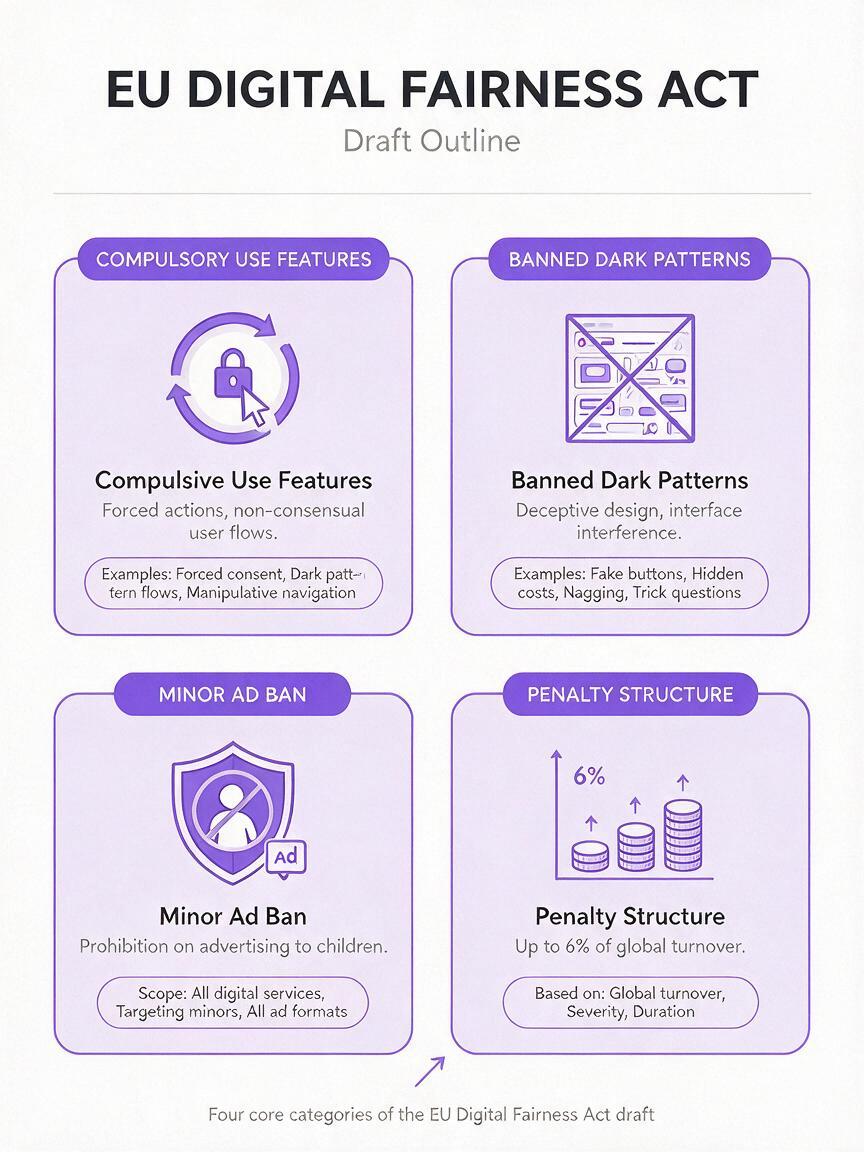
Under the draft text, platforms would be required to allow adult users to disable a broad set of features identified as drivers of compulsive use. These include autoplay for video and content feeds, notifications unrelated to a user’s explicit activity, streak reward mechanics that encourage repeated daily logins, and AI systems designed to “simulate relationships” with users. The proposal also includes a blacklist of 10 so-called dark patterns, defined as deceptive design practices that manipulate users into taking actions they may not have intended. Banned patterns include making cancellation of a service harder than sign-up, hiding auto-renewal terms in fine print, and other tactics that erode user control.
Additional provisions include a full ban on personalized advertising targeted at minors, mandatory disclosure of how many units of a product are available at the advertised price under dynamic pricing systems, and expanded enforcement powers for EU consumer protection authorities. Penalties for violations can reach up to 6% of a company’s global annual turnover, a higher maximum than the 4% cap under GDPR. The draft text is still subject to negotiation with EU member states and the European Parliament, and final provisions could change significantly before the legislation takes effect.
Key AI-Specific Provisions and Industry Impact
The inclusion of AI systems that simulate relationships in the compulsive use framework is one of the most notable elements of the draft, marking one of the first major regulatory attempts to address AI-driven emotional engagement at the EU level. While the text does not define “simulate relationships” in detail, it would likely apply to AI companion apps, chatbots designed to build ongoing personal rapport with users, and potentially even recommendation algorithms that tailor content to create a sense of personalized connection.
For the broader ai industry, the proposal adds another layer of regulatory uncertainty at a time of massive ai capital expenditure and rapid ai funding growth. Companies building AI tools for consumer-facing use cases would need to build compliance controls into their product design, potentially increasing development costs and slowing launch timelines for new features. Platforms that rely on autoplay, personalized notifications, and streak mechanics to drive user engagement would face pressure to redesign their core product experiences, which could have ripple effects on user retention, ad revenue, and content distribution algorithms.
The 6% maximum penalty is particularly significant for large technology companies, as it would apply to global revenue rather than just EU revenue. For a company with hundreds of billions in annual revenue, a maximum penalty could run into the tens of billions of dollars, creating strong incentive to comply with even the most costly requirements. The draft also follows a pattern of increasingly strict EU digital regulation, including the Digital Services Act, Digital Markets Act, and AI Act, creating a complex compliance landscape for companies operating in the region.
What This Means for Content Creators
For content creators and content teams that rely on EU audiences or distribute work through major digital platforms, the proposed rules carry several practical implications. The most immediate impact would likely come from changes to content recommendation and distribution systems, as platforms adjust autoplay, notification, and algorithmic personalization features to comply with compulsive use rules. These changes could alter how content is surfaced to users, potentially shifting reach patterns for creators who have built audiences around current algorithmic dynamics.
Creators who use AI tools to develop interactive content, AI-driven audience engagement features, or personalized content experiences may also face new compliance requirements if their work falls under the draft’s definition of relationship-simulating AI. While the exact scope remains unclear, creators building AI-powered chatbots, virtual characters, or personalized content journeys for EU audiences would need to monitor the legislative process closely to ensure their work aligns with final rules.
The regulatory uncertainty also highlights the risk of over-reliance on a single platform or AI vendor for content creation and distribution. As rules shift and platforms adjust their features and algorithms to comply, creators who have locked their workflow into one ecosystem may face costly overhauls to keep up. A more flexible approach, using a range of tools and distribution channels, can help mitigate the impact of regulatory changes on content production and audience reach.

Building a Flexible Creative Workflow Amid Regulatory Change
For content teams looking to reduce their exposure to platform-specific and regulatory risk, a multi-model creative platform offers a stable, flexible foundation for AI-powered content production. Unlike tools tied to a single social platform or technology vendor, an independent platform gives you access to a broad range of AI models and creative tools in one place, so you can adapt your workflow as regulations and platform policies evolve.
Whether you use an ai image generator to create social media assets, text to video to produce short-form content, or AI writing tools to draft scripts and captions, a unified platform lets you switch between models and creative approaches without rebuilding your entire production pipeline. This flexibility makes it easier to adjust to new compliance requirements, shift distribution strategies, or take advantage of new AI capabilities as they emerge, without being locked into a single vendor’s roadmap.
For teams that produce content for global audiences, having access to a diverse set of AI tools also makes it easier to tailor content to regional regulatory requirements, ensuring that work distributed in the EU complies with local rules while content for other markets can take advantage of a broader set of features. try these models for free to build a more flexible, resilient creative workflow that can adapt to changing regulatory and industry conditions.

Key Takeaways
- The leaked EU Digital Fairness Act draft proposes rules targeting compulsive platform features, AI systems that simulate relationships, and 10 banned dark patterns, with penalties up to 6% of global annual turnover.
- The legislation still requires negotiation with EU member states and the European Parliament, so final provisions may change before taking effect.
- For content creators, the proposal could lead to changes in platform algorithms and distribution dynamics, as well as new compliance requirements for AI-powered interactive content.
- Building a flexible, multi-model creative workflow reduces reliance on any single platform or vendor, helping teams adapt to regulatory shifts without disrupting production.
Keywords
eu digital fairness act, ai regulation, ai industry, dark patterns, ai tools, ai capital expenditure, ai funding