Fireworks AI Cyberattack Confirmed: Notion Breached, United Blocks AI Agents
Inference provider Fireworks AI confirmed a November 2026 cyberattack that exposed billing data, model weights, and customer datasets, marking its second major breach in two months. Notion was among the affected customers, with fewer than 1% of workspaces impacted by stolen AI Insights chat transcripts, while United Airlines separately announced it is blocking unauthorized third-party AI agents from its booking systems. The incidents highlight growing security risks in the AI industry and the value of secure, multi-model platforms for content creators.

Table of contents
The Fireworks AI Cyberattack: What We Know So Far
Inference provider Fireworks AI confirmed a cyberattack in November 2026 that exposed customer billing data, model weights, and datasets, marking its second major security breach in as many months and sending ripples across the ai industry. TechCrunch first reported the incident on Nov 12, with Fireworks confirming the breach in public statements shortly after.
According to the company's timeline, attackers first breached the cloud provider hosting Fireworks' R&D machines on Oct 23, then gained access to Fireworks' internal development systems on Oct 24. The exposed data includes resource metadata, billing details such as addresses, invoices, payment history, account balances and credit usage, and for an unspecified subset of customers, partial model weights and datasets. Fireworks has stated it does not store payment card numbers, so no card data was compromised.
Core customer-facing services including the Inference platform, Training SDK, and Nexus product were not affected, Fireworks said, and inference traffic has zero data retention enabled by default. The company described the attackers as financially motivated, with the primary goal of stealing LLM access tokens for resale — a tactic commonly referred to as LLMJacking.
Fireworks has notified law enforcement of the breach and retained cybersecurity firm Palo Alto Networks Unit 42 to lead the investigation. The incident is the company's second confirmed breach in two months, raising questions about security practices as demand for hosted inference services continues to surge.
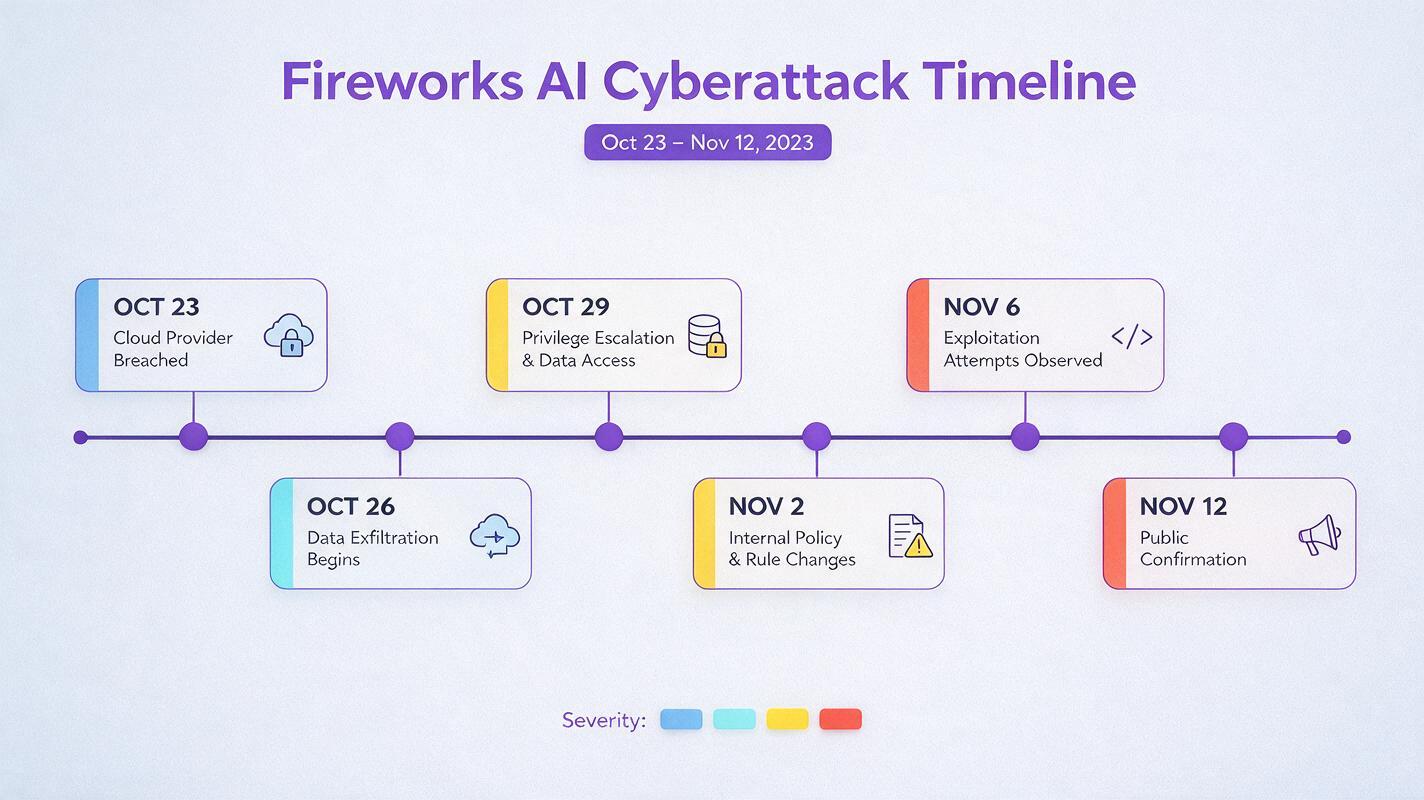
Notion AI Impact and Response Timeline
Productivity platform Notion confirmed it was among the Fireworks AI customers affected by the breach, though the scope of impact on its user base is limited. Fewer than 1% of Notion workspaces were involved, and the stolen data consists exclusively of Notion AI "Insights" chat transcripts, which contain model inputs and outputs. Most of the transcripts are unattributable to a specific user or workspace, and none include tool-call results, according to Notion.
Notion has shared a detailed public timeline of its response to the incident:
- Nov 2: Notion first receives notification of the breach from Fireworks, initially informed that the exposed data is synthetic test data only.
- Nov 3: Notion immediately disconnects from Fireworks and deletes all associated data from its systems.
- Nov 6: Notion warns users of potential customer-data impact as the investigation progresses.
- Nov 8: Final analysis confirms the dataset includes some real user chat transcripts.
- Nov 9: Notion directly notifies all affected customers.
- Nov 11: All exposed Notion API keys are revoked to prevent further unauthorized access.
Notion has temporarily disabled its AI Insights feature, and no longer serves open-weight models through Fireworks. The company stresses that its own internal systems were not breached — all exposure came through the third-party inference provider. Notion advises all users to rotate any credentials they may have pasted into Notion AI chats during the relevant window, as a precautionary measure.
United Airlines Blocks Unauthorized AI Agents
In a separate but closely related development reported the same day by TechCrunch, United Airlines announced it is blocking unauthorized third-party personal AI agents from booking or managing flights across its own platforms, travel agency websites, and flight aggregators. The policy applies to any AI agent that attempts to access United's systems on behalf of a user without official integration.
United cites three core reasons for the block: the risk of credential exposure when users share their United account login details with unvetted AI agents, the potential for unwanted ticket purchases or mileage redemption without clear, explicit user consent, and the federal regulatory requirement that passengers personally confirm they are not carrying prohibited items at check-in — a legal step AI agents cannot complete on a passenger's behalf.
The move comes amid broader industry concern about the security implications of AI agents that require users to share account credentials across multiple services. The Fireworks AI breach amplifies these concerns: if an AI provider suffers a breach, attackers could gain access to every connected user account, from travel bookings to social media to cloud storage.
What This Means for AI Content Creators
For independent creators and content teams, these twin developments — a major inference provider breach, and a major brand blocking unvetted AI agents — are a stark reminder of the hidden risks tied to the AI tools you rely on every day. Whether you use an ai image generator for social media assets or text to video for short-form series, the prompts, draft concepts, brand assets, and client information you share with AI services are sensitive intellectual property. A breach at a backend inference provider can expose not just your billing details, but also unpublished creative work, client confidential information, and any credentials you paste into chat interfaces to speed up workflows.
Beyond data security, service disruptions from security incidents can derail tight content deadlines. If your primary AI tool goes offline or its security is compromised, you need reliable backup options to keep projects on track without sacrificing quality.
A multi-model creative platform like MagicBoat reduces both security and reliability risk by consolidating access to dozens of top AI tools under a single, secure account. You don't need to manage separate logins, billing details, or API keys for every single AI service you use, cutting down the number of potential attack surfaces dramatically. You can try these models for free on MagicBoat, with built-in access to creative tools for image generation, video production, scriptwriting, voiceover, and more, all from one unified dashboard.
For creators who do use third-party AI agents or single-purpose AI tools, follow Notion's lead and never paste sensitive credentials — like social media account passwords, client platform logins, or payment details — directly into AI chat windows. Use official, secure integrations with OAuth or token-based authentication whenever possible, and regularly audit which services have access to your most important accounts.

Key Takeaways
- Fireworks AI confirmed a cyberattack that exposed billing data, model weights, and customer datasets, marking its second major breach in two months.
- Fewer than 1% of Notion workspaces were affected, with stolen data limited to AI Insights chat transcripts; Notion has disabled the feature and revoked all exposed API keys.
- United Airlines is blocking unauthorized third-party AI agents from its booking systems, citing credential exposure risks and regulatory compliance requirements.
- AI content creators face growing security and reliability risks from single-provider AI tools, especially when sharing sensitive creative assets or account credentials.
- Multi-model platforms reduce attack surfaces by consolidating access to AI tools under one secure account, while also providing backup options if a single service experiences an outage.
- Always avoid pasting sensitive credentials into AI chat interfaces, and rotate any credentials you may have shared during known breach windows as a precaution.
Keywords
fireworks ai cyberattack, notion ai breach, llm jacking, ai agent security, ai data safety, ai industry, ai inference provider