Fireworks AI Cyberattack Exposes Notion AI Insights Data
Fireworks AI confirmed that attackers reached its development systems after compromising a cloud provider hosting its R&D machines, exposing billing information and some customer model assets. Notion said fewer than 1% of its workspaces were affected through stolen Notion AI Insights transcripts, highlighting the security risks surrounding connected AI workflows.

Table of contents
Fireworks AI Confirms a Cyberattack With Customer Data Exposure
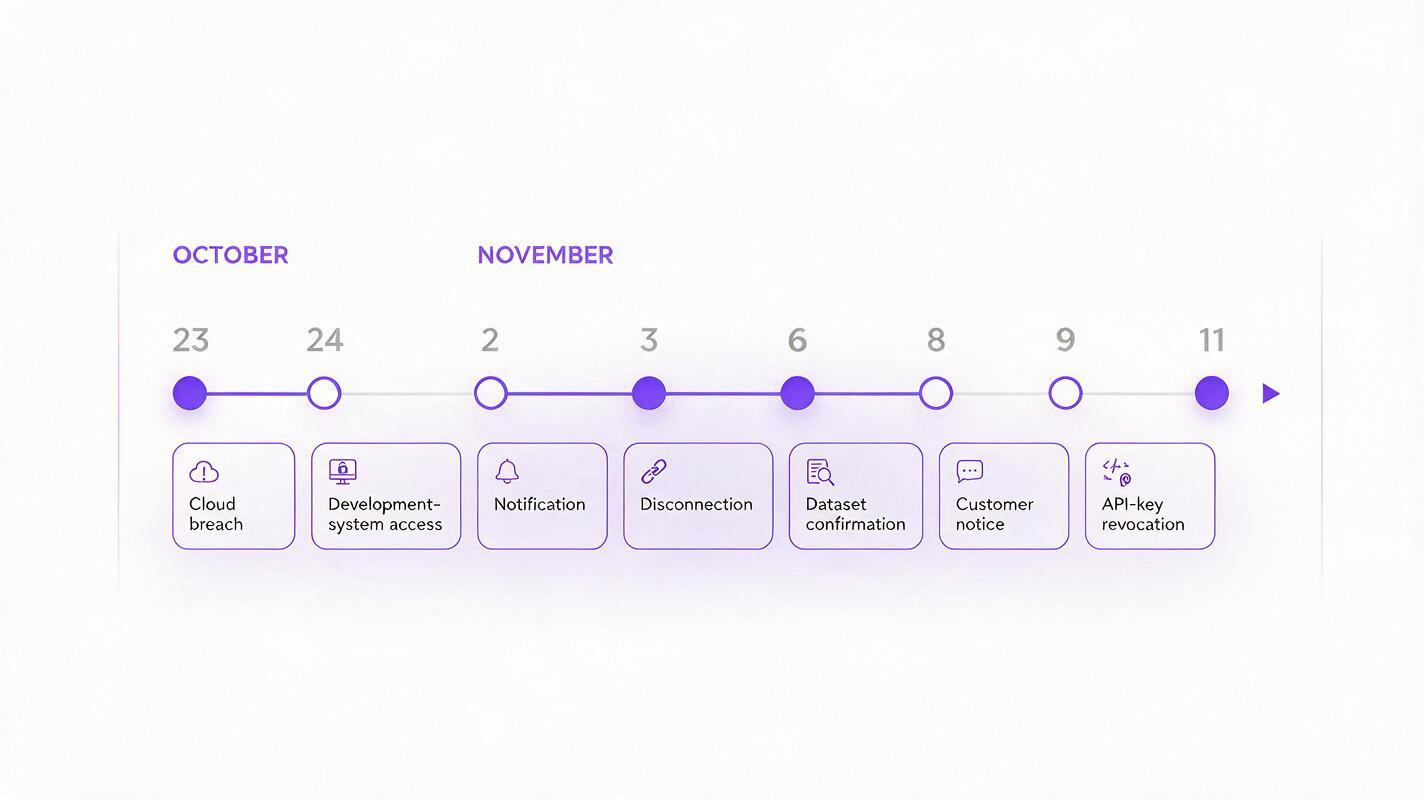
Fireworks AI confirmed a cyberattack after intruders first breached the cloud provider hosting its research and development machines on October 23, then reached Fireworks development systems on October 24. According to the company’s account reported on November 12, the attackers accessed resource metadata and billing information, including addresses, invoices, payment history, balances and credit usage.
For some customers, the compromised material also included subsets of model weights and datasets. Fireworks said it does not store payment card numbers and reported that its Inference service, Training SDK and Nexus were unaffected. It also said Inference uses zero data retention by default.
The company characterized the attackers as financially motivated and said they appeared to be pursuing LLM access tokens for resale, an activity commonly described as LLMJacking. This was Fireworks AI’s second breach in two months. The provider notified law enforcement and brought in Palo Alto Networks Unit 42 to assist with the response.
Notion subsequently confirmed that it was among the affected customers. Fewer than 1% of Notion workspaces were involved, but the incident shows how sensitive prompts and outputs can cross organizational boundaries when an AI assistant depends on an external inference provider. For content teams, that makes provider security and workflow resilience as important as output quality.
What Notion Says Was Taken
Notion said the stolen information consisted of Notion AI “Insights” chat transcripts containing model inputs and outputs. The company described most of the material as unattributable to a particular user or workspace, and it said the exposed transcripts did not include tool-call results.
That distinction limits the reported scope, but it does not make prompt data unimportant. Model inputs can contain draft copy, campaign plans, unpublished research, internal instructions or credentials that users paste into a conversation. Outputs can reveal the direction of a project even when the account behind the request is not immediately identifiable.
Notion emphasized that its own systems were not breached. The exposure occurred through Fireworks AI, an external provider used to serve open-weight models for Notion AI Insights.
Notion advised anyone who pasted credentials into Notion AI during the relevant window to rotate them. That advice reflects a broader security principle for any AI workflow: prompts should not be treated as a safe place to store passwords, API keys or other reusable secrets.
The Notion Response Timeline
Notion’s published sequence shows how the reported understanding of the incident changed over several days:
| Date | Reported development |
|---|---|
| November 2 | Fireworks notified Notion and initially characterized the affected material as synthetic test data. |
| November 3 | Notion disconnected from Fireworks and deleted the related data. |
| November 6 | Notion was warned that customer data might have been affected. |
| November 8 | The final exposed dataset was confirmed. |
| November 9 | Notion notified affected customers. |
| November 11 | Exposed Notion API keys were revoked. |
Notion has disabled Insights and no longer serves open-weight models through Fireworks. Those decisions reduce the immediate connection between the affected feature and the compromised provider while the organizations address the incident.
The timeline also illustrates a recurring challenge in supply-chain incidents: the first notification may not describe the final scope. Customers can receive an early assessment, disconnect a service and then learn later that production data was involved. AI automation therefore needs contingency planning that does not depend on perfect information arriving immediately.
Why LLMJacking Matters Beyond Stolen Tokens
Access tokens have direct economic value because they can enable unauthorized use of paid model infrastructure. Fireworks said the attackers appeared interested in reselling that access, making cost abuse a central concern in this case.
The wider risk is that one credential can connect several layers of an AI workflow. An AI agent may send prompts to a model, retrieve project material, invoke external services and store outputs. If credentials or provider access are compromised, the resulting exposure can involve more than a single chat window.
- Billing risk: stolen access can generate unauthorized model usage and unexpected charges.
- Confidentiality risk: prompts, datasets or model weights may contain proprietary material.
- Workflow risk: disabling a provider can interrupt scheduled production and approvals.
- Attribution risk: data that appears unattributable may still contain contextual details within the text.
- Dependency risk: an organization can be affected even when its own systems were not directly breached.
This is why AI workflow security must cover the whole provider chain rather than only the application visible to the user. An interface may remain operational while a development environment, cloud host or external inference layer is under investigation.

What the Incident Means for AI Content Production
Creative teams increasingly use an ai assistant to summarize research, draft scripts, generate visual concepts and organize production notes. Those tasks can involve commercially sensitive information long before a campaign or video is published. The Fireworks AI cyberattack is a reminder to separate creative context from secrets that grant access to other systems.
Teams should also distinguish between data-retention policies and broader infrastructure exposure. Fireworks said its Inference service uses zero data retention by default and that Inference was unaffected, yet attackers still reached development systems and accessed other categories of information. Retention controls remain valuable, but they are only one part of the security picture.
A resilient ai video workflow should avoid making one provider the only route from concept to final asset. If a service is disconnected during incident response, teams still need a practical way to continue drafting, visual development and production without rebuilding the entire process.
Building a More Resilient Multi-Model Workflow
MagicBoat gives content teams one place to move across creative capabilities rather than anchoring every project to a single external model path. A team can develop visual concepts with an ai image generator, then continue production with text to video tools while keeping the workflow focused on the deliverable.
This does not remove the need for sound security practices. Credentials should remain outside prompts, access should be limited to what each workflow requires and sensitive source material should be reviewed before it is submitted to any AI service. The practical advantage of a multi-model environment is operational flexibility: if availability, policy or reliability changes, production has alternatives.
That flexibility matters because model selection is no longer based only on output quality. Security response, service continuity, data handling and provider dependencies increasingly influence which tool is appropriate for a particular project. For studios and marketing teams, reliable AI automation requires both creative range and the ability to change routes when infrastructure conditions change.
The Wider Agent-Control Debate
The same November 12 reporting also described United Airlines blocking unauthorized third-party personal AI agents from booking or managing flights through its platforms, travel agencies and aggregators. United cited risks including credential exposure, unwanted purchases or mileage use, as well as the requirement that passengers personally confirm at check-in that they are not carrying prohibited items.
The airline action and the Fireworks incident concern different systems, but both highlight the same boundary question: what should an ai agent be allowed to access, and which actions must remain under direct human control? As AI tools connect to more accounts and services, permissions become part of product design rather than a background technical setting.
For content operations, the safest pattern is to give tools only the information required for the current task. Drafting a scene does not require a payment credential. Generating a visual concept does not require access to an entire document repository. Narrower permissions reduce the consequences when an account, token or provider is compromised.
Key Takeaways
- Fireworks AI said attackers breached its cloud provider on October 23 and reached development systems on October 24.
- Exposed information included resource metadata, billing data and, for some customers, subsets of model weights and datasets.
- Fireworks said payment card numbers were not stored and that Inference, Training SDK and Nexus were unaffected.
- Notion said fewer than 1% of its workspaces were involved through stolen Notion AI Insights inputs and outputs.
- Notion disconnected from Fireworks, disabled Insights, stopped serving open-weight models through the provider and revoked exposed API keys.
- Creative teams should keep credentials out of prompts and prepare alternatives for critical model dependencies.
- To explore a flexible content-production environment, try these models for free.
Keywords
fireworks ai cyberattack, notion ai insights, llmjacking, ai workflow security, ai agent, ai automation, ai assistant, ai video workflow