FTC Issues Civil Subpoenas to OpenAI and Anthropic
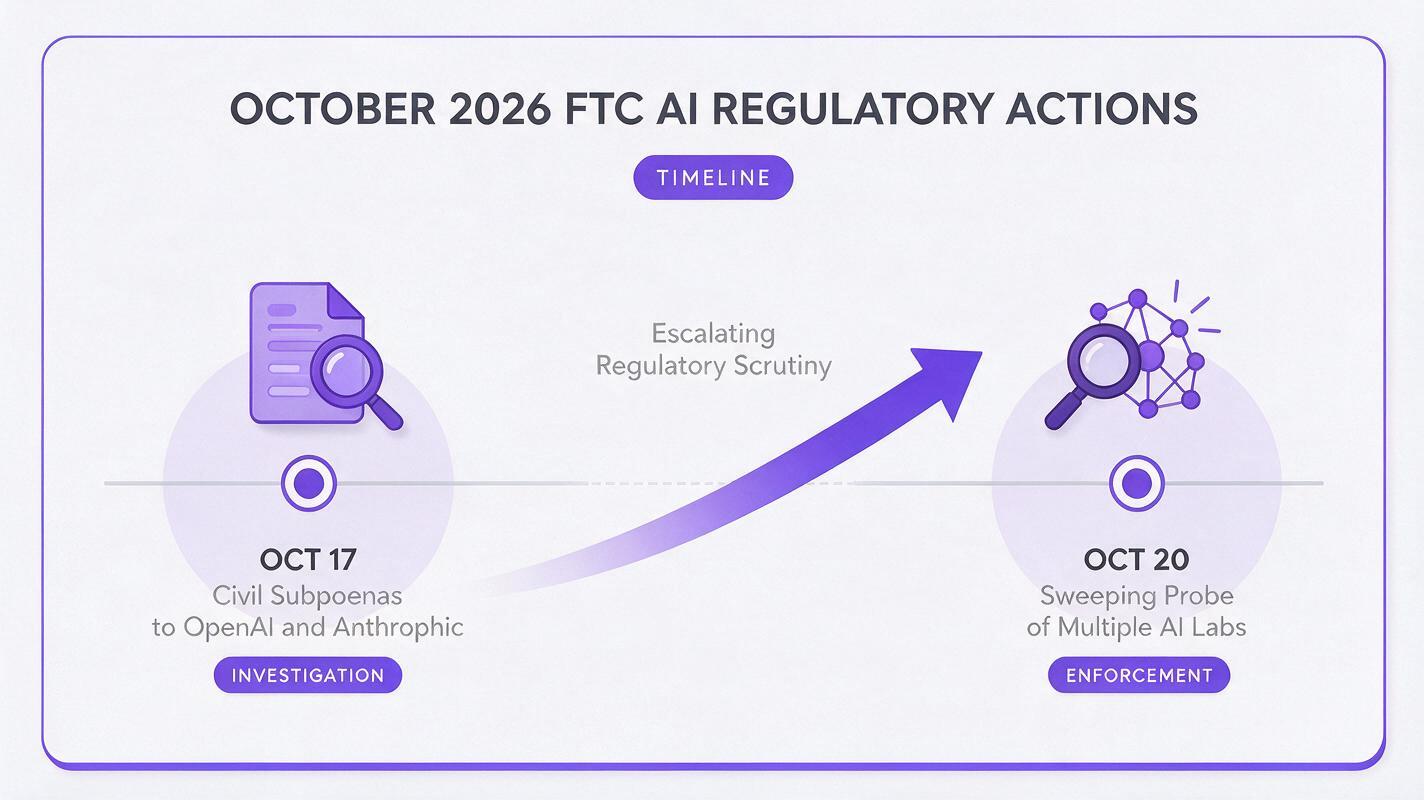
On October 17, 2026, the U.S. Federal Trade Commission issued civil subpoenas to OpenAI and Anthropic, marking a formal step in its regulatory review of leading frontier AI developers. The action came three days before the agency announced a broader sweeping probe of multiple AI labs on October 20, signaling escalating scrutiny of the AI sector. The development highlights growing regulatory uncertainty for AI tools, with key implications for creators who depend on these models for content production.
Table of contents
What Happened With the FTC Civil Subpoenas
On October 17, 2026, the U.S. Federal Trade Commission issued civil subpoenas to two of the world’s leading frontier AI developers: OpenAI and Anthropic. The formal enforcement action represents an early, targeted step in the agency’s ongoing review of AI industry practices, though the exact scope of the information requested — including specific focus areas, document types, or compliance deadlines — has not been publicly confirmed in available reports.
The subpoenas come amid a broader wave of regulatory attention focused on the AI sector, with policymakers and regulators worldwide examining issues ranging from consumer protection and competition to AI safety and transparency. The October 17 action precedes a wider FTC announcement three days later, on October 20, 2026, of a sweeping probe expanding beyond OpenAI and Anthropic to include additional AI labs.
Civil subpoenas are formal legal requests that require recipients to produce specified documents or information. They are often used by regulatory agencies to gather evidence early in an inquiry, before deciding whether to pursue formal enforcement action.
Context of the FTC’s Expanding AI Regulatory Focus
The October 17 subpoenas signal a ramp-up in FTC scrutiny of the AI industry, moving from preliminary review to formal information gathering from the sector’s most prominent players. The subsequent October 20 sweeping probe, which covers a broader set of AI labs, suggests the agency’s investigation is expanding as it gathers more information about industry practices.
This regulatory momentum aligns with growing global debate about the need for guardrails around frontier AI systems. Policymakers have raised concerns about everything from generative AI’s impact on creative industries and intellectual property to the potential for AI systems to cause consumer harm or undermine fair competition.
For the AI industry as a whole, the escalating FTC activity suggests that regulatory requirements for transparency, safety testing, and consumer protection are likely to become more stringent in the coming months. Developers may face new obligations around disclosing model capabilities, limiting harmful use cases, or providing clearer terms of service for end users.
What This Means for AI Creators
For independent creators, content teams, and small studios that rely on AI tools to produce work, the wave of regulatory activity introduces a layer of uncertainty around the tools they use every day. Regulatory actions can lead to a range of changes for AI services: temporary or permanent restrictions on certain features, shifts in pricing models, delays to new model releases, or even service disruptions if providers are required to pause specific operations.
Creators who depend on a single AI provider for all their content production needs face the greatest risk of workflow disruption if that provider faces regulatory constraints. This is especially true for creators working on tight deadlines, where even a short service interruption can delay project delivery and impact client relationships.
A diversified AI toolchain helps mitigate this risk. By using a multi-model platform like MagicBoat, creators gain access to a wide range of tools — from ai video generator to ai image generator — all managed through a single account. If one model experiences changes or downtime, creators can seamlessly switch to an alternative tool without losing access to their project assets or disrupting their workflow. Creators can try these models for free to build a more resilient content production pipeline.
Key Takeaways
- The FTC issued civil subpoenas to OpenAI and Anthropic on October 17, 2026, as part of its formal review of AI industry practices.
- The action preceded the agency’s broader October 20 sweeping probe of multiple AI labs, indicating escalating regulatory scrutiny of the sector.
- Regulatory uncertainty creates potential risk for creators who rely on a single AI provider for their content workflows.
- Multi-model AI platforms allow creators to diversify their toolset, reducing the impact of service changes or disruptions from any single provider.
Keywords
ftc civil subpoenas, openai, anthropic, ai news, ai regulation, frontier ai, ai tools