Gemini 4 Argon Scores 97.5% on ARC-AGI-3 Benchmark
An October 19, 2026 update reports that Google's Gemini 4 Argon frontier model has scored 97.5% on the ARC-AGI-3 benchmark, marking the latest milestone in the model's rapid rollout. The result comes amid a broader shift in the competitive frontier AI landscape, where Google and Meta's combined push has ended OpenAI and Anthropic's previous absolute lead. For content creators, the update highlights the growing capability of frontier models while reinforcing the value of flexible, multi-model production workflows.

Table of contents
What the New Gemini 4 Argon Benchmark Report Says
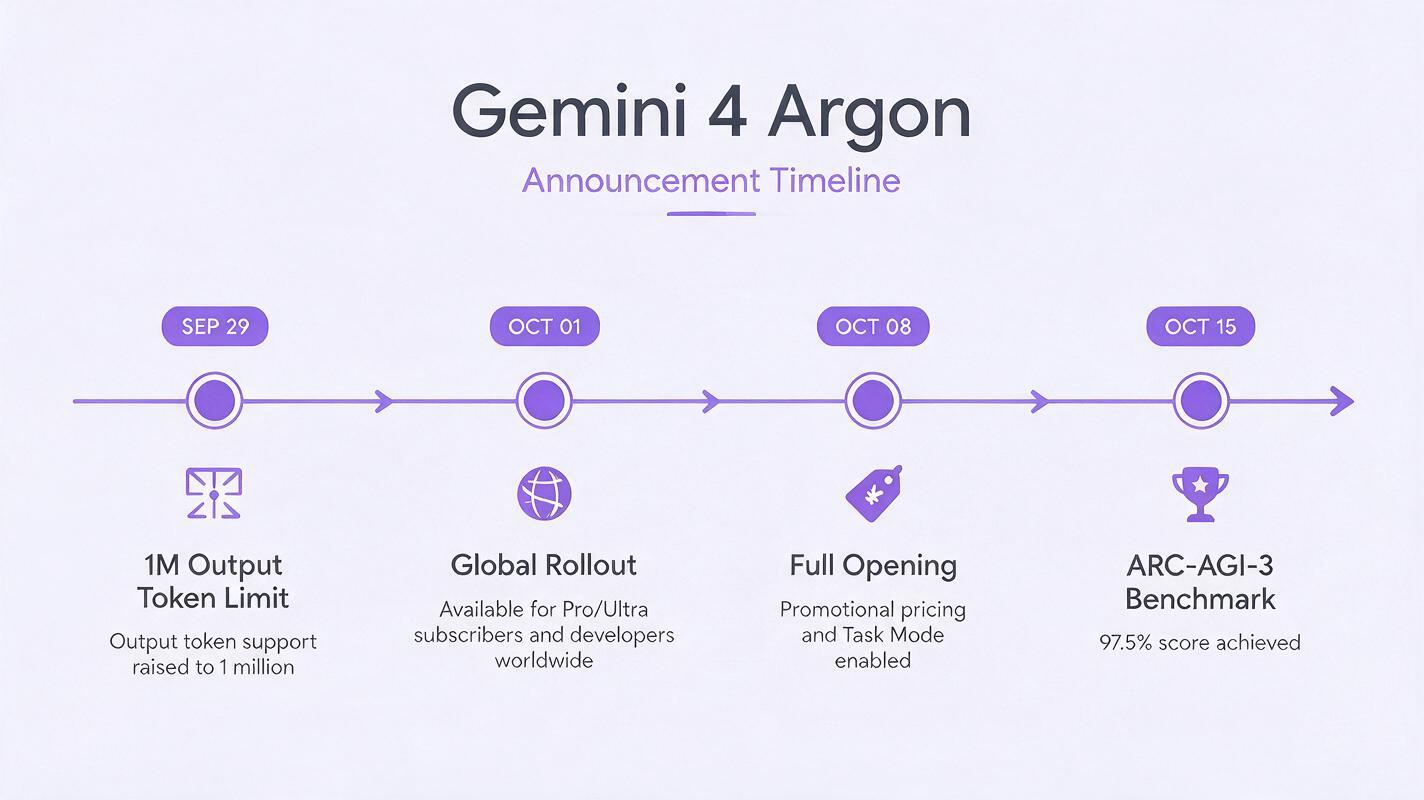
On October 19, 2026, a new update reported that Google’s Gemini 4 Argon frontier model has achieved a 97.5% score on the ARC-AGI-3 benchmark. The announcement marks the latest milestone for the Gemini 4 Argon model, which has rolled out rapidly across user segments over the past week, expanding access and adding new features at a fast pace.
Just five days prior, on October 14, Google launched Gemini 4 Argon globally for Pro and Ultra subscribers, as well as for developers building on the Gemini API. One day later, on October 15, the model was fully opened to eligible users with promotional pricing set at $2 per million input tokens and $10 per million output tokens, alongside a new Task Mode feature designed for focused, single-objective workloads. The model also supports a 1 million token output window, first detailed in late September 2026.
The 97.5% ARC-AGI-3 score is one of the first high-profile public benchmark results released for Gemini 4 Argon since its full launch. While specific details about the evaluation setup, prompt format, and direct comparison group have not been disclosed alongside the initial report, the score represents a notable data point for teams evaluating frontier model capabilities for real-world use cases.
How This Result Fits Into the Frontier AI Race
The Gemini 4 Argon benchmark update comes amid a wave of frontier AI announcements from major providers that have shifted the competitive landscape dramatically. An October 16, 2026 analysis concluded that the combined frontier push from Google and Meta has ended the previous absolute lead held by OpenAI and Anthropic, a shift reflected in the steady stream of new model releases and performance updates across all four providers.
On the same day as the Gemini 4 Argon benchmark report (October 19), OpenAI released two open-weight models, GPT-OSS-120B and GPT-OSS-20B, marking its first major entry into the open-weight model space. NVIDIA also unveiled its Nemotron 3.5 Super VL and Bolt local-agent models on October 19, expanding the range of frontier-capable models available for different deployment setups, from cloud APIs to local devices.
Meta launched its Muse Wonder frontier model on October 12, priced at twice the rate of competing models, while Anthropic has rolled out updates to its Claude model family including the low-cost Claude Haiku 5.5 and expanded enterprise and government features. The frequency of new model launches and benchmark updates underscores how quickly the frontier AI ecosystem is evolving, with providers competing on both raw benchmark performance and practical features like context window size, pricing, and specialized task modes.

What This Means for Content Creators
For content creation teams, high benchmark scores like the one reported for Gemini 4 Argon signal growing potential for AI tools to handle more complex creative tasks. Frontier models with strong general reasoning performance can support a wider range of creative workflows, from drafting long-form video scripts and generating detailed visual concepts to editing support, audience targeting analysis, and even cross-platform content adaptation.
It is important to note, however, that benchmark scores do not always translate directly to real-world creative output quality. A model that performs well on standardized reasoning tests may struggle with specific creative tasks like maintaining consistent character design across a video series, matching a brand’s unique tone of voice, or producing visually coherent long-form content. The only reliable way to evaluate a model for creative use is to test it on your exact workflow, with your own prompts and quality standards.
This is where a multi-model platform like MagicBoat adds clear value. Instead of managing separate accounts, billing plans, and workflow integrations for every new frontier model, teams can access a wide range of AI tools through a single, unified interface. You can test ai video generator capabilities across different models, compare ai image generator output for brand consistency, and iterate on scripts and storyboards without switching between multiple services. As new models like Gemini 4 Argon launch and update, you can test them immediately alongside your existing workflow tools, without disrupting your production pipeline or reworking entire processes.
The rapid pace of model launches also means that relying on a single provider can create unnecessary workflow risk if a model changes, is temporarily unavailable, or shifts its pricing structure. A multi-model approach lets you switch between tools to find the best fit for each individual task, while keeping your creative assets, prompts, and project history centralized in one place. try these models for free to see how different frontier models perform on your specific creative projects.

Key Takeaways
- Google’s Gemini 4 Argon model reportedly scored 97.5% on the ARC-AGI-3 benchmark in an October 19, 2026 update, marking the latest milestone for the recently launched frontier model.
- The result comes amid a broader shift in the frontier AI landscape, where combined investments from Google and Meta have ended the previous absolute lead held by OpenAI and Anthropic.
- Benchmark scores are a useful starting point for evaluating model capabilities, but they do not guarantee strong performance on specific creative tasks — direct testing with your own workflows and quality standards is always necessary.
- A multi-model AI platform like MagicBoat lets creators test new models as they launch, compare output across tools, and maintain stable production workflows without the hassle of managing multiple provider accounts.
Keywords
gemini 4 argon, arc-agi-3, ai news, ai roundup, ai tools, frontier ai, ai model benchmark