Gemini 4 Argon Hits 97.5% on ARC-AGI-3, Second After OpenAI
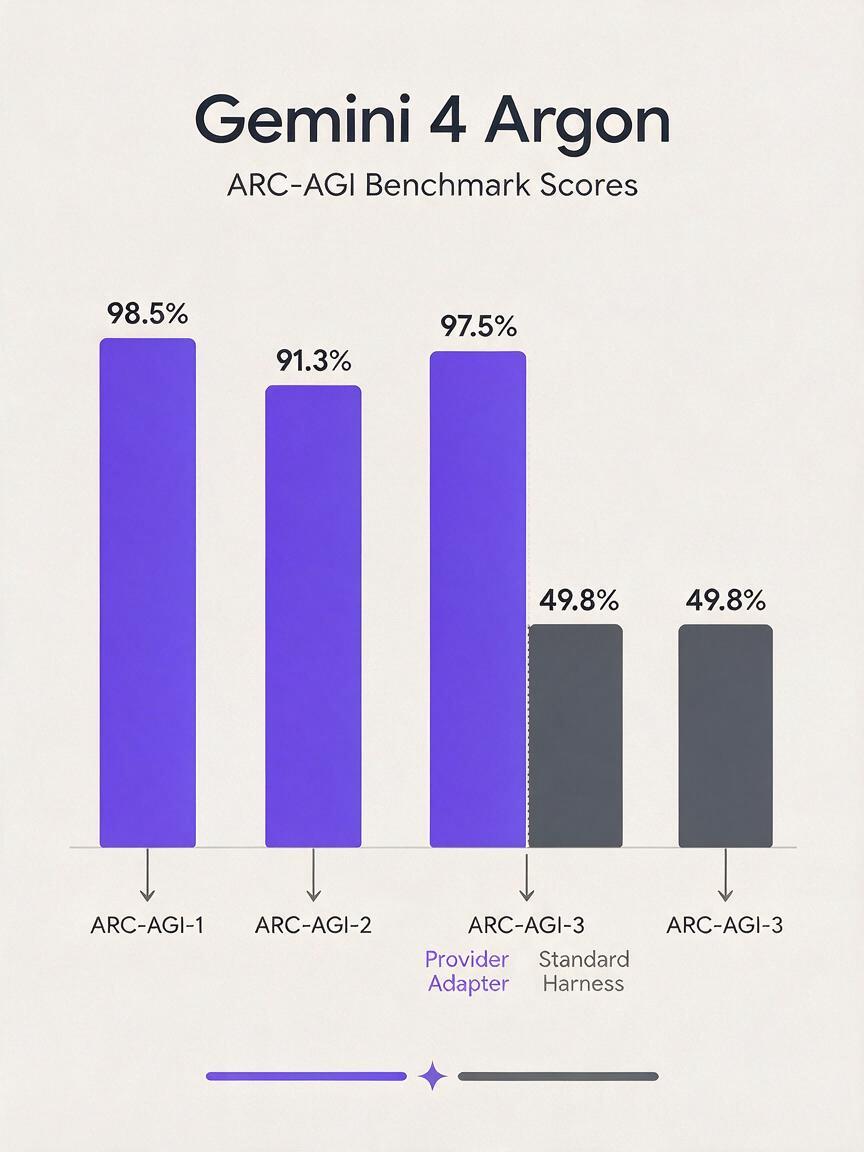
Google’s Gemini 4 Argon has scored 97.5% on the ARC-AGI-3 benchmark using a Provider Adapter harness, making it the second AI lab after OpenAI to surpass the 95% threshold. The model also posted 98.5% on ARC-AGI-1 and 91.3% on ARC-AGI-2 with the adapter, but scored only 49.8% on the standard harness, highlighting significant system-level effects from model-plus-harness combinations. For AI video and image creators, these results underscore the importance of testing real-world workflows rather than relying solely on raw benchmark numbers.
Table of contents
Google’s Gemini 4 Argon has become only the second AI model to cross the 95% threshold on ARC-AGI-3, but its performance varies drastically depending on the supporting harness used.
New benchmark results released October 19, 2026, put Google’s flagship model in rare company, while also revealing how much surrounding tooling impacts measured AI capability.
What the Benchmark Results Reveal
Gemini 4 Argon’s 97.5% score on ARC-AGI-3, achieved with a Provider Adapter harness, marks a key milestone for Google’s frontier model lineup. The benchmark run cost approximately $4,800, and makes Google the second AI lab after OpenAI to push past the 95% mark on the assessment.
The model also delivered strong results on lower-level ARC-AGI tasks with the same adapter harness: 98.5% on ARC-AGI-1 and 91.3% on ARC-AGI-2.
The most striking detail from the results is the performance gap between harness configurations. When tested on the standard harness without the Provider Adapter layer, Gemini 4 Argon scored only 49.8% on ARC-AGI-3 — less than half its score with the adapter. This massive difference highlights what the report calls model-plus-harness system effects: the idea that measured AI performance is a product of both the model itself and the tooling used to connect it to tasks.
The Model-Plus-Harness System Effect
The gap between the two harness configurations is not a trivial difference — it nearly doubles the model’s measured performance on the same benchmark. This means headline benchmark scores cannot be attributed to the model alone; the surrounding infrastructure, prompting frameworks, and adapter layers play a critical role in unlocking a model’s capability.
For anyone evaluating AI models, this complicates direct side-by-side comparisons. A model’s performance on a given task depends heavily on how well it’s integrated with the tools and workflows used to run that task, not just its raw underlying parameters or training.
What This Means for AI Content Creators
For AI video and image creators, headline benchmark scores can be misleading when choosing a model for creative work. A model that tops abstract reasoning benchmarks might not be the best fit for text to video generation, image editing, or storyboarding if it isn’t optimized for those specific creative tasks. Conversely, a model with a lower raw benchmark score might outperform higher-ranked alternatives when paired with task-specific prompting and integration in an ai video generator.
The key takeaway is that real-world workflow performance matters more than benchmark rankings, especially for specialized creative outputs like image to video animations or AI-generated marketing assets. Benchmarks are a useful data point, but they don’t tell the full story of how a model will perform for your specific creative goals.

Why a Multi-Model Platform Solves Benchmark Uncertainty
Instead of relying on benchmark scores to pick a single model, creators can use a multi-model platform like MagicBoat to test top models side-by-side in their actual workflow. This approach eliminates the guesswork of translating benchmark scores to real creative output.
You can try these models for free to see which delivers the best results for your specific creative goals, whether you’re drafting video scripts, refining visual assets, or building full short-form content. MagicBoat’s integrated environment removes the hassle of managing multiple accounts and API keys, so you can focus on creating instead of comparing benchmark numbers.
Key Takeaways
- Gemini 4 Argon is the second AI model to surpass 95% on ARC-AGI-3, using a Provider Adapter harness.
- The model’s score drops to 49.8% on the standard harness, proving tooling and integration drive a huge portion of measured performance.
- Headline benchmark numbers don’t always translate to better real-world performance for creative tasks.
- Testing models in your actual workflow is the most reliable way to find the best fit for your projects.
- A multi-model platform lets you compare top models side-by-side without the hassle of multiple accounts.
Keywords
gemini 4 argon, arc-agi-3, ai benchmark, gpt-6, claude opus, ai video model, model harness