Gemini 4 Argon, Muse Wonder End OpenAI/Anthropic Frontier Lead: Analysis
A new October 16 analysis from Charmloop finds that rapid frontier-model releases from Google and Meta, including Gemini 4 Argon and Muse Wonder, have ended the absolute frontier AI lead long held by OpenAI and Anthropic. The report argues that pricing, model openness, and ecosystem integration have replaced raw benchmark performance as the key competitive levers in the AI market. This shift has significant implications for AI video and image creators choosing tools for their workflows.
Table of contents
What the New Frontier AI Analysis Reveals
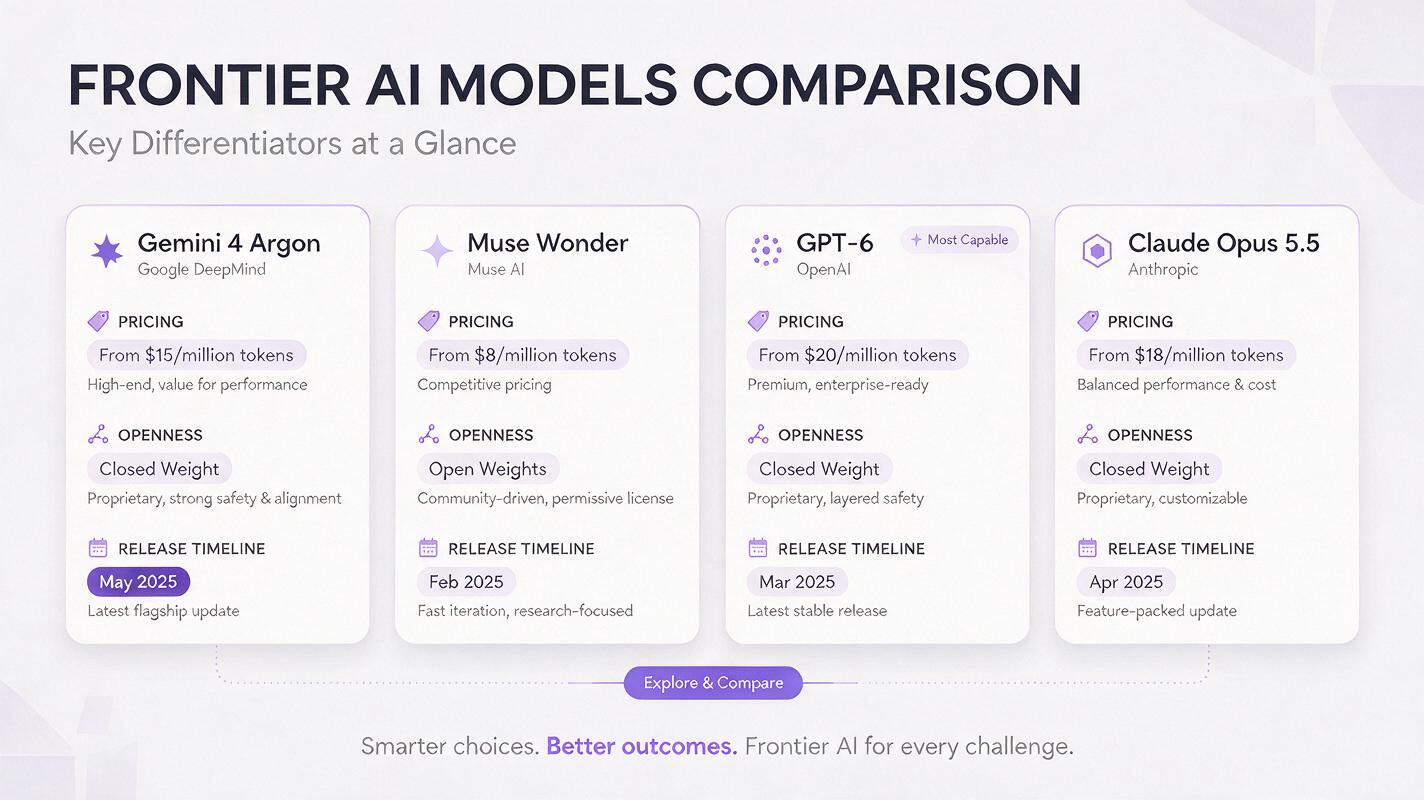
A new October 16 analysis from Charmloop finds that rapid frontier-model releases from Google and Meta have ended the long-held absolute frontier AI lead of OpenAI and Anthropic. The report singles out Google’s Gemini 4 Argon and Meta’s Muse Wonder as key releases that have closed the performance gap at the top of the AI market, shifting the focus of competition away from raw benchmark scores and toward three new core levers: pricing, model openness, and ecosystem integration.
For years, OpenAI and Anthropic were widely viewed as the unchallenged leaders in frontier AI, with models like GPT-6 and Claude Opus 5.5 setting the standard for complex reasoning, multimodal understanding, and long-context tasks. The Charmloop analysis argues that this era of a clear two-horse race at the frontier is over, as Google and Meta have accelerated their release cadences to deliver comparable top-tier performance in a matter of weeks.
How Google and Meta Closed the Frontier Performance Gap
The speed of recent releases from Google and Meta is a central factor in the shifting landscape, with both companies rolling out flagship models and major updates at a pace that outstrips historical norms for frontier AI.
Google’s Gemini 4 Argon first launched on September 30, initially made available to cybersecurity defenders via the Fairwind program. The model rolled out globally to Gemini Pro and Ultra subscribers and developers on October 14, less than two weeks after its debut, and was fully opened to all eligible users on October 15 with promotional pricing of $2 per million input tokens and $10 per million output tokens. Gemini 4 Argon supports up to 1 million output tokens, scored 77.9% on DeepSWE v1.1, and ranked first on Zapier AutomationBench with a 51.3% score, with a new Task Mode designed for complex long-horizon work.
Meta’s Muse Wonder launched on October 12, with two app subscription tiers priced at $20 and $100 per month, and a higher-end Wonder Full tier for Muse Code users. The company claims Muse Wonder outperforms both Claude Opus 5.5 and GPT-6 Astra on some benchmarks, though full parameter, context window, and benchmark details have not been publicly released. Meta also reinforced its position on October 16 with the launch of Muse Spark Open, an 81.6 billion-parameter open-weight Mixture-of-Experts model with native multimodality and a 1 million-token context window, framed as the strongest open-weight model released by a U.S. company to date.
The analysis emphasizes that this is not a case of one single model taking the top spot, but a broader leveling of the playing field where multiple providers now offer frontier-level performance. This means raw capability is no longer a unique selling point, and providers must compete on other factors that matter to users.
What This Shift Means for AI Content Creators
For AI video and image creators, the end of the absolute frontier lead is a meaningful development that expands choice and lowers barriers to high-quality AI tools. Instead of being locked into one or two providers for top-tier performance, creators can now select from a growing pool of frontier models tailored to different workflow needs, budget constraints, and creative goals.
Pricing is one of the most immediate benefits of increased competition. As providers compete on cost, creators gain access to more powerful models at lower price points, making it feasible to run more iterations, experiment with bolder ideas, and take on larger projects without exceeding budget. For example, Gemini 4 Argon’s promotional pricing makes complex long-form tasks like scriptwriting for text to video productions far more accessible for independent creators and small creative teams.
Model openness is another growing differentiator that directly benefits creators. Open-weight models like Muse Spark Open give users far more control over their tools, allowing for fine-tuning on specific creative styles, local deployment for privacy-sensitive client work, and direct integration into custom ai image generator pipelines without relying on a third-party API. This level of customization is particularly valuable for creators working in niche genres or with highly specific brand aesthetic requirements.
Ecosystem integration is the third key lever, as creators increasingly prioritize models that fit seamlessly into their existing workflows. Models that work with popular creative tools, support common file formats, and integrate with multi-step production pipelines reduce friction and save time that creators can instead spend on creative decision-making. The shift also makes it easier for creators to use specialized models for individual parts of their workflow—one model for concept art, another for script generation, a third for editing support—rather than forcing a single general-purpose model to handle every task.
Why a Multi-Model Creative Platform Offers Stability
While more choice is a net positive for creators, the rapid pace of change in the frontier AI space also introduces new uncertainty. A model that is the best fit for a workflow today may be overtaken by a new release next month, or a provider may adjust pricing, introduce usage limits, or experience service disruptions that derail production timelines.
A unified multi-model creative platform addresses this uncertainty by giving creators access to a range of leading AI tools in a single, consistent interface. Instead of managing multiple accounts, billing setups, and tool learning curves, creators can test different models side by side, pick the best option for each specific task, and switch between providers seamlessly as the market evolves.
This flexibility is especially valuable as the competitive landscape continues to shift. Creators who rely on a single provider risk being caught off guard by sudden changes to pricing, features, or availability, while those using a multi-model platform can adapt quickly without overhauling their entire workflow. Creators looking to build a flexible, future-proof AI creative workflow can try these models for free and explore which tools work best for their specific needs.
Key Takeaways
- A new October 16 analysis finds that Google and Meta’s rapid frontier model releases, including Gemini 4 Argon and Muse Wonder, have ended OpenAI and Anthropic’s long-held absolute lead in top-tier AI performance.
- Pricing, model openness, and ecosystem integration have replaced raw benchmark scores as the primary competitive levers for frontier AI providers.
- AI video and image creators now have more high-quality model options to choose from, with greater flexibility for budget, workflow, and creative style requirements.
- Using a unified multi-model creative platform helps creators stay agile and avoid disruption as the frontier AI landscape continues to evolve at a fast pace.
Keywords
gemini 4, muse wonder, gpt-6, claude opus, ai video model, text to video, frontier ai