Google + Meta Frontier Push Ends OpenAI/Anthropic Absolute Lead
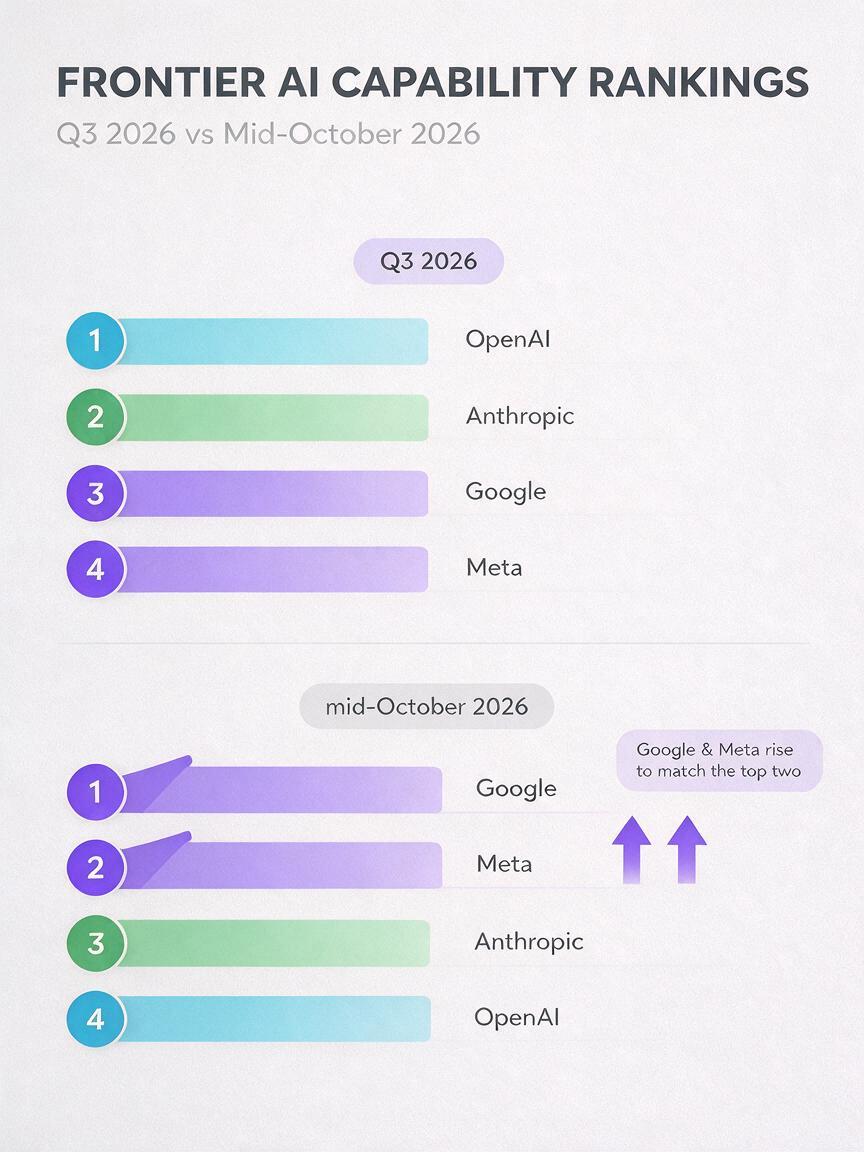
As of October 16, 2026, industry analysis indicates that Google and Meta's combined frontier AI advancements have ended the unchallenged lead previously held by OpenAI and Anthropic. The shift follows a string of high-profile model launches and partnerships from both Google and Meta in late 2026, expanding the competitive landscape for top-tier AI capabilities. For creators, this growing field of frontier models offers more choice but also underscores the value of flexible, multi-model AI platforms that reduce workflow disruption risk.
Table of contents
What the October 16 Frontier AI Analysis Found
On October 16, 2026, new industry analysis concluded that the combined frontier AI push from Google and Meta has ended the absolute lead that OpenAI and Anthropic held over the rest of the market. The assessment marks a notable shift in the competitive landscape of top-tier AI, which had been dominated almost exclusively by OpenAI and Anthropic for much of the preceding two years.
While specific benchmark details and methodology behind the analysis were not disclosed in initial reports, the conclusion aligns with a flurry of recent announcements from both Google and Meta that have expanded their frontier model portfolios, improved performance, and broadened access to developers and enterprise users. The analysis frames the shift not as a decline in capability from OpenAI or Anthropic, but as a rapid acceleration of investment and innovation from Google and Meta that has closed the gap entirely.
Key Recent Moves From Google and Meta
Several high-profile launches and partnerships from Google and Meta in the weeks leading up to the October 16 analysis support the conclusion of a tightened frontier race:
- Meta's open-weight MoE model launch: Meta unveiled Muse Spark Open, an 81.6-billion-parameter open-weight mixture-of-experts model, alongside a partnership with Apple to optimize the model for Mac devices. The release expands access to frontier-tier capabilities for developers and researchers working with open-source and locally deployable AI tools.
- Google's Gemini 4 global rollout: Google launched Gemini 4 Argon globally to Pro and Ultra subscribers and developers on October 14, 2026, bringing its latest frontier model to a wide user base just two days before the analysis was published. The model offers a 1 million token output window, positioning it as a direct competitor to long-context offerings from OpenAI and Anthropic.
- Broader ecosystem expansion: Both companies have invested heavily in supporting hardware, developer tooling, and enterprise integrations, making their frontier models more accessible and usable for production workloads beyond research and experimental use cases.
What This Competitive Shift Means for AI Users and Developers
The end of OpenAI and Anthropic's absolute lead brings both significant opportunities and practical challenges for AI users across industries. On one hand, a more competitive frontier AI market typically drives faster innovation, more transparent pricing, and a wider range of specialized model capabilities tailored to specific use cases. Users no longer have to rely on just two providers for state-of-the-art performance, giving them more leverage and flexibility in selecting tools that align with their unique needs and budget constraints.
On the other hand, a more fragmented market can create operational and workflow challenges. With new models launching regularly from a growing number of providers, users may find themselves juggling multiple accounts, API keys, and billing systems to access the best tools for different tasks. Rapid model iteration and occasional retirements can also disrupt existing workflows that are tightly coupled to a single provider's model or API.
What This Means for Content Creators
For content creators, the expanding field of frontier AI models opens up new possibilities for creative expression, from generating concept art and script drafts to producing full short-form videos and interactive content. A more competitive market means more specialized creative tools and lower costs over time, making high-end AI capabilities more accessible to independent creators and small production teams that may not have had access to top-tier models just a year prior.
However, the same market fragmentation that affects all AI users also impacts creators, who often rely on a mix of text, image, and video AI tools to bring their ideas to life. Switching between different platforms to access the best ai video generator or ai image generator can slow down creative workflows and make it harder to maintain a consistent visual or tonal style across projects. Provider-specific changes, like sudden model retirements or pricing shifts, can also derail projects that are built around a single tool's capabilities.
This is where multi-model AI platforms like MagicBoat add clear, tangible value. By bringing together top-tier text, image, and video AI models in a single, unified interface, MagicBoat eliminates the need to manage multiple accounts or switch between disjointed tools. Creators can test different models for the same task, compare results side by side, and pivot quickly if a model is updated or retired — all without disrupting their existing creative pipeline or losing access to their work.
Key Takeaways
- Industry analysis published on October 16, 2026 finds that Google and Meta's combined frontier AI push has ended the absolute lead previously held by OpenAI and Anthropic.
- The shift follows recent high-profile launches, including Meta's Muse Spark Open 81.6B MoE model and Google's global rollout of Gemini 4 Argon with a 1 million token output window.
- A more competitive frontier AI market brings more choice, faster innovation, and lower costs for users, but also creates workflow fragmentation and disruption risks.
- Content creators can mitigate these risks by using a multi-model AI platform that centralizes access to top creative tools in one place.
- You can try these models for free on MagicBoat to build a flexible, resilient creative workflow that adapts to the changing AI landscape.
Keywords
ai news, frontier ai, google meta ai, openai anthropic, ai tools, ai video generator, ai roundup