Google and Meta Frontier Push Ends OpenAI-Anthropic Absolute Lead
An October 16, 2026 industry analysis concludes that Google and Meta’s recent frontier AI advancements have ended the previously unchallenged lead held by OpenAI and Anthropic in the top-tier AI model market. The shift reflects accelerating competition across the AI industry, with new model releases, open-weight strategies, and ecosystem partnerships expanding options for developers and content creators. This changing landscape underscores the value of flexible, multi-model AI platforms that help creators adapt to rapid market shifts while maintaining workflow stability.

Table of contents
What the New Frontier AI Analysis Says
For the first time since the generative AI boom began, OpenAI and Anthropic no longer hold an unchallenged lead at the frontier of AI model development, according to a new industry analysis published October 16, 2026.
The analysis frames a structural shift in the AI market, where concurrent advances from Google and Meta have eroded the two-lab dominance that defined the top tier of AI capabilities through 2025 and early 2026. The conclusion ties directly to a flurry of high-impact releases and strategic moves from both Google and Meta in the preceding weeks, spanning frontier model performance, open-weight accessibility, and hardware ecosystem integration.
The October 16 analysis lands the same day as two major announcements that underscore the shifting competitive landscape: Meta’s launch of Muse Spark Open, an 81.6-billion-parameter open-weight mixture-of-experts (MoE) model with official Apple Mac integration, and OpenAI’s Rosalind Academic Plan, which offers sponsored access to its GPT-Rosalind model for academic research labs. While OpenAI’s move targets research community access, Meta’s open-weight release and Apple partnership signal a push to expand frontier model reach across consumer and developer ecosystems — a direct challenge to the closed-model dominance of OpenAI and Anthropic.
Key Evidence Behind the Competitive Shift
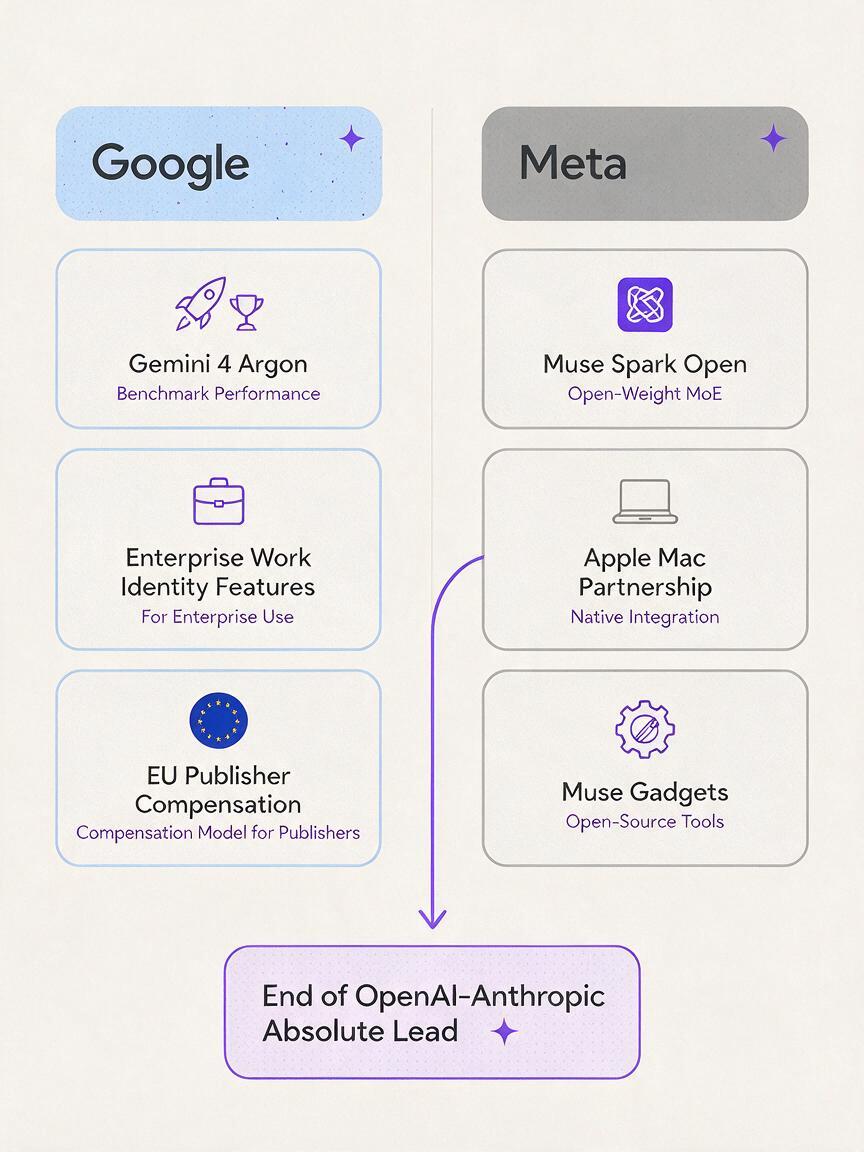
The analysis draws on a string of recent developments from Google and Meta that collectively narrow, and in some areas exceed, the capability gap with OpenAI and Anthropic’s flagship models. Each company has taken a distinct strategic path to the frontier, with Google focusing on high-performance closed models and enterprise integration, and Meta leaning into open-weight accessibility and cross-platform partnerships.
Google’s Gemini 4 Argon and Enterprise Push
Google’s front in the frontier push is led by its Gemini 4 Argon model, which has rolled out in rapid stages through mid-October 2026. The model launched globally for Pro and Ultra subscribers and developers on October 14, followed by a full open release on October 15 with promotional pricing of $2 per million input tokens and $10 per million output tokens, plus a new Task Mode feature. By October 19, Gemini 4 Argon had scored 97.5% on the ARC-AGI-3 benchmark, a widely watched measure of advanced reasoning capability.
Beyond raw model performance, Google has expanded Gemini’s enterprise use cases, rolling out work identity features on October 8 that position Gemini as an enterprise agent integrated with organizational workflows. The company has also signaled openness to EU publisher compensation, addressing a key regulatory and content licensing concern that has created friction for competing AI labs.
Meta’s Open-Weight and Ecosystem Strategy
Meta’s challenge to the OpenAI-Anthropic lead takes a different shape, centered on open-weight models and broad ecosystem integration. The October 16 release of Muse Spark Open, an 81.6B-parameter open-weight MoE model with native Apple Mac partnership, makes frontier-level capabilities available to run locally on consumer hardware, a move that closed-model providers have been slower to embrace. The release follows the October 12 launch of Meta’s Muse Wonder frontier model, positioned at 2x competitor pricing, and Meta CEO Mark Zuckerberg’s October 13 statement at TechCrunch Disrupt 2026 that the company has “caught up at the AI frontier” and plans to challenge OpenAI and Anthropic directly.
Meta’s strategy also includes open-sourcing tooling like Muse Gadgets, released October 2, which lowers the barrier for developers to build on its model ecosystem. Combined with its strong presence in social media and advertising, Meta’s open-weight approach creates a distinct competitive vector that reaches beyond the closed API model that defined the early frontier AI market.
What This Shift Means for AI Content Creators
For content creators who rely on AI tools for everything from scriptwriting to visual asset generation, the end of the OpenAI-Anthropic absolute lead brings both new opportunities and new complexities. On the opportunity side, a more competitive frontier means more model options tailored to different creative tasks: open-weight models for local, private workflows; vision-language models for high-fidelity image and video generation; and enterprise-grade models for large-scale collaborative projects. Pricing competition is also likely to accelerate, as more providers fight for market share with tiered pricing, promotional rates, and open-weight alternatives that reduce per-token costs.
At the same time, a more fragmented market creates new challenges. Creators who built their entire workflow around a single provider’s model may find that competing models offer better performance for specific tasks, but switching requires learning new prompt structures, managing separate subscriptions, and reworking existing assets. Rapid model updates and retirements — like the October 19 GitHub Copilot model refresh that replaced six older models with newer versions — can also disrupt established workflows if creators are locked into a single platform.
For creators working with video content, this shift is particularly pronounced. A high-quality ai video generator from one provider might excel at realistic character movement, while another offers better text-to-scene conversion, and a third integrates more smoothly with existing editing tools. Picking a single provider means leaving capability on the table, but managing multiple accounts and billing cycles adds administrative overhead that cuts into creative time.

How Multi-Model Platforms Simplify the New Landscape
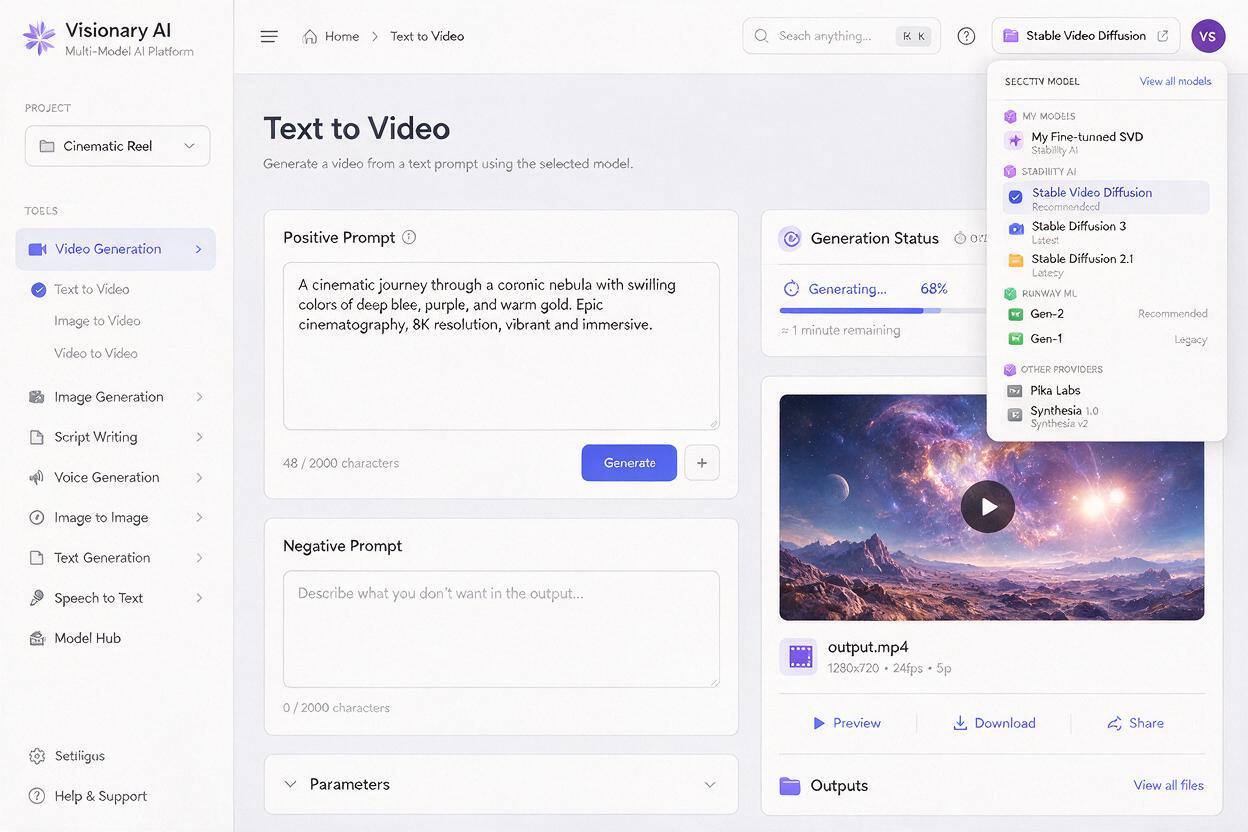
Multi-model AI platforms are designed to solve exactly this fragmentation problem, giving creators access to a wide range of leading AI models through a single account and unified interface. Instead of managing separate API keys, subscriptions, and billing for every model provider, creators can compare, test, and switch between models in seconds, choosing the best tool for each specific task without workflow disruption.
For example, a creator working on a short social media video might use one model to draft a script, another to generate concept art, and a third to handle text to video conversion — all within the same platform. This flexibility lets creators leverage the unique strengths of each model, from open-weight options for private, local generation to frontier closed models for complex reasoning tasks, without being locked into a single provider’s roadmap or pricing changes.
Platforms like MagicBoat also help insulate creators from the rapid shifts of the AI market. When a new model launches, or an existing model is retired or updated, creators don’t have to rebuild their entire workflow from scratch. Instead, they can test the new model alongside their existing tools, migrate gradually, and keep their creative assets portable and usable across different models. This stability is particularly valuable as the frontier AI market continues to evolve, with new entrants, regulatory changes, and model updates becoming a regular part of the industry landscape.
If you’re ready to explore the full range of frontier AI models for your creative workflow, try these models for free on MagicBoat and see how a multi-model approach can elevate your content.
Key Takeaways
- An October 16, 2026 industry analysis concludes that Google and Meta’s combined frontier AI advancements have ended OpenAI and Anthropic’s previously unchallenged lead in top-tier AI models.
- Google’s push is led by Gemini 4 Argon, which has posted strong benchmark scores and rolled out enterprise features, while Meta’s strategy centers on open-weight models and broad ecosystem integration with partners like Apple.
- For content creators, the shift brings more model options and pricing competition, but also increased workflow fragmentation and the risk of disruption from rapid model changes.
- Multi-model AI platforms like MagicBoat help creators navigate the new landscape by providing unified access to multiple leading models, reducing administrative overhead, and protecting workflows from provider-specific changes.
- Creators can leverage specialized tools for tasks like video generation and text-to-video conversion without being locked into a single AI provider.
Keywords
ai news, ai frontier competition, ai tools, multi-model ai, ai video generator, text to video, ai roundup