GPU Power Draw Can Reveal AI Workloads: New Research Shows 97% Accuracy in Detecting Training vs. Inference
A new arXiv preprint demonstrates that an external observer can identify whether an NVIDIA H200 GPU is running AI training, inference, or non-AI tasks by analyzing its power draw, achieving 97% accuracy and raising significant AI security concerns.
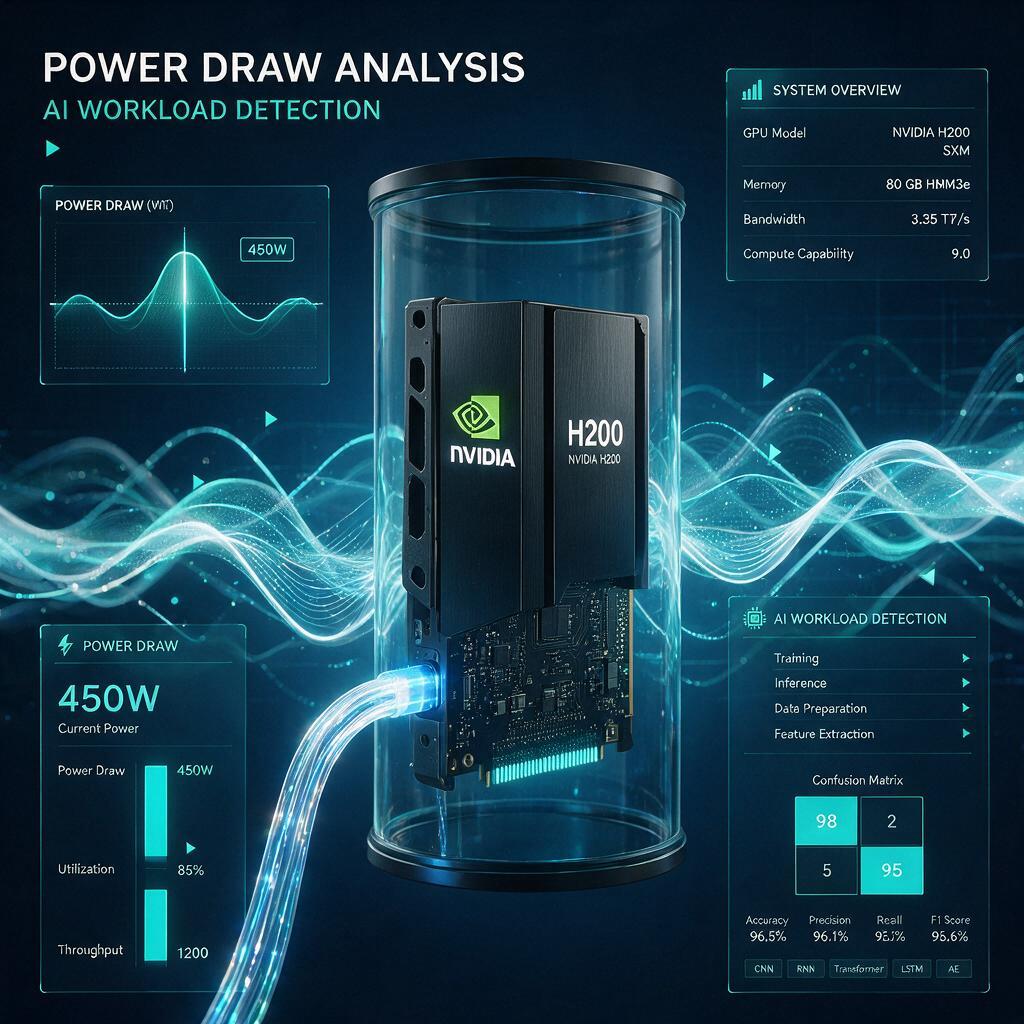
Table of contents
Introduction: The Challenge of Distinguishing AI Workloads in Shared GPU Environments
As AI models grow in complexity and value, the ability to determine whether a GPU is performing training or inference has become a critical concern for cloud providers, enterprises, and regulators. In shared computing environments, such as cloud data centers or multi-tenant GPU clusters, knowing the nature of a workload can reveal sensitive information about a competitor's research priorities, model architecture, or intellectual property. A new preprint on arXiv (arXiv:2609.00309v1) introduces a method that uses physical side channels—specifically, power draw—to identify the class of workload running on an NVIDIA H200 GPU, achieving 97% accuracy in distinguishing training from inference and non-AI computation.
Summary of the Research: Power Draw as a Side Channel
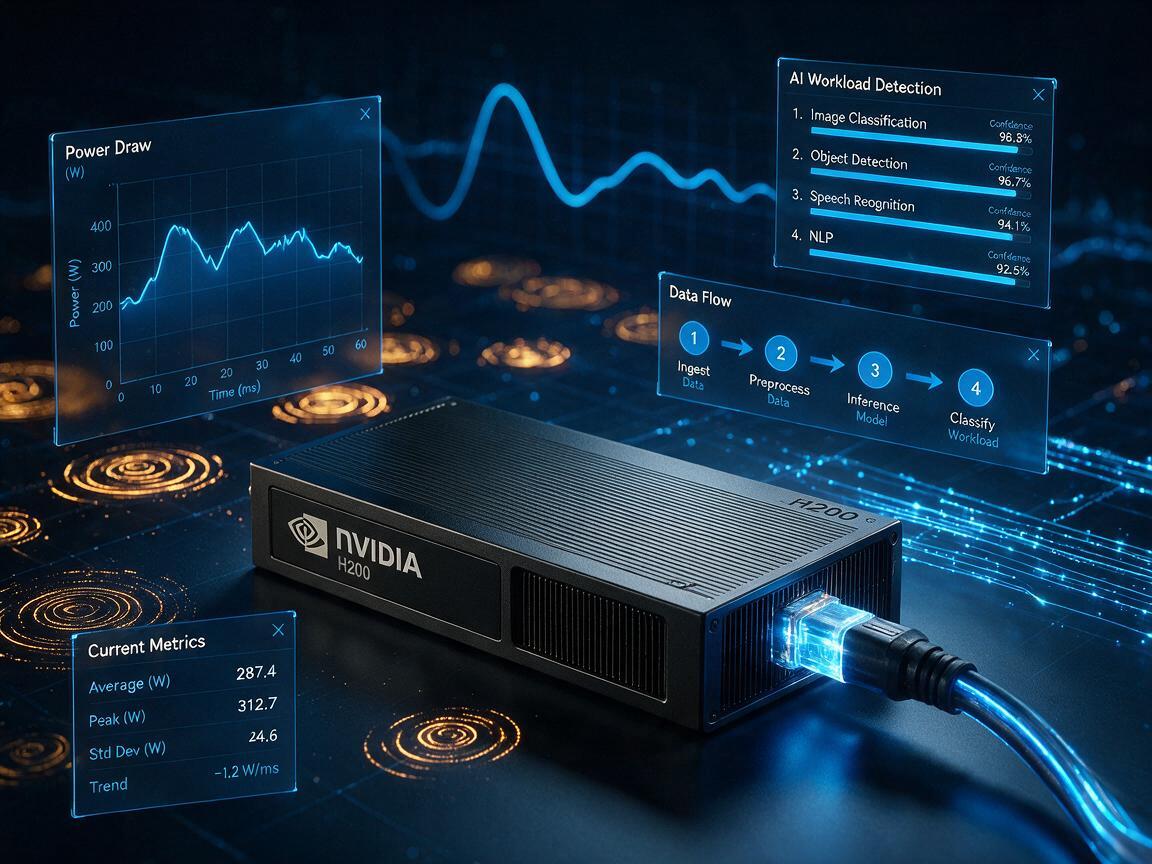
The study, conducted by researchers and posted on arXiv, recorded 930 five-second traces at approximately 10 MHz, covering 17 open LLM families and 25 non-AI workloads. Unlike on-chip NVML telemetry, which can be spoofed or replayed, the physical power draw channel can be observed independently of operator cooperation. The researchers separated training from inference and from non-AI computation with an accuracy of 97% and a macro-averaged F1 score of 0.955, evaluated on model families unseen during training.
Key Findings: Spectral Signatures and the Memory-Bound Optimizer Update
The analysis revealed that AI workload spectral content predominantly lies below approximately 20 kHz. Training workloads are particularly recognizable through the memory-bound optimizer update, a distinct pattern that emerges during the weight update phase of model training. This signature allows the detector to differentiate training from inference, which lacks such memory-intensive operations.
Evasion Strategies and Detector Robustness
The researchers treated the GPU operator as adversarial and tested four evasion strategies designed to disguise training as inference, producing an additional 680 adversarial traces. A hardened detector, with the tested strategy held out, caught training at least 99% of the time for three of the four strategies. The fourth strategy, diluted low-rank adaptation (LoRA), proved more challenging: the hardened classifier detected it only 48–88% of the time. However, with an additional rescue rule, the detection rate rose to at least 98%.
“While these attacks are not a comprehensive evaluation against adversarial behaviour, they offer initial insights beyond genuine activities and a dataset for developing and testing stronger evasion mechanisms,” the authors note.
Implications for Cloud Providers, Enterprises, and Regulators
This research has significant implications for AI security and governance. For cloud providers, the ability to detect training workloads via power draw could be used to enforce usage policies, allocate resources, or detect unauthorized model training. For enterprises, it raises concerns about competitive espionage: an external observer could potentially infer a competitor's AI development activities by monitoring power consumption patterns. For regulators, the method offers a tangible tool for AI compute verification, as highlighted in the paper's abstract: “AI compute verification is one of the first tangible and tractable points for international policy aimed at AI governance.”
However, the same technique could be misused for malicious purposes, such as stealing intellectual property or conducting industrial espionage. The paper underscores the need for countermeasures, such as obfuscating power draw patterns or using hardware-level protections.
Caveats and Limitations
It is important to note that this research is a preprint (arXiv:2609.00309v1) and has not yet undergone peer review. The publication date listed is September 2, 2026, which is in the future relative to the current date, potentially indicating a data error or speculative content. Additionally, the method is specific to the NVIDIA H200 GPU; its generalizability to other hardware remains unverified. The evasion strategies tested are not a comprehensive evaluation against adversarial behavior, and the dataset may not cover all possible workloads or evasion techniques.
Conclusion: A New Vector in AI Security
This research signals a new vector in AI security that the industry must address. As AI workloads become more valuable and contested, the ability to detect them through physical side channels like power draw will require both technical countermeasures and policy frameworks. Cloud providers, enterprises, and regulators should monitor developments in this area to protect model confidentiality and ensure fair use of shared computing resources.
Sources
Keywords
AI security, GPU power analysis, training vs inference detection, side-channel attack, NVIDIA H200, model confidentiality, AI governance, workload identification, physical side channels, adversarial evasion