Gemini 4 Argon Opens With Task Mode and $2/$10 Promo Pricing
Gemini 4 Argon fully opened up with promotional pricing of $2 per million input tokens and $10 per million output tokens, plus a new Task Mode for complex long-horizon work. Here is what the expansion means for AI content production and multi-model creative workflows.
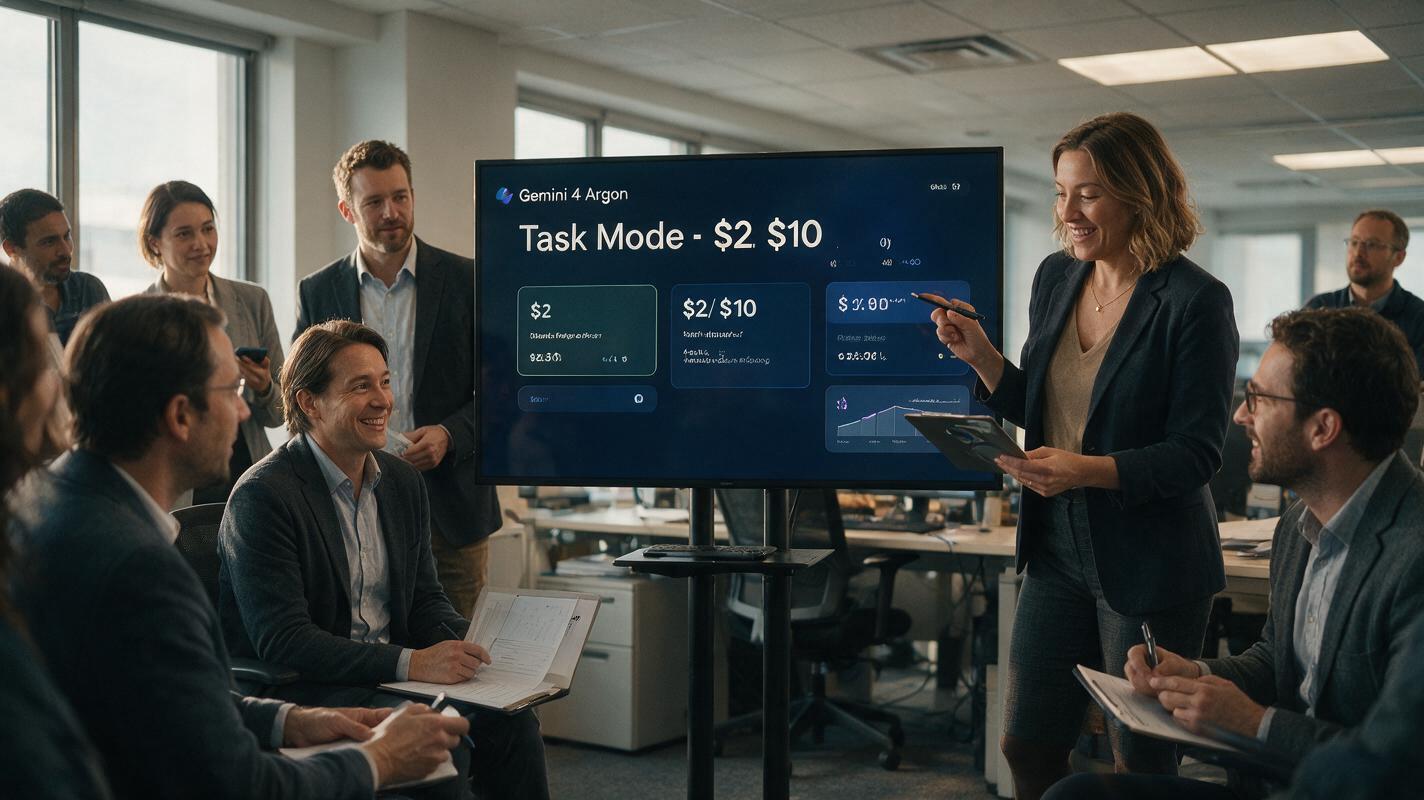
Table of contents
Google’s Gemini 4 Argon expansion adds a long-horizon task experience and promotional token pricing, sharpening the competition around model access, cost and workflow design.
AI model news analysis · October 15, 2026
Gemini 4 Argon Broadens Access With a New Task Mode
Gemini 4 Argon was described as fully opened up on October 15, 2026, with promotional pricing set at $2 per million input tokens and $10 per million output tokens. The expansion also introduced a new Task Mode in the Gemini app, targeting complex assignments that unfold over longer working horizons rather than isolated, one-off requests.
The update followed a rapid rollout for the model. Google initially released Gemini 4 Argon on September 30, with support for up to one million output tokens and an input price of $2 per million tokens. It then launched globally for Pro and Ultra subscribers and developers on October 14, less than two weeks after that debut. The October 15 expansion added the reported promotional output price and brought Task Mode into focus as a distinct part of the Gemini app experience.
Google’s previously reported evaluation figures for Gemini 4 Argon include 77.9% on DeepSWE v1.1 and a first-place 51.3% result on Zapier AutomationBench. Those results concern software engineering and automation rather than visual generation, so they should not be interpreted as evidence that Gemini 4 Argon is an AI video model.
For people producing images and video, the immediate significance is therefore not a newly announced rendering engine. It is the prospect of using a long-horizon model to support the planning, organization and coordination surrounding creative production.
What the Confirmed Gemini 4 Argon Update Includes
| Area | Confirmed detail | Why it matters |
|---|---|---|
| Access | Reported as fully opened up on October 15 | Continues the model’s rapid expansion following its initial release and global launch |
| Input pricing | $2 per million input tokens under promotional pricing | Makes the cost of supplying extensive project material easier to quantify |
| Output pricing | $10 per million output tokens under promotional pricing | Provides a stated cost reference for generated responses |
| Gemini app | New Task Mode | Targets complex, long-horizon assignments |
| Output capacity | Up to one million output tokens | Supports unusually large generated outputs when a project calls for them |
The central news is the combination of broader availability, explicit promotional pricing and a mode aimed at sustained work—not a claim that Gemini 4 Argon directly generates finished images or video.
Task Mode Signals a Shift Toward Longer AI Workflows
Many AI products began as conversational tools built around a prompt followed by a response. Task Mode points toward a different interaction pattern: assigning a broader objective that may require more context, organization and continuity.
That distinction can matter in media production because a finished visual project contains far more than a single generation request. It may involve a concept brief, character notes, scene descriptions, shot variations, continuity rules, campaign copy and a list of deliverables for different channels. A model designed for complex long-horizon tasks could potentially help structure that surrounding material, although the announcement does not specify individual creative-production functions.
The reported one-million-token output ceiling also gives the model room for very large responses. Capacity alone does not guarantee quality or consistency, but it changes the scale of work that can fit inside one model interaction. Teams evaluating Gemini 4 Argon should therefore look beyond the headline context figure and assess whether its output remains useful across the entire assignment.
Long output is not the same as finished media
Gemini 4 Argon can be considered for reasoning, planning and automation-oriented work based on the available details. Actual visual production still calls for dedicated capabilities such as text to image and video-generation tools.
Pricing Makes Large Creative Briefs Easier to Evaluate
The promotional rate provides a clearer basis for estimating model usage. At $2 per million input tokens and $10 per million output tokens, input and output are priced differently, making the direction of the workload important.
A project dominated by reference material may have a different cost profile from one that repeatedly requests extensive generated drafts. Creative teams comparing models should account for both sides of that equation instead of focusing only on the lower input figure.
The word promotional is also material. It indicates that these figures should be treated as the reported offer for this expansion, not as a guarantee that pricing will remain unchanged indefinitely. Production budgets are safer when model costs and availability can be reviewed without tying an entire pipeline to one provider.
Where Gemini 4 Argon Fits in an AI Content Pipeline
The confirmed update positions Gemini 4 Argon around complex tasks, large outputs and automation-oriented performance. Those strengths can sit upstream from the tools that produce finished creative assets.
A team might use a general-purpose frontier model to organize a campaign brief, consolidate scene requirements or prepare alternative narrative directions. Dedicated visual tools can then handle image generation and motion. For example, an ai video generator serves a different production function from a model being evaluated for long-horizon planning.
This division of labor is increasingly important as GPT-6, Claude Opus and Gemini 4 compete across pricing, access and model behavior. A model that is useful for one part of a project may not be the right choice for every other part. The practical question is not simply which name leads a benchmark, but how reliably several capabilities can be combined into a repeatable workflow.
Model-plus-workflow performance matters
Recent Gemini 4 Argon reporting has already highlighted how strongly results can depend on the surrounding system. In a separate ARC-AGI-3 evaluation, the model scored 97.5% with a Provider Adapter harness but 49.8% on the standard harness. That gap reinforces a broader lesson: a model’s real-world value depends partly on the tools, interfaces and orchestration around it.
For visual production, the same principle applies. Strong planning output is most useful when it can move cleanly into image, video and story workflows without requiring the entire project to be rebuilt around a single model.
Why Multi-Model Access Reduces Workflow Friction
Fast model release cycles can create operational uncertainty. Access expands, pricing changes, new modes appear and providers revise which models are available. Gemini 4 Argon’s accelerated rollout illustrates how quickly the surrounding environment can move, even when the underlying model name stays the same.
A multi-model platform helps separate the creative objective from any one release schedule. MagicBoat brings multiple creation capabilities into one account, allowing a project to move from ideas and visual development into video production without depending entirely on one frontier model’s availability.
This does not make model selection irrelevant. It makes selection more practical. Teams can choose tools according to the artifact they need—planning, an image, a moving sequence or a broader story—while retaining alternatives when pricing or access conditions shift.
Key Takeaways
- Gemini 4 Argon was reported as fully opened up on October 15, 2026.
- Promotional pricing was listed at $2 per million input tokens and $10 per million output tokens.
- A new Task Mode in the Gemini app targets complex long-horizon assignments.
- The model supports up to one million output tokens, but output scale does not by itself establish quality.
- The available announcement does not identify Gemini 4 Argon as a dedicated image or video generation model.
- Creative teams can evaluate it as one component within a broader, multi-model production system.
Build a More Flexible AI Creation Workflow
Model launches move quickly, but a production pipeline should remain usable when access, pricing or preferred tools change. Explore image, video and story capabilities in one place and try these models for free.
Keywords: Gemini 4 Argon, Gemini Task Mode, Gemini 4 pricing, long-horizon tasks, AI content creation, AI video model, multi-model platform