Jensen Huang Resigns as Nvidia CEO Effective Immediately After 33 Years
Nvidia co-founder Jensen Huang resigned as president, CEO and board member on November 12, 2026, effective immediately, ending 33 years leading the chipmaker. EVP and CFO Colette Kress will serve as interim CEO while the board conducts a permanent search, and Harvey C. Jones was named the company’s first board chairman. The announcement followed an internal board investigation, with shares falling 4.34% on the day and wiping roughly $182 billion in market value, with ripple effects across the broader AI industry.

Table of contents
What Happened at Nvidia on November 12
Nvidia co-founder Jensen Huang resigned as president, CEO and board member effective immediately on November 12, 2026, ending 33 years at the helm of the chipmaker that became the backbone of the global AI industry. The surprise announcement came days after the company’s board opened an internal investigation on November 8.
EVP and CFO Colette Kress, who joined Nvidia in September 2013 after nearly 25 years in finance roles at Cisco and Microsoft, will serve as interim CEO while retaining her current responsibilities. The board also named veteran director Harvey C. Jones, former Synopsys CEO and executive chairman, as Nvidia’s first-ever board chairman.
A permanent CEO search is underway, considering both internal and external candidates. Nvidia has scheduled an all-hands meeting for November 18, and its quarterly earnings report is still planned for release after market close on November 17.
Market Reaction and Financial Impact
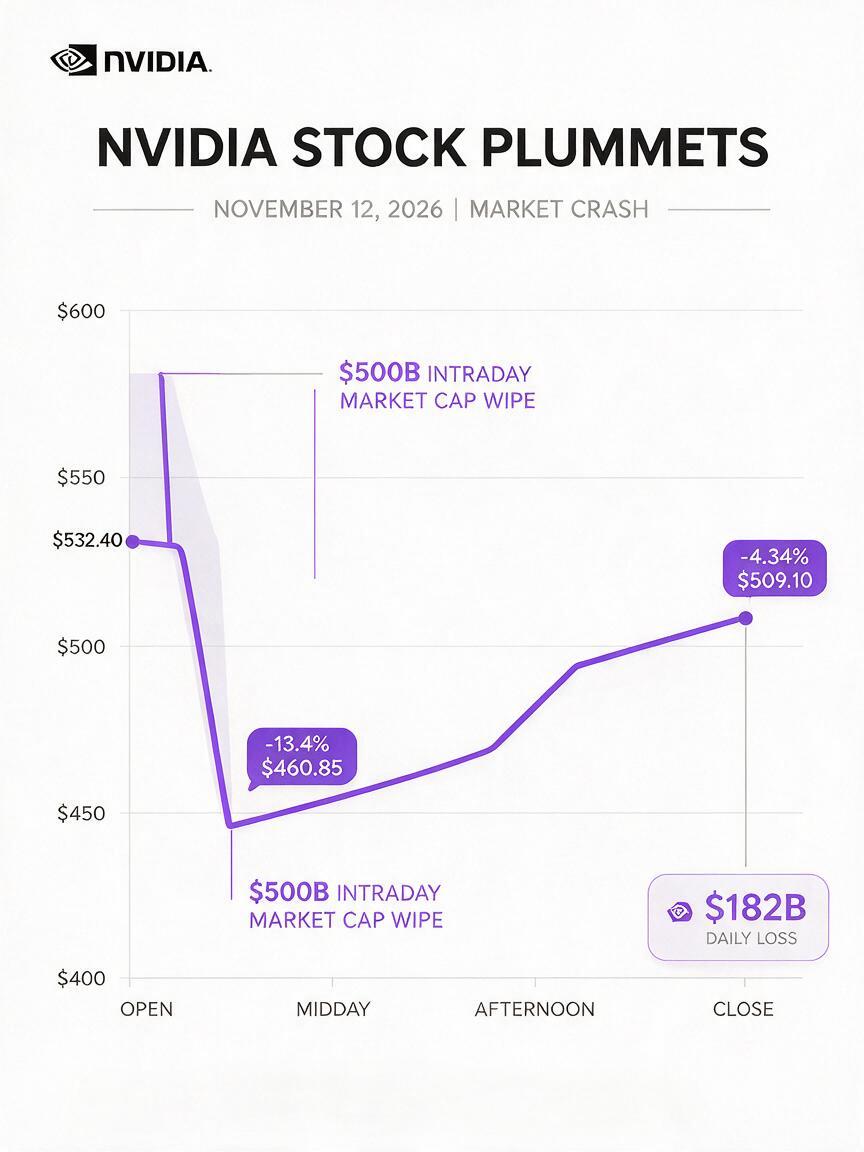
The announcement triggered sharp volatility in Nvidia shares when markets opened on November 12. The stock fell as much as 13-14% in early trading, briefly wiping out roughly $500 billion in market value and pushing Nvidia’s market capitalization below $4 trillion for the first time since July 2025.
By the close of trading, shares had partially recovered to finish down 4.34% at $166.19, representing about $182 billion in lost market value on the day. The move rippled across the semiconductor sector and broader markets: AMD rose 5.86% and Broadcom gained 5.54%, while the Dow Jones Industrial Average fell 0.36%, the S&P 500 dropped 0.35% and the Nasdaq Composite declined 0.39%.
Bloomberg reports Huang forfeits approximately $108 million in unvested equity following his immediate resignation. Market context for the selloff includes a 91% implied probability of a December interest rate hike and a 10-year Treasury yield at 5.1%.
Background of the Board Investigation
The board’s internal investigation, launched on November 8, has been tied to multiple published reports. The New York Times and Financial Times reported a relationship between Huang and former Singapore data-center executive Alice Huang, along with an allegation she worked for Chinese intelligence. China’s Foreign Ministry rejected what it called the “spy narrative” on November 12.
The New York Times also reported a second relationship with healthcare VP Kimberly Powell on November 11. WIRED cited a single anonymous source saying the direct-report relationship and Megaspeed dealings may have mattered more to the board than the espionage claim.
Semafor reports multiple Department of Justice investigations touch Nvidia, including one antitrust probe and one involving Supermicro, with no sign of planned criminal charges. Huang has agreed to closed-door congressional testimony before Thanksgiving. Public figures have also weighed in on succession: former President Trump floated Tim Cook as the only successor on Truth Social, while Elon Musk said hiring Huang would be an honor.
Industry-Wide Implications for AI Infrastructure and Funding
Nvidia’s dominance in AI training and inference chips makes its leadership transition a critical factor for the entire ai industry. The company’s GPUs power the vast majority of large language models, image generation systems and video generation pipelines used by creators and enterprises alike.
The governance shakeup comes amid a historic wave of ai capital expenditure, with global data center capacity expanding rapidly to meet surging demand for AI workloads. Any disruption to Nvidia’s product roadmap, supply chain or customer partnerships could have cascading effects on ai funding trends, startup valuations and the pace of AI tool development. The transition also opens doors for other AI ecosystem players, from competing chipmakers like AMD and Broadcom to fast-growing model providers including DeepSeek, which recently saw an 801% week-over-week jump in API call volume per industry reports.
For content teams, this uncertainty highlights the value of flexible, multi-vendor creative workflows that are not tied to a single hardware or model provider. Using tools that support multiple underlying models and infrastructure providers reduces the risk of cost spikes, service disruptions or feature delays if any single vendor faces instability.

What This Means for AI Content Creators
As AI content tools become more integral to production pipelines, creator teams need reliable access to a range of models without overreliance on any single provider. An ai image generator that works across multiple model architectures, for example, gives teams more flexibility than a tool locked to one chip platform.
Similarly, teams producing video content benefit from diverse model options that help keep ai video cost predictable even as infrastructure markets shift. An ai video generator with support for multiple underlying models lets creators switch between providers based on price, quality and availability, rather than being locked into a single vendor’s roadmap.
MagicBoat offers a unified platform with access to dozens of leading AI creative tools, all under one account. Whether you need static visuals, dynamic video or audio production, you can try these models for free and build a flexible workflow that adapts to changing industry conditions.

Key Takeaways
- Jensen Huang resigned as Nvidia CEO and board member effective immediately on November 12, ending 33 years leading the chipmaker.
- Colette Kress will serve as interim CEO while the board conducts a permanent search, and Harvey C. Jones was named the company’s first board chairman.
- Nvidia shares closed down 4.34% on the day, wiping roughly $182 billion in market value after an early 13-14% drop.
- The leadership transition follows an internal board investigation and comes amid a period of unprecedented AI capital expenditure and industry growth.
- Content creators benefit from flexible, multi-model AI platforms that reduce reliance on any single hardware or software vendor.
Keywords
nvidia, jensen huang, ai industry, ai capital expenditure, ai funding, ai video cost, ai image generator, deepseek