Musk Pledges SpaceX Shares to Every US Child, Responding to Anthropic Fund
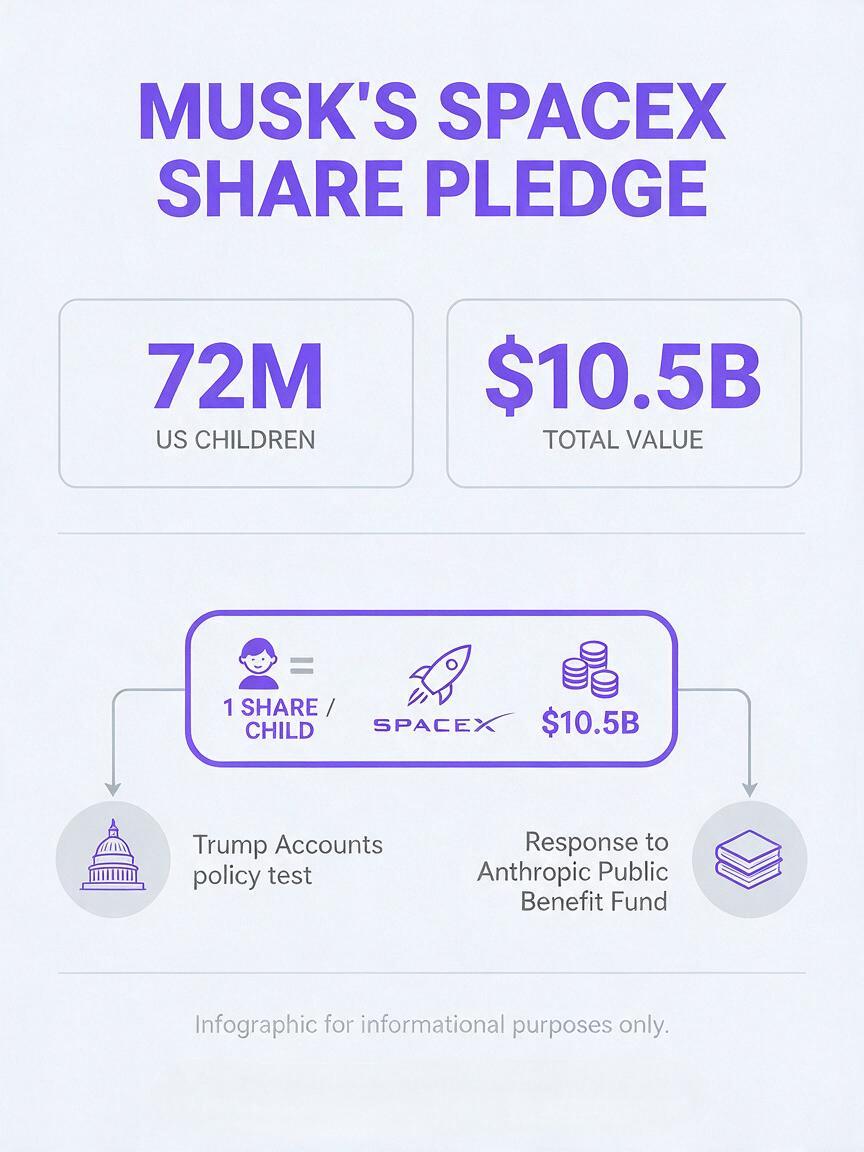
Elon Musk has pledged one SpaceX share to each of the roughly 72 million children in the United States, with the total gift valued at approximately $10.5 billion at the latest closing price. The pledge, framed as "just the start," is explicitly positioned as a response to Anthropic's October 2026 Public Benefit Fund announcement and a test of the Trump administration's "Trump Accounts" child-investment policy. The move highlights growing competition among tech and AI leaders around public benefit commitments, with implications for AI creators navigating an evolving industry landscape.

Table of contents
Elon Musk’s latest public pledge puts SpaceX stock in the hands of every US child, while drawing direct lines to AI industry public benefit efforts and federal child-investment policy.
On October 20, 2026, Musk announced plans to give one share of SpaceX stock to each of the roughly 72 million children living in the United States. At the latest closing price, the total value of the gift comes to approximately $10.5 billion, and Musk has framed the initiative as "just the start" of broader efforts. The pledge is positioned both as a response to recent AI industry public benefit moves and as a real-world test of the Trump administration’s proposed "Trump Accounts" child-investment policy framework.
What the SpaceX Share Pledge Entails
The pledge covers all US children, a group estimated at around 72 million people, with each child receiving one full share of SpaceX stock. Based on the most recent private market valuation and closing price for the company’s shares, the total value of the distribution is roughly $10.5 billion.
Musk has characterized the gift as an initial step, using the phrase "just the start" in his public announcement. The initiative is also explicitly designed to test the viability of the Trump administration’s "Trump Accounts" policy, a proposed child-investment framework that would create government-funded savings accounts for children. By structuring the pledge as a private-sector parallel to the policy, Musk is effectively demonstrating how a large-scale child-investment program could operate in practice.
While the pledge is not directly an AI industry announcement, it is explicitly framed as a response to a recent public benefit commitment from leading AI lab Anthropic, placing it squarely within the broader conversation about AI’s role in public welfare and corporate responsibility.
Why the Pledge Ties to Anthropic's Public Benefit Fund
Musk’s announcement comes one day after Anthropic, the company behind Claude Opus and other frontier AI models, established its own Public Benefit Fund on October 19, 2026. Anthropic’s fund is structured to receive 5% of the company’s outstanding shares, pending shareholder approval, with an additional 2% contribution for every 50% increase in the company’s valuation going forward.
Notably, Anthropic’s fund has strict guardrails: shares in the fund cannot be used to finance lobbying or political donations, and the fund’s primary focus is addressing AI’s impact on the labor market. Combined with the 80% equity pledge from Anthropic’s founders, roughly 20% of the company’s total shares are earmarked for public benefit purposes.
Musk’s SpaceX pledge is framed as a competitive response to Anthropic’s move, highlighting a growing trend among tech and AI leaders to compete not just on model capabilities or market share, but on public benefit commitments. This competition is shaping how AI companies position themselves to regulators, customers, and the general public, with potential ripple effects across the entire AI ecosystem.
What This Means for AI Video and Image Creators
While a SpaceX stock pledge for children may seem unrelated to AI content creation at first glance, its ties to the AI industry’s public benefit and regulatory landscape carry tangible implications for video and image creators who rely on AI tools.
First, the growing competition around public benefit commitments signals that AI labs are increasingly balancing commercial goals with public-facing responsibility mandates. This balance can lead to shifts in model access, pricing structures, and terms of service as companies adjust their strategies to align with public benefit goals and regulatory expectations. For creators who depend on a single AI provider for core tools like text to video generation, these shifts can disrupt workflows and delay projects.
Second, the link between public benefit pledges and broader policy debates suggests that AI regulation will continue to evolve rapidly in the coming months. As policymakers and industry leaders negotiate the terms of AI’s public role, creators may face changing compliance requirements, content restrictions, or access limitations for certain AI tools. Staying flexible and maintaining access to multiple tools can help creators navigate these changes without pausing production.
Third, the focus on labor market impact in Anthropic’s fund highlights the ongoing conversation about AI’s effect on creative professions. As AI tools become more integrated into content creation workflows, creators are increasingly looking for ways to leverage these tools while maintaining creative control and financial stability. Access to a diverse set of AI models and tools can help creators adapt to changing industry dynamics and find new creative and commercial opportunities.
How Multi-Model Platforms Support Creator Stability
In an era of shifting AI company priorities, regulatory changes, and public benefit mandates, relying on a single AI provider for all creative work introduces unnecessary risk. A multi-model platform like MagicBoat gives creators access to a wide range of AI tools in one place, reducing dependence on any single company and making workflows more resilient to unexpected changes.
For example, creators using an ai image generator can switch between different models with different strengths and pricing structures without creating new accounts or learning new interfaces. This flexibility means that if one provider changes its terms, raises prices, or restricts access, creators can seamlessly shift to another model without missing deadlines.
MagicBoat also integrates tools for video generation, script writing, voiceover, lip sync, and more, all under a single account. This unified approach simplifies workflow management, reduces administrative overhead, and gives creators the freedom to choose the best tool for each specific task, rather than being locked into a single provider’s ecosystem.
Whether you’re working on short-form social media content, long-form video projects, or visual art, having access to multiple AI tools in one platform helps you stay productive and adaptable, even as the broader AI industry continues to evolve. You can try these models for free to build a more resilient creative workflow today.
Key Takeaways
- Elon Musk has pledged one SpaceX share to each of the roughly 72 million US children, with the total gift valued at approximately $10.5 billion at the latest closing price.
- The pledge is explicitly framed as a response to Anthropic’s October 19 Public Benefit Fund announcement and a test of the Trump administration’s "Trump Accounts" child-investment policy.
- Growing competition around AI industry public benefit commitments signals potential shifts in model access, pricing, and regulation that could affect creative workflows.
- Multi-model platforms like MagicBoat help creators maintain workflow stability by providing access to a diverse set of AI tools under one account, reducing reliance on any single provider.
Keywords
musk spacex share pledge, anthropic public benefit fund, trump accounts, ai industry philanthropy, ai lab competition, creator workflow resilience, tech public benefit