Musk Promises Affordable Starlink in India vs Ambani’s Jio Ahead of IPO
Elon Musk has promised affordable Starlink service in India, positioning the satellite-internet provider against Ambani’s Jio as Jio’s parent approaches an IPO. Specific pricing, launch timing and service details have not yet been disclosed.
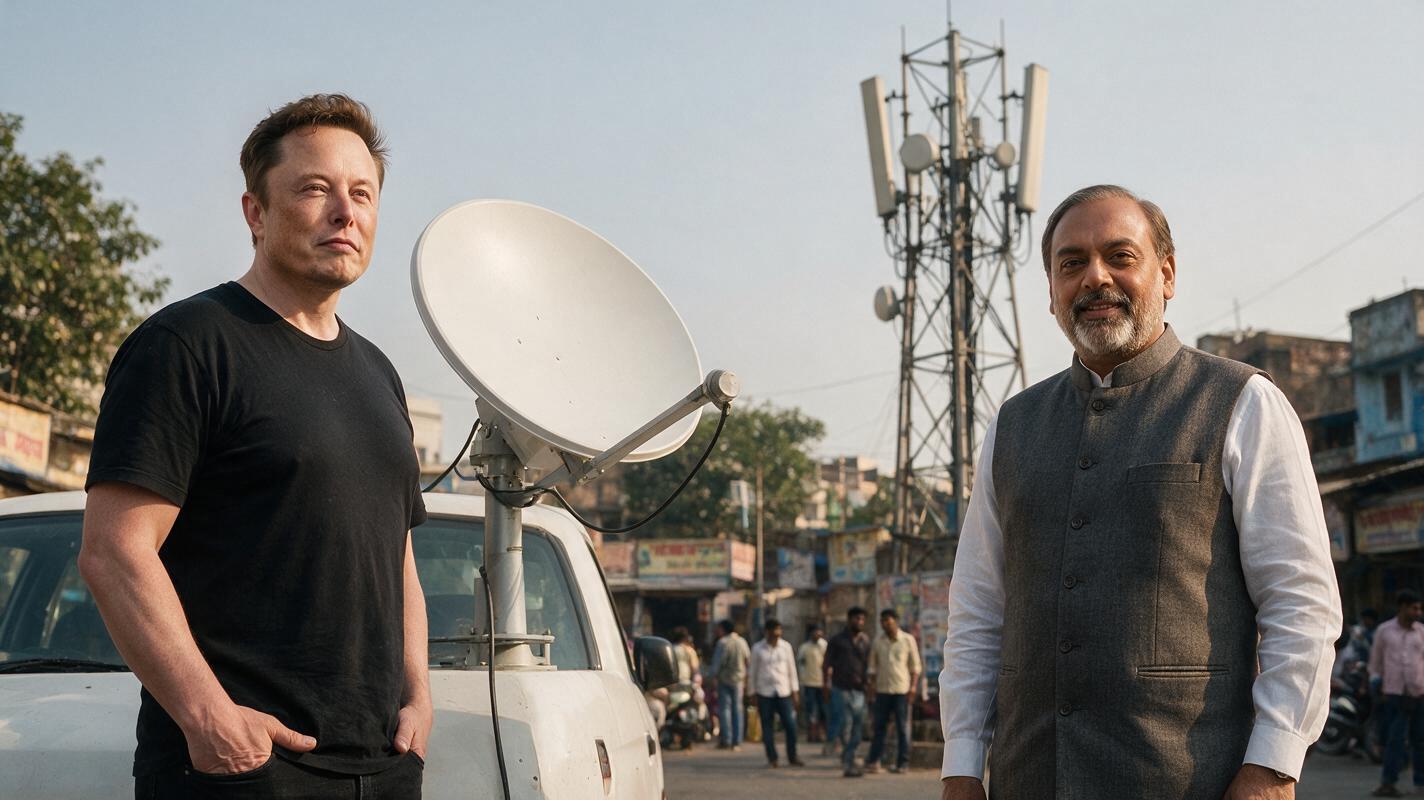
Table of contents
Satellite Internet News
Musk Promises Affordable Starlink in India vs Ambani’s Jio Ahead of IPOThe affordability pledge brings Starlink’s India ambitions into sharper focus as Jio’s parent approaches an initial public offering.
Elon Musk promised affordable Starlink service in India on October 11, placing the satellite-internet provider more directly against Ambani’s Jio at a consequential moment for the Indian company. The pledge arrived ahead of the planned IPO of Jio’s parent, adding a competitive technology narrative to an already important corporate event.
The central news is the promise of affordability rather than a disclosed price. No subscription figure, launch timetable, coverage target, or service specification was included in the report summarized here. What is clear is that Musk is presenting price accessibility as part of Starlink’s India positioning while Jio remains the named local rival.
That distinction matters. “Affordable” can signal an intended market position, but it does not by itself establish the final cost, availability, or value of a service. The meaningful comparison will depend on what customers can actually buy and use once commercial details are available.
For creators and content teams, the story is relevant because connectivity affects where cloud-based production can happen and how reliably large media assets can move through a workflow. It also offers a useful reminder to separate a vendor promise from the measurable performance of a finished service.
Why the Starlink–Jio Contest Matters
The headline brings together three significant elements: Musk’s global Starlink brand, Ambani’s Jio, and the impending IPO of Jio’s parent. The immediate focus is internet access, but the wider business question concerns which provider can build a persuasive relationship with Indian users through price, availability, and dependable service.
The timing gives the pledge additional weight. An IPO puts attention on a company’s market position and future prospects. A high-profile affordability promise from a prospective rival can therefore shape the surrounding conversation even before detailed offers can be compared.
Affordability is currently a positioning claim in this story, not a published price comparison.
That boundary is important for both business analysis and content production. Marketing teams covering the news should avoid converting the promise into an unsupported price forecast. The defensible story is that Musk promised affordable Starlink service in India as Jio’s parent approached its IPO—not that Starlink had already undercut Jio.
What Is Confirmed and What Remains Open
| News element | What is established | What is not stated |
|---|---|---|
| Starlink positioning | Musk promised affordability in India. | No final price or package was provided. |
| Competitive context | Ambani’s Jio is the named rival. | No service-performance comparison was given. |
| Corporate timing | The news came ahead of the IPO of Jio’s parent. | No IPO valuation or schedule was stated. |
This fact pattern supports a focused editorial angle: a global satellite-internet provider is emphasizing affordability while entering a market conversation shaped by a powerful incumbent and a major capital-market event. It does not support precise claims about which service will be cheaper, faster, or more widely available.
The AI Industry Connection Is Infrastructure
Starlink and Jio are connectivity businesses in this report, but the story has a practical connection to the AI industry. Modern creative production increasingly depends on moving prompts, reference images, generated media, revisions, and final files between users and cloud services. The quality of that experience is influenced by access to dependable connectivity.
An ai image generator may produce a visual asset, but a working production pipeline also has to upload references, deliver results, and support review. An ai video generator adds even greater attention to file movement because video assets can create heavier production demands than static images.
This does not mean the Starlink promise immediately changes AI video cost or image-generation economics in India. No such pricing effect was stated. It means connectivity belongs in the broader infrastructure conversation alongside models, cloud capacity, and AI capital expenditure.
Content teams should measure outcomes rather than slogans
The same discipline used to assess “affordable” internet applies to AI production tools. Teams benefit from examining real workflow outcomes instead of relying on a single promotional phrase. Useful internal measures include:
- Availability: whether the service can be used when production deadlines demand it.
- Turnaround time: how long it takes to move from an idea to a reviewable asset.
- Revision burden: how much additional work is required before approval.
- Cost per approved asset: the total production expense after retries and revisions.
- Workflow resilience: whether the team can continue when one tool or provider is unsuitable.
These measures create a clearer bridge between infrastructure news and day-to-day production. A compelling market announcement can indicate strategic direction, while completed work reveals actual value.
Why Multi-Model Access Fits a Changing Market
The Starlink–Jio story illustrates how quickly vendor competition can become tied to pricing language, corporate timing, and market access. AI creation has a similar need for flexibility: no single model or format is necessarily the right match for every campaign, visual style, or delivery schedule.
MagicBoat gives content teams a centralized environment for exploring AI-assisted image and video creation. Keeping creative options together can make it easier to compare outputs, adapt a concept to a different format, and avoid building an entire production plan around one isolated tool.
The goal is not to treat connectivity news as a model benchmark. It is to recognize a shared operational principle: promises attract attention, while availability, cost, consistency, and completed results determine whether a service belongs in a real workflow.
Key Takeaways
- Musk promised affordable Starlink service in India on October 11.
- Ambani’s Jio is the named competitive reference in the report.
- The announcement arrived ahead of the IPO of Jio’s parent.
- No specific Starlink price, launch timetable, or service benchmark was stated.
- For AI content teams, connectivity is part of the infrastructure behind cloud-based media production.
- Vendor claims are most useful when tested against availability, turnaround time, revision burden, and total production cost.
Build a More Flexible Creative Workflow
Explore image and video creation in one place, compare suitable options for each project, and evaluate results against the needs of your production pipeline.
Keywords: Starlink India, Ambani Jio, Jio parent IPO, satellite internet, AI industry, AI video cost, AI content creation