Nvidia Board Prepared to Remove Jensen Huang Before His Resignation
Reports said Nvidia’s board was preparing to remove Jensen Huang before his resignation, raising questions about governance, leadership continuity and AI infrastructure risk.
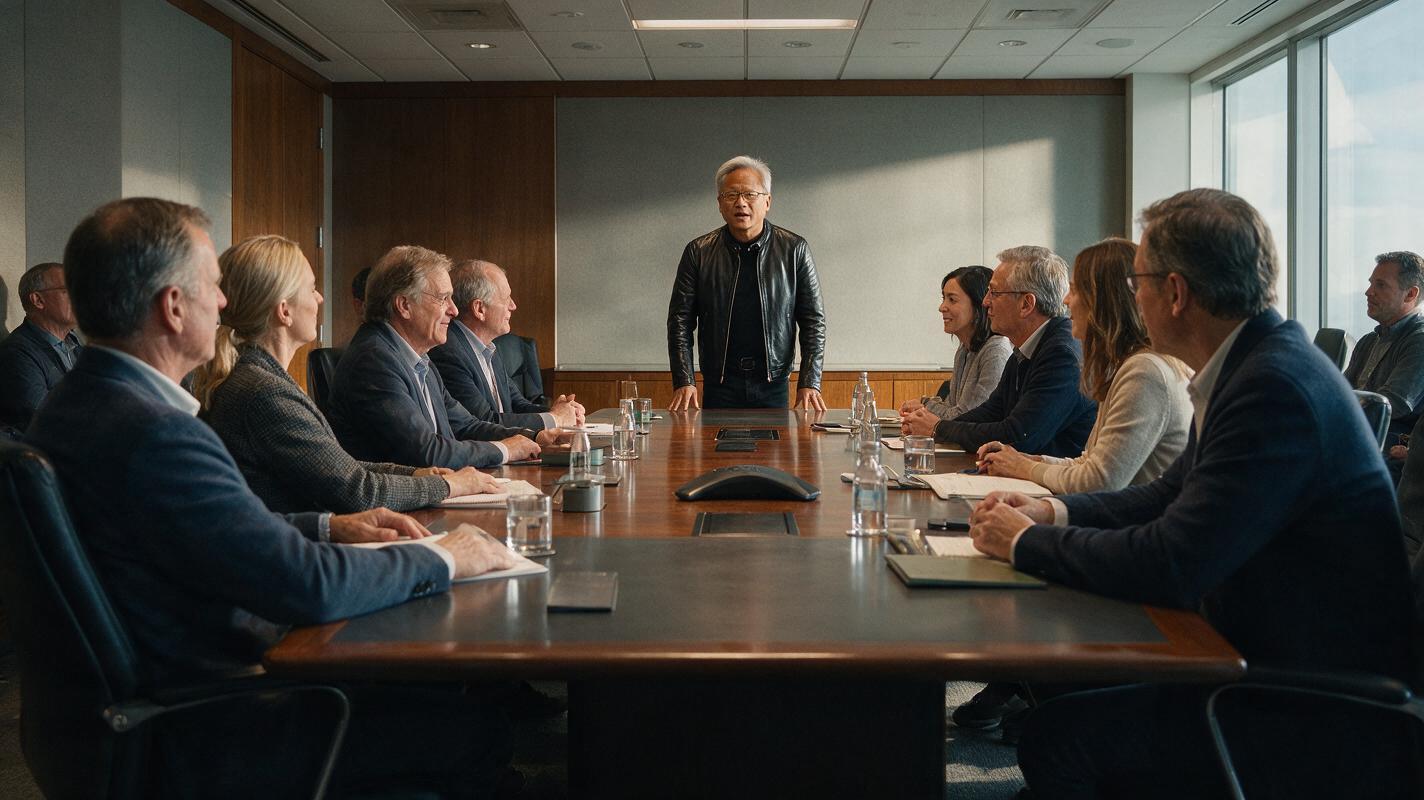
Table of contents
Reports of an imminent board decision sent Nvidia shares sharply lower and revealed how quickly leadership uncertainty can become infrastructure risk across the AI industry.
News analysis · Nvidia leadership and AI infrastructure
The Reports That Preceded Nvidia’s Leadership Change
Late on November 11, The Wall Street Journal and Bloomberg reported that Nvidia’s board was preparing to remove founder and CEO Jensen Huang. According to people described as close to the board, directors could make a decision at a meeting as soon as November 12. The company had reportedly retained an outside search firm, and appointing an interim chief executive was among the scenarios under consideration.
The reports landed after Nvidia shares had closed the regular session 2.87% higher at $173.73. In after-hours trading, however, the stock fell more than 9%. It was still down 8.79% by 08:50 Beijing time on November 12, illustrating how rapidly corporate-governance uncertainty could outweigh a positive trading session.
The New York Times separately reported a second internal relationship involving Huang and healthcare vice president Kimberly Powell, who reported directly to him. Its account included a March GTC incident and requests for witnesses to sign nondisclosure agreements. At the same time, Polymarket priced an 86% probability that Huang would leave Nvidia before the end of November.
At that stage, the central claims were based on anonymous sources and had not been confirmed by Nvidia. Governance scholars quoted by Fortune considered a different outcome—retaining Huang while reducing his authority—more likely. The conflicting signals made the story as much about information quality and board process as executive succession.
The crucial distinction: the November 11 reports described preparations and possible outcomes, not a confirmed board decision. Nvidia announced Huang’s immediate resignation on November 12, making the earlier reporting part of the chronology leading into the final leadership change.
For content teams, the episode highlights a practical issue that extends beyond the stock market. Leadership and governance events at a major AI infrastructure supplier can influence confidence around investment, product continuity and the broader availability of the systems supporting generative-AI services.
Why the Market Reaction Was So Sharp
Nvidia occupied a central position in AI infrastructure, so reports of a possible founder removal carried more weight than a routine executive transition. The uncertainty covered several questions simultaneously: whether Huang would remain, whether the board would appoint an interim leader and whether an external search would alter Nvidia’s strategic direction.
The initial after-hours decline also reflected the difference between measurable operating news and difficult-to-price governance risk. Revenue, capital spending and product demand can be modeled from disclosed figures. A fast-moving board dispute based on anonymous reporting is harder to value because investors do not immediately know the duration, management structure or operational consequences.
| Reported development | Known detail at the time | Source of uncertainty |
|---|---|---|
| Possible CEO removal | A board meeting could occur as soon as November 12 | Nvidia had not confirmed the report |
| Leadership search | An outside search firm had reportedly been retained | No permanent or interim candidate was publicly named |
| Alternative governance outcome | Scholars quoted by Fortune favored retention with reduced authority | The board’s preferred structure remained unclear |
| Market response | Shares fell more than 9% after hours | Trading moved before formal confirmation |
The sequence is also a reminder that prediction-market pricing is not confirmation. The 86% departure probability reflected market expectations, while the company’s formal announcement supplied the eventual corporate record.
A Governance Event With AI Industry Consequences
Nvidia’s importance meant that its leadership uncertainty reached far beyond one company. AI funding plans and AI capital expenditure depend on confidence in hardware road maps, supply relationships and data-center buildouts. When a central supplier faces abrupt governance disruption, customers and investors have to consider whether planned infrastructure schedules remain dependable.
That does not mean the reported board preparations automatically changed Nvidia’s products or customer commitments. The available facts did not establish such an effect. The episode instead introduced an additional category of risk into an already capital-intensive market: a company can have strong technology demand while still facing uncertainty at the leadership and board level.
This distinction matters when interpreting AI industry headlines. A share-price fall tied to governance reporting does not by itself prove weaker demand for AI services. It shows that markets also price execution continuity, internal controls and confidence in decision-making.
What Content Teams Can Take From the Nvidia Episode
Creative teams rarely purchase data-center hardware directly, but they still depend on the infrastructure chain behind image, video and language models. A disruption involving a major supplier can eventually affect provider priorities, investment timing or service reliability, even when the immediate event is a corporate-governance matter.
The practical response is not to predict every board decision. It is to avoid making an entire production workflow dependent on one vendor or one technical route. Teams evaluating an ai video generator or ai image generator should consider availability and workflow flexibility alongside output quality and AI video cost.
Reliability belongs in the model-selection conversation
Creative model comparisons often emphasize visual quality or generation speed, but the Nvidia news shows why operational resilience deserves equal attention. The infrastructure beneath a model includes suppliers, cloud systems and corporate decisions that users may never see.
- Keep source materials portable: retain prompts, scripts and reference assets outside any single generation service.
- Separate creative intent from one model: document the visual brief so a project can move between available tools.
- Watch confirmed company statements: distinguish formal announcements from anonymous-source reporting and market speculation.
- Build for continuity: select workflows that offer alternatives when one provider becomes unavailable or unsuitable.
A multi-model platform can reduce the friction involved in testing those alternatives. MagicBoat brings creative tools into one account, allowing teams to compare available approaches without rebuilding their workflow around each individual provider.
Key Takeaways
- Reports published late November 11 said Nvidia’s board was preparing to remove Jensen Huang and could decide as soon as November 12.
- An outside executive-search firm had reportedly been retained, with an interim CEO among the possible outcomes.
- Nvidia shares fell more than 9% after hours after closing the regular session at $173.73, up 2.87%.
- The claims were initially anonymous and unconfirmed, while governance scholars cited by Fortune considered retention with reduced authority more likely.
- Nvidia announced Huang’s immediate resignation on November 12, establishing the outcome after the earlier period of uncertainty.
- For creative teams, the wider lesson is to treat provider reliability and workflow portability as core model-selection criteria.
Keep AI Production Flexible
Infrastructure and leadership conditions can change faster than a content calendar. Use one flexible creative workspace to explore different generation options, protect production continuity and try these models for free.
Keywords: Nvidia board, Jensen Huang, Nvidia leadership, AI industry, AI capital expenditure, AI infrastructure, model reliability