Netflix Moments and the New Blueprint for AI Short Drama
Netflix’s expanded Moments feature lets members save scenes with custom start and end points, reinforcing the value of compact, shareable story beats. Creators can apply the same principle to AI short drama by designing memorable moments first, then building coherent episodes around them.

Table of contents
Netflix Moments makes the scene a creative unit
Netflix expanded Moments so members can choose the beginning and end of a scene they want to save, revisit, and share from the mobile app. For content creators, that change highlights a practical opportunity: build AI-assisted stories around concise, emotionally complete moments rather than treating every short video as a compressed feature film.
This is more than a sharing feature. It reflects the way audiences increasingly remember entertainment—as a reveal, reaction, line, transformation, or cliffhanger that can stand on its own while pointing back to a larger story.
The creator takeaway: a short drama becomes easier to discover and remember when each episode contains at least one moment viewers would want to describe, revisit, or share.
What changed with Netflix Moments
Netflix introduced Moments as a mobile feature for saving favorite scenes and sharing them through social platforms or messaging. Its later expansion added the ability to define where a saved moment begins and ends, giving viewers more control over the exact piece of a title they want to preserve.
The strategic signal is not that creators should reuse Netflix footage. Copyrighted scenes, characters, dialogue, and visual identities remain protected. The useful signal is structural: audiences value entertainment at both the title level and the moment level.
A full episode provides context, escalation, and payoff. A memorable excerpt provides an immediate emotional proposition. That excerpt might contain:
- A character making a difficult choice
- A visual transformation with a clear before and after
- An unanswered question that opens a story loop
- A reversal that changes the meaning of an earlier action
- A final image that creates anticipation for the next episode
For independent creators, the challenge is to make those moments feel native to an original story—not like disconnected clips assembled only for reach.
The shift from episode-first to moment-aware storytelling
Traditional production usually moves from premise to script, scenes, filming, editing, and promotion. AI content creation can make iteration faster, but speed alone does not guarantee that a story will contain anything memorable.
A moment-aware pipeline introduces a creative checkpoint before full production: identify the emotional image, decision, or reveal that gives the episode its identity. The surrounding scenes can then be designed to set up and resolve that beat.
| Production focus | Common starting point | Creative risk | Moment-aware alternative |
|---|---|---|---|
| Conventional short video | A broad topic or trend | The clip communicates information but lacks a dramatic payoff | Define one visible change the audience can recognize immediately |
| AI-generated montage | A collection of attractive prompts | Shots look polished but feel unrelated | Give every shot a role in setting up, delivering, or reacting to the central beat |
| Short-drama episode | A condensed multi-scene script | Too many plot points compete for limited time | Organize the episode around one decision, reversal, or revelation |
| Promotional cut | Highlights chosen after completion | No scene works cleanly outside the full episode | Plan a self-contained, context-rich excerpt during development |
This does not mean writing only for clips. It means ensuring that the smallest shareable unit still carries character, conflict, and consequence.
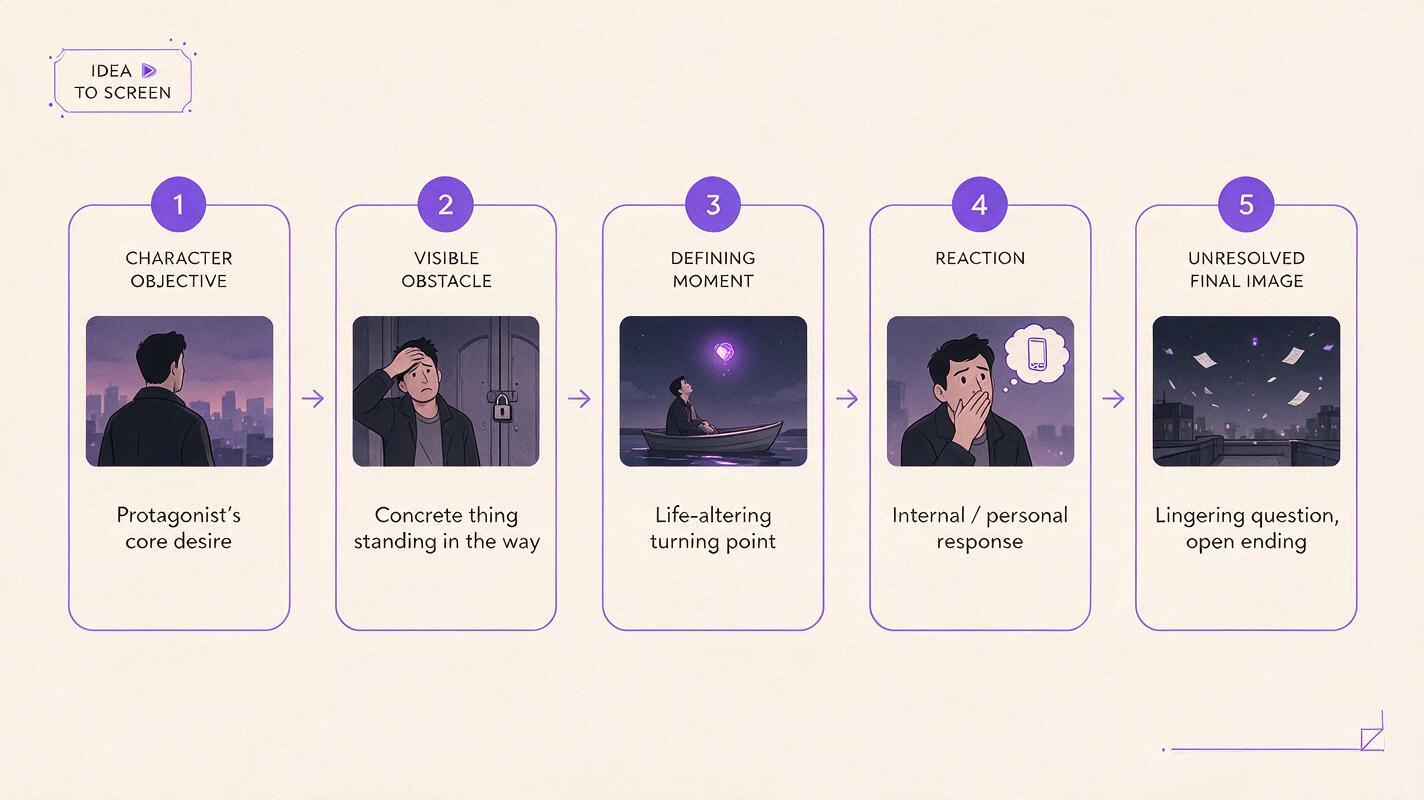
An AI video pipeline built around memorable beats
An effective AI video workflow can begin with a moment brief rather than a long screenplay. The brief defines what changes, why it matters, and what the audience should feel before any shots are generated.
The moment brief
A useful brief answers four questions:
- Who wants something? Name the active character and immediate objective.
- What interrupts the plan? Introduce one obstacle that can be shown visually.
- What changes? Specify the decision, discovery, or reversal.
- What remains unresolved? Leave a question with enough weight to support another episode.
The language should describe observable action instead of relying on abstract emotions. “She realizes she has been betrayed” is difficult to visualize consistently. “She compares the signature on the letter with the signature inside her locket, then hides the evidence as the door opens” gives the production process concrete actions and props.
A prompt that protects story continuity
The following framework can be adapted for original text to video development:
Create a short dramatic sequence about [original character] in [specific location].

Story objective: [what the character wants]
Visible obstacle: [what prevents it]
Central moment: [the discovery, choice, or reversal]
Continuity anchors: [wardrobe, prop, lighting, time of day]
Shot progression: setup, interruption, close reaction, decisive action, unresolved final image
Tone: [precise emotional and visual direction]
Avoid: new characters, unexplained location changes, copyrighted characters, logos, and imitation of a living artist's style
The final production may require several prompts or generation passes. Keeping the objective, continuity anchors, and central moment stable helps the resulting shots feel like parts of one scene rather than unrelated demonstrations.
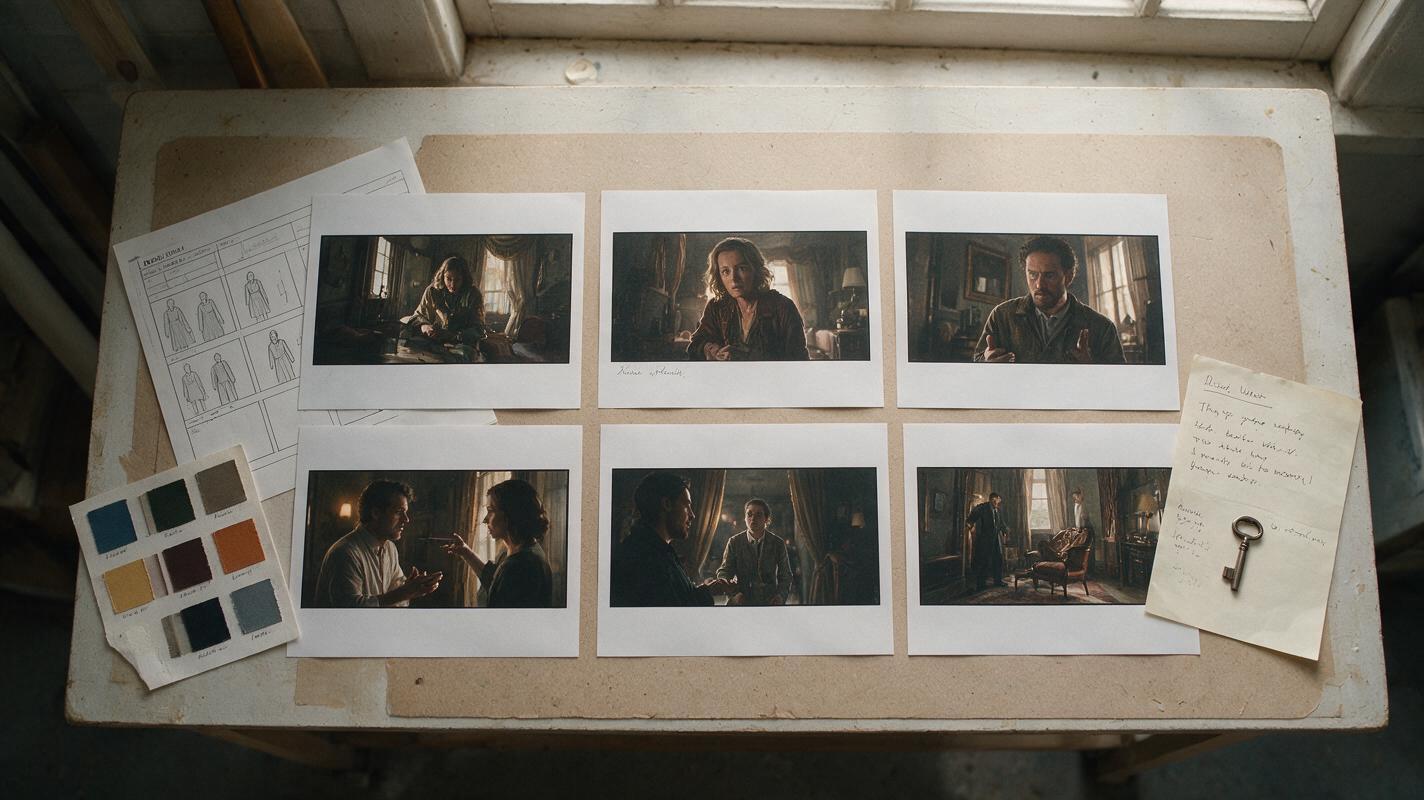
Where AI short drama gains an advantage
Short drama is especially compatible with moment-aware development because its constraints encourage concentration. A creator does not need to establish an entire fictional universe in every episode. One room, one relationship, and one consequential choice can be enough.
AI-assisted production can support early experimentation with:
- Premise variations: test whether the same reveal works better as romance, mystery, comedy, or science fiction.
- Visual staging: compare entrances, reaction shots, prop placement, and final compositions before committing to a sequence.
- Alternate hooks: explore whether the episode should open with the consequence and rewind, or build chronologically toward it.
- Episode bridges: generate concepts for a closing image that naturally becomes the next installment’s opening problem.
- Format adaptation: rethink framing and shot duration for vertical viewing without merely cropping a horizontal composition.
The advantage is not automatic production at unlimited scale. It is the ability to compare creative possibilities earlier, when changing the concept costs less than rebuilding a finished story.
A practical scene architecture for original AI films
A compact AI film scene can be organized into five dramatic functions without presenting them as rigid time limits.
| Story function | Audience question | Useful visual evidence |
|---|---|---|
| Immediate situation | Where are we, and what is happening? | A recognizable location, action, and important prop |
| Character objective | What does the protagonist need right now? | A destination, task, message, object, or person |
| Interruption | Why can the objective not continue normally? | An arrival, warning, missing item, contradiction, or physical barrier |
| Defining moment | What changes the story? | A choice, reveal, transformation, refusal, or reversal |
| Forward pull | Why should the audience continue? | A new threat, unanswered message, hidden witness, or changed relationship |
Before producing a complete episode, creators can draft several versions of only the defining moment. If the beat remains confusing without extensive explanation, the setup may need clearer visual evidence. If it feels predictable, the character’s choice may need a more meaningful cost.

Originality and rights still shape the opportunity
Netflix Moments makes sharing a favorite portion of a title easier within Netflix’s own feature. It does not turn entertainment footage into unrestricted source material for outside production.
Creators applying this trend should work with original or properly licensed elements:
- Write new characters, dialogue, settings, and conflicts.
- Avoid reproducing recognizable scenes from Netflix titles or other protected works.
- Do not use actor likenesses, platform logos, or signature franchise imagery without permission.
- Keep records for licensed music, stock assets, voice performances, and collaborator contributions.
- Review generated shots for accidental trademarks or similarities before publication.
The strongest response to a popular entertainment moment is usually not imitation. It is understanding the emotional mechanism—surprise, recognition, suspense, relief—and expressing that mechanism through a new premise.
Bringing moment-aware production into MagicBoat
MagicBoat gives creators a place to explore AI-assisted video and short-drama workflows from an original moment brief. A practical project can begin with a character objective and central reveal, expand into a shot progression, and then be refined around continuity and episode-to-episode momentum.
Use the first generation as a story test rather than assuming it is the final cut. Check whether the objective reads without exposition, whether the central prop remains recognizable, and whether the last image creates a real question. Those observations can guide the next prompt or edit.
Start creating with MagicBoat for free and turn one original, memorable beat into the foundation of an AI short drama.
Sources
- Netflix — Introducing Moments: A New Way to Save and Share
- Netflix — Now You Can Save and Share Even More of Your Favorite Netflix Moments
Final checklist
- Give each episode one clearly identifiable emotional or narrative turn.
- Build setup and reaction shots around that defining moment.
- Use visible actions, props, and locations instead of abstract prompt language.
- Keep continuity anchors stable across generated shots.
- End with a meaningful question rather than an arbitrary cut.
- Create original material and verify rights before publishing.
Keywords
netflix moments, ai video, ai content creation, ai short drama, text to video, ai film, short-form storytelling