North American Box Office Reaches $8.76B, Up 20% From 2025
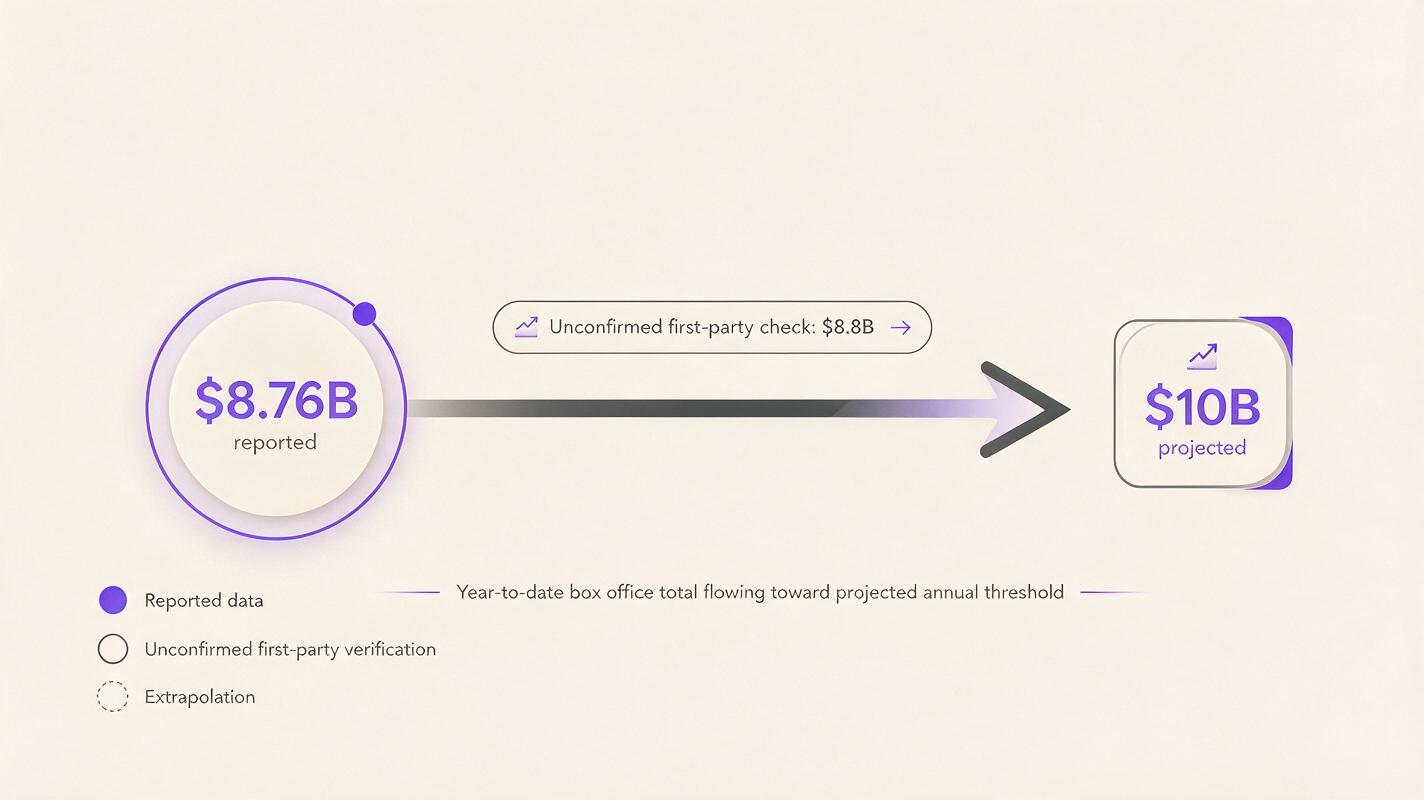
North American box office revenue reached a reported $8.76 billion through Nov. 15, running 20% ahead of the same point in 2025. The recovery could produce the industry’s first $10 billion year since 2020, although the underlying figures and individual film results require careful interpretation.

Table of contents
North American Box Office Hits $8.76 Billion
North American theatrical revenue has reached a reported $8.76 billion year-to-date as of Nov. 15, putting the market 20% ahead of the same point in 2025.
The figures, attributed to Rentrak data relayed through Chinese media, suggest that cinemas are approaching a major post-2020 milestone. With The Hunger Games: Sunrise on the Reaping opening Nov. 20, Avengers 5 arriving Dec. 16 and Dune 3 following Dec. 31, the industry is on course for its first $10 billion North American year since 2020.
That outlook is encouraging, but it is not yet a confirmed final result. The $10 billion forecast is an extrapolation from the reported year-to-date total, while the $8.76 billion figure and 20% increase have not been independently confirmed through first-party Comscore or Box Office Mojo data.
The weekend’s individual results also showed how uneven the recovery remains. Johnny Depp’s Cold Night Tale led the weekend, with Paramount reportedly keeping its budget below $40 million. Separate Chinese reports placed its global opening day below $7 million and its cumulative gross at around $48.1 million amid poor word of mouth, but those figures describe different scopes and should not be combined into one performance calculation.
At the opposite end of the market, an unnamed Liam Neeson film was reportedly removed from 826 theaters after one week. Its opening-weekend average was only $458 per theater. The 98-minute film had no announced streaming date.
For filmmakers and digital storytellers, the broader message is that a growing market does not guarantee success for every release. Audience positioning, budget discipline and rapid promotional response remain essential even when total theatrical revenue is rising.
Why the $10 Billion Outlook Still Needs Caution
The headline trajectory is strong: $8.76 billion by mid-November, a 20% year-over-year lead and three major franchise releases still scheduled before the end of December. Those conditions make a $10 billion finish plausible, but they do not make it certain.
Several distinctions matter when interpreting the report:
- The year-to-date total is reported data: It was attributed to Rentrak but relayed through Chinese media rather than presented through first-party North American box office services.
- The 20% comparison uses the same reported source chain: It indicates substantial momentum but still awaits separate confirmation.
- The $10 billion outcome is a projection: It depends on the remaining release calendar performing strongly enough to close the gap.
- Presales and franchise recognition are not final grosses: Upcoming titles can strengthen the market without automatically delivering every dollar anticipated.
A strong annual total describes the health of the overall market. It does not remove the financial risk attached to an individual film.
The distinction is especially important for independent producers. Large franchise releases can lift aggregate revenue while smaller or poorly received films lose screens quickly. Market growth and title-level success must therefore be evaluated separately.
Cold Night Tale and the Cost of Weak Word of Mouth
Cold Night Tale illustrates the tension between chart position and underlying performance. It was the weekend leader, and Paramount reportedly held its budget below $40 million. Yet the available reporting also described poor word of mouth and supplied two figures that cannot be treated as directly comparable: a global opening day below $7 million and a cumulative total of around $48.1 million.
Being No. 1 for a weekend can provide a powerful marketing message, but rank alone does not reveal profitability, audience retention or long-term demand. Budget, geographic scope, reporting period and subsequent declines all affect the meaning of a chart position.
The reported Liam Neeson result presents an even sharper example. A $458 opening-weekend per-theater average preceded the film’s removal from 826 theaters after only one week. Without an announced streaming date, the film also lacked a publicly identified second release window in the source material.
| Market signal | Reported detail | What it indicates |
|---|---|---|
| Overall North American market | $8.76 billion through Nov. 15 | Strong year-to-date recovery |
| Year-over-year movement | 20% ahead of the same point in 2025 | Broad theatrical momentum |
| Cold Night Tale | Weekend leader; budget below $40 million | Chart leadership with controlled production cost |
| Unnamed Liam Neeson film | $458 per-theater average; removed from 826 theaters | Weak demand can shorten theatrical availability rapidly |
Release Timing Is Becoming Part of the Story
The remaining calendar concentrates significant attention into a short period. The Hunger Games: Sunrise on the Reaping opens Nov. 20, followed by Avengers 5 on Dec. 16 and Dune 3 on Dec. 31. Their placement gives the market several opportunities to add substantial revenue before year-end.
This concentration also means every campaign must compete for attention around established entertainment properties. Smaller releases cannot rely solely on general audience enthusiasm for cinemas. They need a recognizable premise, distinctive visual identity and promotional material suited to multiple channels and viewing formats.
That principle applies beyond theatrical distribution. An AI film, an episodic web series or an ai short drama may operate on a different scale, but each still faces the same fundamental challenge: audiences must understand the hook quickly enough to choose it over competing entertainment.
What the Box Office Signals for AI Film Teams
The reported box office recovery gives independent teams a useful strategic signal. Audience demand exists, but attention remains selective. Rather than treating AI content creation as a reason to produce more undifferentiated material, filmmakers can use it to explore concepts, visual directions and promotional assets before committing to a full release.
MagicBoat brings story development and visual production into one account. An ai film generator can support early concept exploration, while text to video can help turn written visual ideas into short-form footage for trailers, pitch materials or audience-facing clips.
The strongest lesson from the theatrical numbers is not simply to reduce costs. It is to connect production scale with demonstrated audience interest. A compact project with a clear genre promise may be more sustainable than a larger release whose message is difficult to communicate.
Build Around a Measurable Creative Thesis
A useful project thesis identifies the audience, emotional promise and release format before extensive production begins. For example, a filmmaker might frame a concept as a tightly paced science-fiction mystery, a recurring vertical drama or a short visual proof of concept. The purpose is not to imitate a reported box office winner, but to make the project easy to recognize and evaluate.
Early promotional experiments can then reveal which images, characters or conflicts attract attention. Those signals are not equivalent to ticket sales, but they can help a team decide where to concentrate its limited time and production resources.
Keep Performance Claims in Their Proper Context
The reporting around Cold Night Tale demonstrates why creators should label metrics precisely. Opening day, opening weekend, cumulative gross, domestic revenue and global revenue are different measurements. Combining them can create a misleading picture of success.
The same discipline should govern digital campaigns. Views, completion rates and audience responses describe different behaviors. Clear labeling makes it easier to compare versions of a trailer or story concept without overstating what the data proves.

Key Takeaways
- North American box office reportedly reached $8.76 billion through Nov. 15.
- The market was reported to be 20% ahead of the same point in 2025.
- A first $10 billion year since 2020 is possible, but it remains an extrapolation rather than a confirmed result.
- Cold Night Tale led the weekend with a reported budget below $40 million, although poor word of mouth complicated the headline ranking.
- The reported opening-day and cumulative figures for the Depp film use different scopes and should remain separate.
- An unnamed Liam Neeson film was reportedly pulled from 826 theaters after posting a $458 opening-weekend per-theater average.
- Independent filmmakers should pair efficient production with a clear hook, disciplined measurement and adaptable promotional assets.
- To develop visual concepts and campaign-ready footage in one place, try these models for free.
Keywords
north american box office, box office 2026, Cold Night Tale, ai film, ai content creation, text to video, film marketing