Nvidia FY27 Q3 Earnings: Record Data Center Revenue & CEO Update | MagicBoat
Nvidia reported its first quarterly earnings since Jensen Huang stepped down as CEO, posting $115.84 billion in FY27 Q3 revenue — up 103% year over year and beating consensus estimates. Data center revenue crossed $100 billion for the first time, driven by surging demand for AI chips, and the company raised its FY28 growth target to 70-75%. The results have direct implications for AI video and image creators, as GPU supply and pricing shape the availability and cost of the AI generation tools they rely on.
Table of contents
Nvidia FY27 Q3 Earnings: Key Takeaways
Nvidia released its FY27 Q3 earnings after market close on Nov 17, 2026 — its first quarterly report since Jensen Huang stepped down as CEO. The results blew past Wall Street expectations, with record data center revenue and strong forward guidance, even as leadership uncertainty lingers. For AI video and image creators, the report signals major shifts in GPU supply and AI model development that will shape the tools they use daily.
The quarter ended Oct 25, 2026, and marks a milestone for Nvidia as it navigates a leadership transition while capitalizing on unprecedented demand for AI accelerators that power everything from ai video generator tools to large language models like GPT-6 and Claude Opus.
Core Financial Results
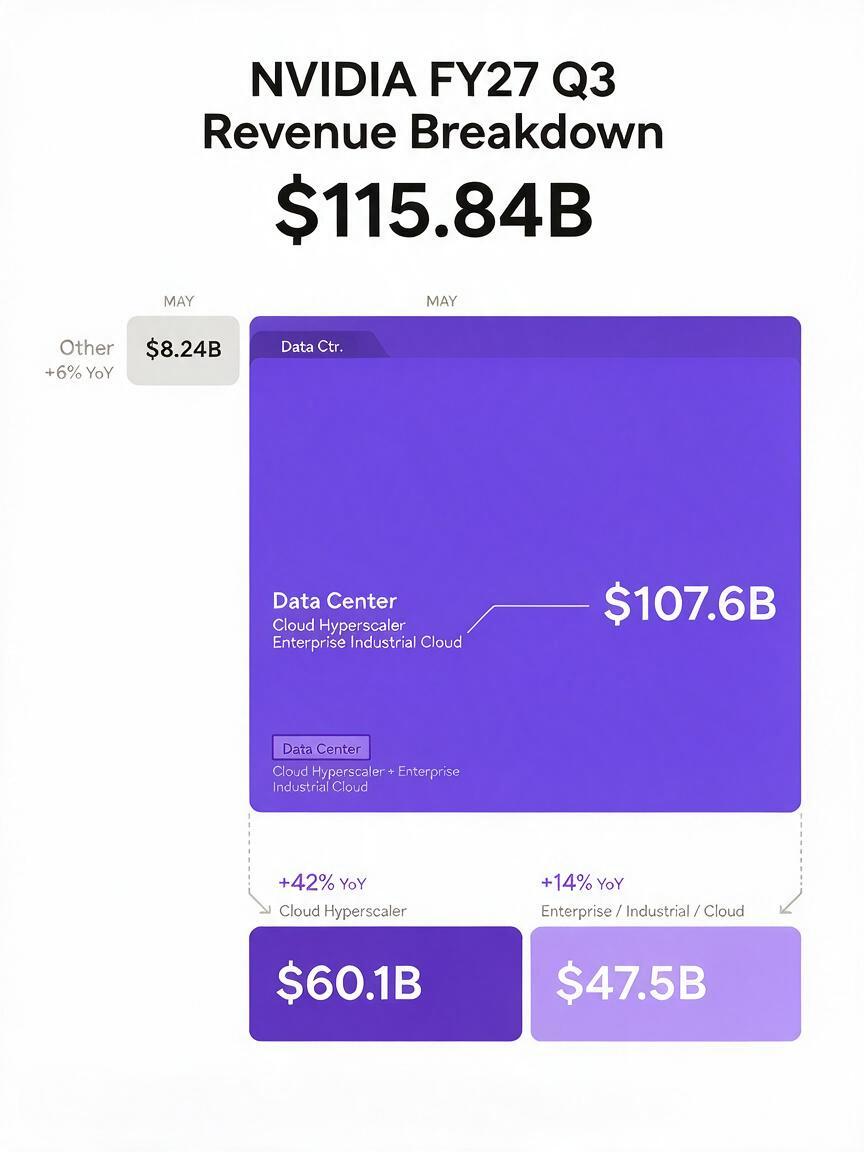
Total revenue came in at $115.84 billion, up 103% year over year and well above the consensus estimate of roughly $109.1 billion. GAAP net income hit $65.3 billion, a 105% year-over-year increase.
Data center revenue was the standout, reaching $107.6 billion — up 110% year over year, crossing the $100 billion mark for the first time, and making up roughly 93% of Nvidia's total revenue. The segment was driven by two key growth areas:
- Hyperscaler sales: $60.1 billion, up 71% year over year, as major cloud providers continue building out AI infrastructure.
- AI cloud, industrial, and enterprise sales: $47.5 billion, up 195% year over year, reflecting faster adoption among mid-market and industry-specific customers.
Forward guidance also exceeded expectations. Nvidia projects Q4 FY27 revenue of $130 billion, plus or minus 3%, compared to the $125.1 billion consensus estimate. The company also raised its FY28 growth target from 70% to 75%, and said future supply commitments have jumped to $390 billion from $279 billion previously — a sign it is locking in long-term chip production to meet sustained demand.
Leadership and Stock Update
This earnings report is the first since Jensen Huang stepped down as Nvidia CEO, a move that has been the subject of widespread speculation and public debate. Board chair Harvey Jones addressed the leadership question directly in the earnings call, stating the board is not considering reinstating Huang, and confirming he left the company over personal conduct that violated Nvidia policy.
Stock movement was mixed in reaction to the news. Shares closed down 0.44% at $155.46 during regular trading on Nov 17, but jumped more than 4% in after-hours trading as investors focused on the strong revenue and guidance numbers rather than leadership uncertainty.
The results come amid a turbulent period for Nvidia, which has seen its market cap shed roughly $1.84 trillion over six weeks since Oct 6, 2026, amid reports of Huang's departure and broader tech sector volatility.
What This Means for AI Video and Image Creators
While Nvidia's earnings may seem like a distant corporate story, they have direct, tangible impacts on the AI tools creators use every day. Nvidia GPUs are the foundational hardware behind nearly all AI model training and inference, including the image to video and text-to-image platforms that power modern creative workflows.
Here are the key takeaways for creators:
- More GPU supply = more model availability: The $390 billion in future supply commitments signals that Nvidia is ramping up production to meet AI chip demand. Over time, this could translate to more reliable access to high-performance AI video models, fewer wait times, and lower generation costs as inference capacity expands.
- Enterprise AI growth fuels creative tool development: The 195% growth in enterprise and industrial AI sales means more companies are investing in AI infrastructure, which often spills over into consumer and creator-facing tools. As more businesses adopt AI, vendors will continue expanding creative features to capture that market.
- Leadership uncertainty adds long-term risk: While current results are strong, the leadership transition creates some uncertainty around Nvidia's long-term roadmap. For creators, this reinforces the value of using a multi-model platform that aggregates tools from multiple providers, so you're not dependent on any single hardware or software vendor's decisions.
Platforms like MagicBoat give creators access to a range of AI generation tools from a single account, making it easy to switch between models or try new ones as the market evolves. You can try these models for free to build a workflow that fits your needs, no matter how the hardware landscape shifts.

Key Takeaways
- Nvidia's FY27 Q3 revenue hit $115.84B, up 103% YoY and beating consensus estimates by nearly $7B.
- Data center revenue crossed $100B for the first time, making up 93% of total revenue, with enterprise AI sales growing nearly 200% YoY.
- Forward Q4 guidance of $130B +/-3% and a raised FY28 growth target of 70-75% signal sustained AI chip demand.
- The board confirmed it will not reinstate Jensen Huang as CEO, citing personal conduct policy violations.
- For creators, expanding GPU supply supports more available and affordable AI video and image tools, while multi-model platforms offer stability amid market shifts.
Keywords
nvidia fy27 q3 earnings, nvidia data center revenue, jensen huang nvidia, ai chip demand, ai video generator, image to video, nvidia q4 guidance