October 23 Theatrical Lineup: Possible Love, Wildwood and Clayface
The October 23 theatrical lineup spans Lee Chang-dong’s Possible Love, Léa Seydoux’s Gentle Monster, Peter Berg’s The Mosquito Bowl, LAIKA’s Wildwood, DC horror film Clayface, Taika Waititi’s Klara and the Sun, and Helen Mirren’s A Talent for Murder. The unusually broad slate offers a timely case study in how genre, format, talent and visual identity help films stand apart in a crowded market.
Table of contents
Seven Distinct Films Enter the October 23 Theatrical Lineup
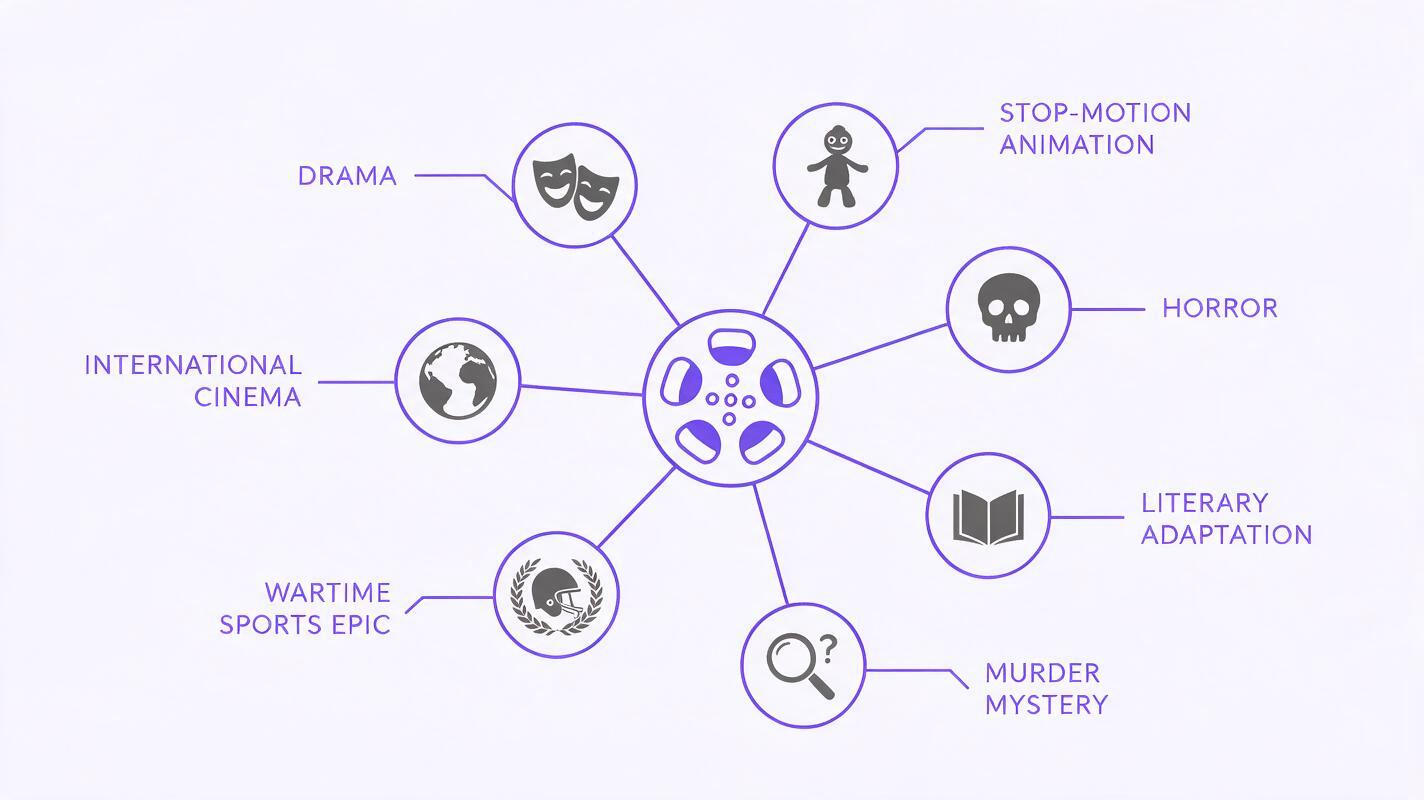
The October 23 theatrical lineup brings together seven notably different films, ranging from international drama and stop-motion animation to wartime spectacle, horror and murder mystery. Lee Chang-dong’s Possible Love, identified as a Netflix release and described by critics as one of the year’s best films, is part of the slate alongside Gentle Monster, featuring Léa Seydoux.
The same date also includes Peter Berg’s World War II football epic The Mosquito Bowl and LAIKA’s stop-motion production Wildwood. DC enters the mix with Clayface, a horror film directed by James Watkins, while Sony offers Klara and the Sun, directed by Taika Waititi and starring Jenna Ortega. Helen Mirren leads another release, A Talent for Murder.
Taken together, the lineup is less a single genre event than a snapshot of how varied theatrical programming can be. Established filmmakers, recognizable performers, literary-style concepts, franchise-connected horror and handcrafted animation are all competing for attention on the same date.
For people working in AI content creation, the slate highlights an essential creative reality: production scale matters less at the concept stage than having a clear identity. An original ai film or ai short drama needs an immediately readable promise before its visuals, cast or technology can make a lasting impression.
A Release Date Defined by Contrast
The most striking feature of the October 23 lineup is its range. Possible Love arrives with critical enthusiasm and the profile of filmmaker Lee Chang-dong. Gentle Monster brings Léa Seydoux into the day’s international film conversation. Neither title needs to occupy the same creative lane as the larger-scale productions around it.
At the other end of the spectrum, The Mosquito Bowl combines two powerful genre signals: World War II and football. Calling it an epic establishes expectations of scale, conflict and historical weight before audiences know anything more about its narrative.
Wildwood offers a different kind of spectacle through LAIKA’s stop-motion format. Its production identity is inseparable from the physical craft associated with that form. Meanwhile, Clayface joins a known DC subject with director James Watkins and an explicit horror direction, distinguishing it from a conventional superhero release.
A crowded release calendar does not erase individual identity. It makes a precise creative promise more important.
Possible Love and the Value of Critical Positioning
Possible Love carries two especially strong pieces of positioning in this lineup: it is associated with Netflix, and critics have called it one of the best films of the year. Those signals give the film a defined place in the conversation even before broader audiences encounter it.
That positioning demonstrates why context matters. A title is not promoted only through plot. Filmmaker reputation, critical reception, distribution and the language used to describe a release can all shape expectations. For an independent project, the equivalent may be a sharp genre description, a recognizable visual motif or a concise statement of emotional intent.
The lesson is not to imitate Lee Chang-dong’s work or the film’s marketing. It is to recognize that audiences need a reason to understand where a project belongs. A dramatic short should communicate its emotional stakes; an experimental production should make its distinctive form visible; and a serialized concept should signal what will sustain it beyond its opening scene.
Wildwood, Clayface and the Power of Format
Wildwood and Clayface show how form and genre can become headline-level information. LAIKA’s stop-motion approach makes the production method part of Wildwood’s identity. Clayface, by contrast, is framed through DC, horror and James Watkins. Each film can be summarized through a compact combination of subject, format and tone.
This is useful for AI filmmakers because tools do not automatically supply identity. A project made with text to video still needs consistent choices about atmosphere, framing, character presentation and dramatic rhythm. The technology can support production, but the concept must determine what every generated shot is trying to communicate.
A visual development process can begin with an ai storyboard that tests whether the intended genre is understandable without lengthy explanation. Horror may depend on spatial tension and concealed information, while animation may depend on a coherent world and recognizable design language. The objective is not to reproduce either October 23 release, but to examine how clearly format can reinforce an original premise.
| Release | Primary identity signal | Creative takeaway |
|---|---|---|
| Possible Love | Lee Chang-dong, Netflix and strong critical response | Context can sharpen audience expectations |
| Gentle Monster | Léa Seydoux | Recognizable talent can anchor initial interest |
| The Mosquito Bowl | World War II football epic | A concise genre combination creates a clear promise |
| Wildwood | LAIKA stop-motion | Production form can be central to identity |
| Clayface | DC horror directed by James Watkins | Genre reframing can distinguish familiar subject matter |
| Klara and the Sun | Taika Waititi and Jenna Ortega | Director and performer associations shape attention |
| A Talent for Murder | Helen Mirren and a murder-mystery premise | A star and an immediately legible genre can work together |
Klara and the Sun and Talent-Led Discovery
Sony’s Klara and the Sun has two prominent names attached: director Taika Waititi and actor Jenna Ortega. Within a seven-film lineup, those names provide fast recognition. A Talent for Murder similarly gains an immediate focal point from Helen Mirren.
Independent productions may not have comparable star power, but they can still build a recognizable center. That center could be a recurring character, a memorable setting, a narrator’s point of view or a strongly defined visual world. In an ai video, continuity of identity can matter as much as visual polish because it gives viewers something stable to follow.
This is particularly important for an ai short drama. Short-form storytelling has limited time to establish who matters, what the conflict is and why another episode should follow. A consistent protagonist and a clear dramatic engine can perform some of the discovery work that famous names provide for major releases.
What the Lineup Suggests for Original AI Film Projects
The October 23 slate does not point to a single winning genre. Instead, it shows several ways a film can become legible in a crowded environment. The Mosquito Bowl has a high-concept genre combination. Wildwood has a distinctive production form. Clayface has franchise recognition redirected toward horror. Possible Love has a filmmaker-led and critically supported identity.
For original AI projects, that means the concept should remain visible throughout development. If the core appeal is an unusual setting, the visuals should repeatedly reinforce that setting. If the project is character-led, the design and point of view should remain coherent. If the hook is a genre collision, both sides of that combination need to appear in the imagery and dramatic structure.
MagicBoat brings multiple creation capabilities into one platform, allowing filmmakers to explore a premise across scripting, storyboarding and video generation without losing sight of the central idea. Rather than treating AI as the subject of every production, creators can use it as a practical medium for developing original worlds, characters and scenes.
Why Clear Positioning Matters More Than Volume
Seven films arriving together create competition, but they also serve different audiences. A stop-motion production does not make a murder mystery redundant, just as a critically praised drama does not erase the appeal of a wartime sports epic. Differentiation gives each title room to make its own case.
The same principle applies to online video. Producing more clips does not necessarily create a stronger project. A smaller collection of scenes with consistent tone and recognizable narrative purpose can establish a clearer identity than a large volume of disconnected material.
The October 23 lineup therefore offers a useful editorial benchmark: every release can be described with a distinct combination of names, genre, format or reputation. Before producing an ai film, creators can ask whether their own concept has an equally concise and original identity.
Key Takeaways
- The October 23 theatrical lineup contains seven releases spanning drama, stop-motion animation, horror, war, sport and murder mystery.
- Possible Love enters with Netflix distribution and strong critical praise.
- Wildwood makes LAIKA’s stop-motion format part of its core identity.
- Clayface combines a DC subject with horror under director James Watkins.
- Klara and the Sun is directed by Taika Waititi and stars Jenna Ortega, while Helen Mirren leads A Talent for Murder.
- Original AI productions benefit from a clear creative promise that remains visible across scripts, storyboards and generated scenes.
Ready to shape a distinctive original project? try these models for free and explore how one idea can develop into a coherent visual story.
Keywords
October 23 theatrical lineup, Possible Love, Wildwood, Clayface, Klara and the Sun, ai film, ai content creation