OpenAI and Abu Dhabi Launch Machine-Readable Government Program
On November 9, 2026, OpenAI and Abu Dhabi launched a Machine-Readable Government program that converts laws, policies, and regulations into AI-processable structured formats, with a first pilot focused on food import compliance. The initiative marks OpenAI's first Middle East in-country inference residency, with all compute running on local UAE GPUs and government data retained exclusively for official use. The program highlights the growing integration of frontier AI into public administration, with ripple effects for creative teams building AI-powered content workflows for regulated industries and public sector clients.

Table of contents
What Is the Machine-Readable Government Program?
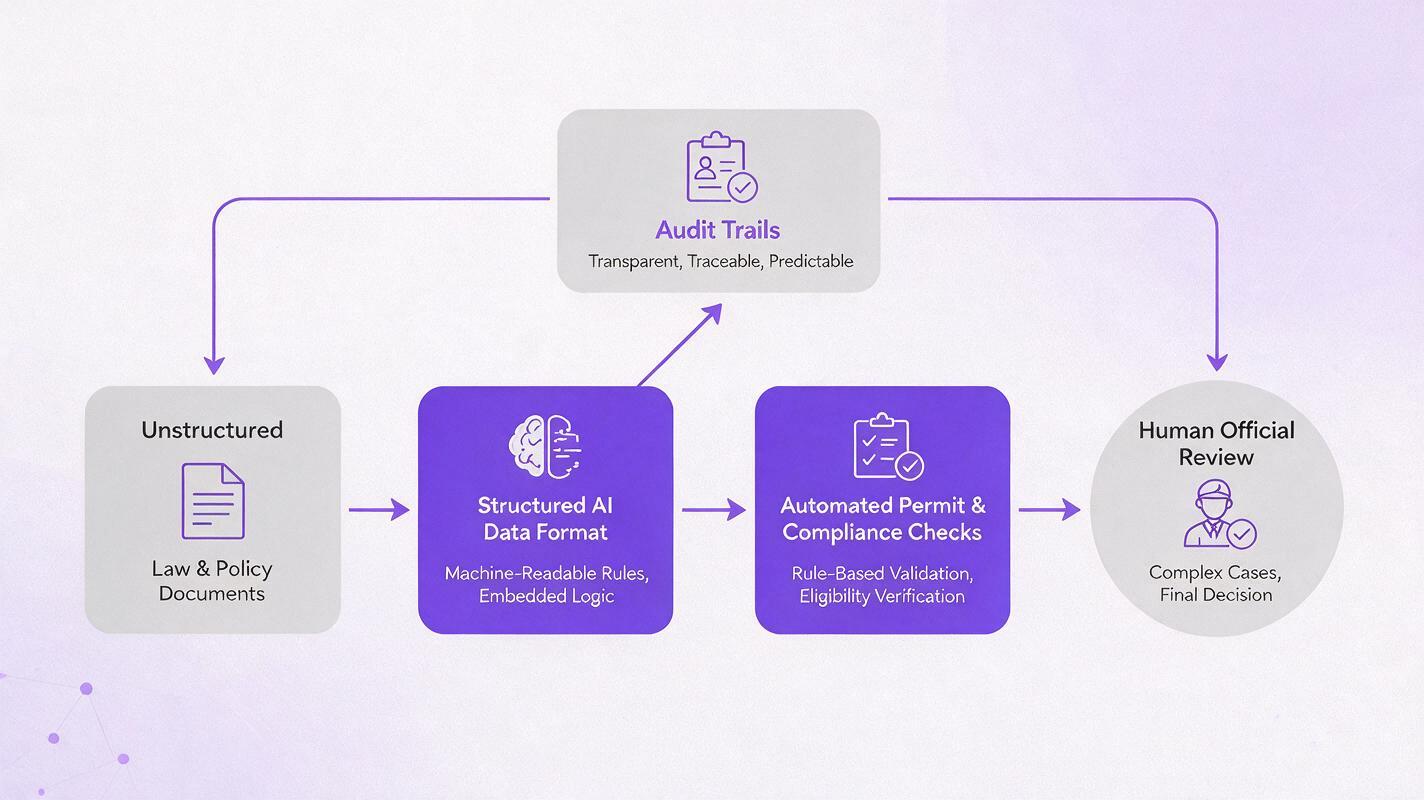
On November 9, 2026, OpenAI and Abu Dhabi announced the launch of a joint Machine-Readable Government program designed to integrate frontier AI into public administration workflows. The initiative converts existing laws, policies, and regulations from unstructured text into structured, AI-processable formats that can power automated routine services.
Under the program, routine permit applications and compliance checks run automatically, with every AI-generated decision linked directly back to a specific clause in the source regulation for full auditability. Human officials retain final decision-making authority for all complex or high-stakes cases, ensuring accountability remains with public sector leadership.
The system operates on a fail-closed basis, meaning if an AI process encounters ambiguity or a safety trigger, it defaults to halting and escalating to a human reviewer rather than making an unvalidated decision.
First Pilot and Expansion Roadmap
The first production pilot of the Machine-Readable Government program is focused on food import oversight at the Abu Dhabi Agriculture and Food Safety Authority. The pilot was built by G42’s Inception42 division as a Policy Adoption Engine tailored to the emirate’s food safety regulations.
Abu Dhabi’s long-term goal is to become the world’s first AI-native government by 2027, with the program expanding to cover a wide range of public services in the coming months. Planned expansion areas include construction permitting, business licensing, data governance oversight, and public procurement processes.
All efficiency claims associated with the program are joint figures from OpenAI and Abu Dhabi government entities, with no independent third-party audit of performance results available at launch.

OpenAI’s First Middle East Inference Residency
A key milestone of the partnership is the establishment of OpenAI’s first Middle East in-country inference residency. All AI inference for the program runs on GPU hardware located physically within the UAE, ensuring data never leaves the emirate’s borders.
All government data used in the program is the exclusive property of the Abu Dhabi government and is not used to train or refine OpenAI’s commercial models, addressing core data sovereignty concerns for public sector AI deployments. This local residency model follows a broader trend of AI providers expanding regional compute footprints to comply with global data protection regulations.

What This Means for AI Video and Image Creators
While the Machine-Readable Government program is focused on public administration, it has ripple effects for AI video and image creators, especially those working with public sector or regulated industry clients.
For creators producing explainer videos, public outreach materials, or training content for government agencies or regulated sectors like food and beverage, construction, or healthcare, machine-readable policy frameworks create a reliable source of structured, auditable regulatory data. This makes it easier to generate accurate, compliant content that aligns with official rules, reducing the risk of factual errors in public-facing materials.
Regional inference residencies also translate to more reliable, lower-latency access to AI models for creators based in the Middle East and North Africa, who may have previously faced slower response times or access restrictions with models hosted exclusively in the US or EU. As more providers expand regional compute footprints, creators in emerging markets will gain more consistent access to the same AI tools used by global teams.
For creators building client-facing content workflows, the rise of AI-native government services signals growing demand for content that integrates with structured policy data. A multi-model platform like MagicBoat gives creators access to text to video tools, an ai image generator, and other creative AI capabilities in a single unified account, making it easier to adapt to shifting regional model availability and build compliance-ready content pipelines. You can try these models for free to explore how multi-model AI can support your creative workflow.
Key Takeaways
- OpenAI and Abu Dhabi launched the Machine-Readable Government program on November 9, 2026, to convert public laws and policies into structured, AI-processable formats.
- The first production pilot focuses on food import compliance, with plans to expand to construction permits, licensing, and procurement as part of the emirate’s 2027 AI-native government goal.
- The initiative marks OpenAI’s first Middle East in-country inference residency, with all government data retained locally and not used for model training.
- For AI creators, the program signals growing demand for policy-aligned content tools and more reliable regional AI access for MENA-based creative teams.
Keywords
openai, abu dhabi ai, machine-readable government, ai policy compliance, ai inference residency, public sector ai, ai government services