OpenAI and Anthropic Ran “The Day After” AI Disaster Exercises
OpenAI and Anthropic reportedly ran private exercises about a major AI disaster. The limited account offers no details about the scenarios or outcomes, but highlights the value of continuity planning for AI image and video work.
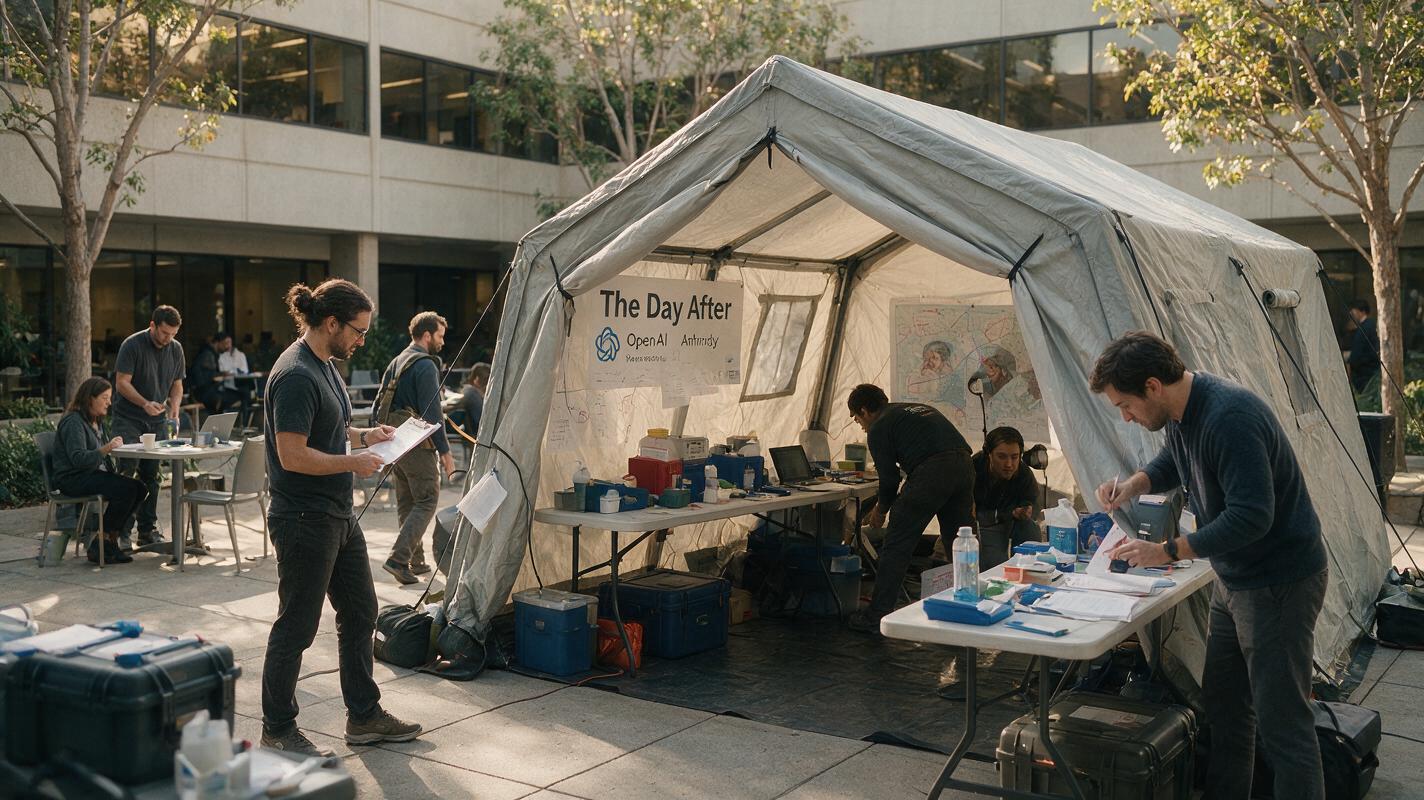
Table of contents
AI safety news · October 11, 2026
OpenAI and Anthropic Ran “The Day After” AI Disaster ExercisesOpenAI and Anthropic privately ran extreme-scenario exercises called “The Day After,” focused on the possibility of a major AI disaster.
The exercises appeared in an October 11 report described as coming from Axios via Sina Finance. The reported participants were two of the best-known AI model developers, and the subject was not an ordinary product launch or benchmark: it was how to think about an extreme failure scenario. The available account does not specify when the exercises took place, what scenario was simulated, what decisions participants made, or whether any resulting policy changed.
That distinction matters. “The Day After” refers to a preparedness exercise, not a report that an AI disaster occurred. Still, the fact that OpenAI and Anthropic privately examined such a scenario puts model reliability and response planning into sharper focus. For people making images and video with AI, those questions become practical when a model, service, or workflow is suddenly unavailable.
What “The Day After” Does—and Does Not—Tell Us
The reported exercises show that both companies considered an extreme-scenario discussion worth holding. Beyond that, the available details are narrow. There is no stated finding about the safety of a particular model, no disclosed incident timeline, and no basis for claiming that either company expects a specific disaster.
It would also be a mistake to read the exercises as a comparison between OpenAI and Anthropic. The news concerns their reported participation in preparedness discussions, not a test of which company’s models are safer or more capable. For anyone selecting an AI model for production, the useful takeaway is less dramatic: capability is only one selection factor. Availability, predictable behavior, and the ability to continue work when circumstances change matter too.
Why Preparedness Matters to AI Image and Video Work
A creative project can depend on more than its final rendered files. It may also depend on prompts, reference images, draft scripts, shot descriptions, and a record of what was approved. If access to a favored model changes, those materials determine whether a team can adapt without reconstructing its decisions from memory.
That is relevant to text to video work, where a useful scene description can be retained and revised even if the production tool changes. It applies equally to image to video projects: keeping the source image and the intended motion separate from any single rendered result makes it easier to assess alternatives.
A preparedness exercise is not evidence that a particular creative tool will fail. It is a reminder to make creative work portable before reliability becomes urgent.
Model Choice Should Include a Continuity Plan
Creators often choose an AI tool by judging the output in front of them. That is sensible, but a dependable production setup also preserves the inputs behind that output. A concise brief, approved visual references, and saved versions of key prompts can help a team compare results or resume work elsewhere without changing the story it intended to tell.
MagicBoat offers a place to explore AI creation options within one account. That flexibility is valuable when a project calls for a different visual approach or when a team wants to avoid tying every draft to one workflow. It does not remove the need to review outputs or keep copies of important project materials; it makes alternatives easier to consider while the creative brief stays intact.
The Bottom Line
“The Day After” is news about preparedness, not a disclosed AI catastrophe. The reported OpenAI and Anthropic exercises leave important details unknown, so sweeping conclusions about individual models would go beyond the available account. The grounded lesson for AI image and video teams is to value continuity alongside output quality: preserve the brief, retain source materials, and leave room to change tools when needed.
Keep your next project flexible. Explore visual creation options on MagicBoat and try these models for free.