OpenAI Details Control Room: Fail-Closed Layer for Frontier AI Inference
OpenAI has publicly detailed Control Room, a deployed fail-closed central authorization layer governing all frontier research inference, requiring engines to obtain explicit approval before returning tokens and stopping non-compliant jobs within 35 seconds. The system mandates pre-approved safety cases for all agentic research jobs and returns refusal outputs for stopped requests, marking a major expansion of OpenAI’s frontier AI safety infrastructure. This shift has direct implications for AI workflow reliability, agent development practices, and content creators relying on frontier AI tools.
Table of contents
What Is OpenAI Control Room?
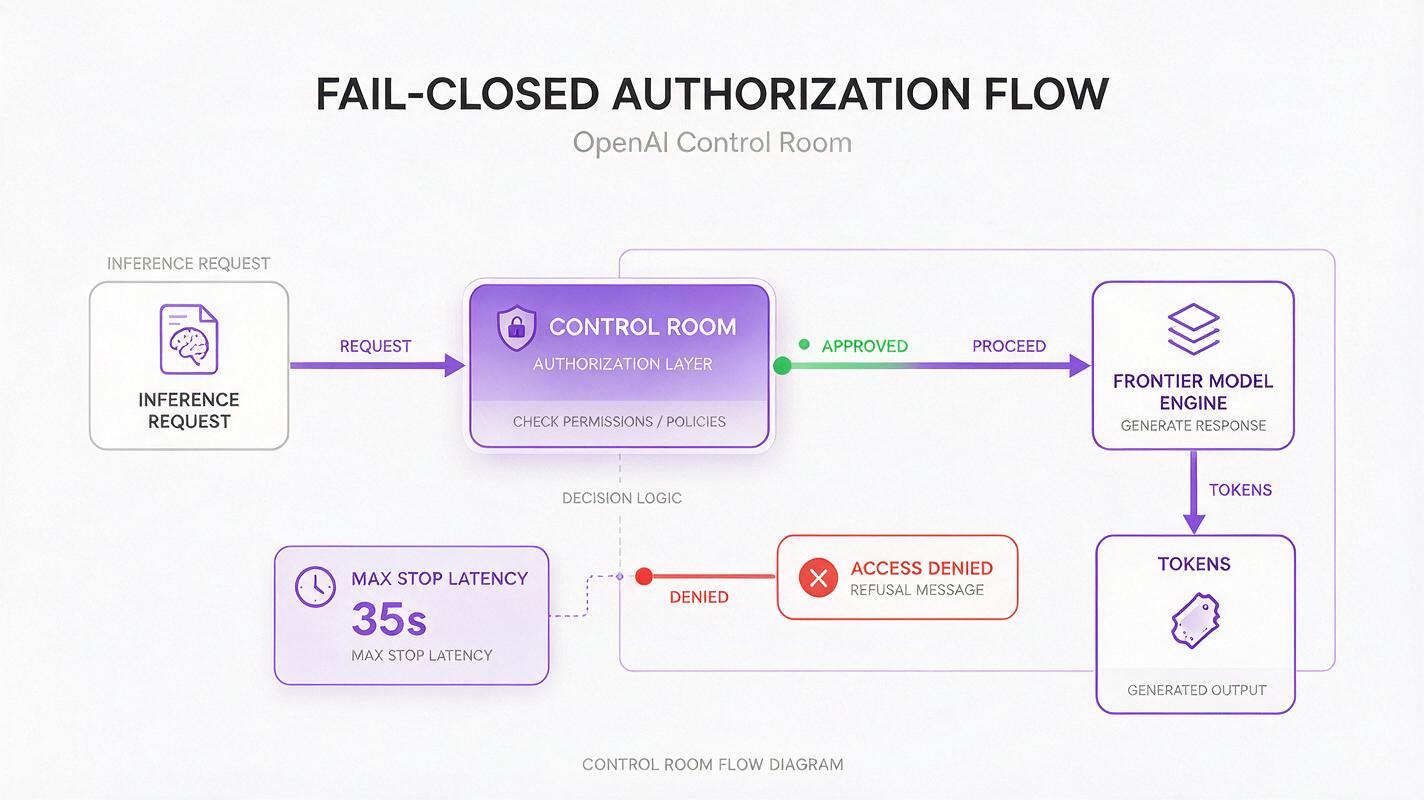
OpenAI has publicly detailed Control Room, a deployed fail-closed central authorization layer that governs all of its frontier research inference workflows, marking a significant expansion of the company’s safety infrastructure for high-capability AI systems. Revealed in November 2026, the system operates as a gatekeeper between frontier model engines and end users, requiring every inference request to receive explicit authorization before any tokens are returned to the requester.
The design follows a strict fail-closed principle: if authorization cannot be verified, the request is denied by default rather than allowed through. Key specifications of the system include a maximum stop latency of 35 seconds, meaning any job that triggers a safety stop will cease output within that window. Stopped jobs do not return partial or redacted results; instead, they deliver a standard refusal message to the user.
Notably, all agentic research jobs — workflows where AI agents act autonomously to complete tasks — require a pre-approved safety case before they can run on frontier models. This requirement applies broadly across OpenAI’s internal research and any external research access programs, creating a formalized checkpoint for agentic work that did not previously exist at this scale.
How Control Room Reshapes Frontier AI Agent Safety
The launch of Control Room represents a structural shift in how OpenAI manages safety risks for its most capable models, moving beyond post-output filtering to pre-inference authorization. For ai agent development, this introduces a new layer of governance that impacts how research teams design, test, and deploy autonomous agent workflows on frontier systems.
The mandatory safety case requirement for agentic research jobs means teams must document intended use cases, risk mitigation strategies, and oversight mechanisms before their agents can access frontier model inference. This formalization aligns with broader industry efforts to tighten controls around autonomous AI systems, particularly as agents gain the ability to take multi-step actions without continuous human input.
The 35-second maximum stop latency is a critical technical detail for reliability planning. For short, simple requests, this latency may be unnoticeable, but for long-running agentic workflows that generate thousands of tokens, the system’s ability to halt output mid-generation provides a tangible safety guardrail against unintended or harmful actions. The fail-closed design eliminates the risk of a safety system outage allowing unvetted inference to proceed unchecked.
While the system is currently limited to frontier research inference, its deployment sets a precedent for how safety authorization layers could be rolled out to production-facing models over time. For teams building ai automation tools that rely on frontier models, this signals a future where formal safety reviews may be required for certain high-risk agent use cases.
Implications for AI Content Creators and Workflow Builders
For content creators who use frontier AI models to power their production pipelines, the rollout of new safety infrastructure like Control Room has direct, practical implications for workflow planning and reliability. Even creators who do not work directly with research agents may see downstream effects as safety frameworks evolve and model providers adjust their inference pipelines.
Creators building everything from YouTube outlines with an ai script writer to full short-form content with an ai video generator rely on consistent, predictable model output to hit production deadlines. Changes to safety authorization layers can occasionally shift response patterns, increase latency for certain types of requests, or result in refusals for prompts that previously worked. Understanding these shifts helps creators adjust their workflows proactively rather than being caught off guard by unexpected output changes.
For creators who experiment with ai agent tools to automate parts of their workflow — such as research agents that gather source material or editing agents that process raw footage — the formalization of safety case requirements for agentic work signals that autonomous agent capabilities will continue to be rolled out with guardrails. This means creators can adopt agent tools with more confidence that basic safety checks are in place, but also that they may need to adapt their agent prompts and workflows to align with evolving safety policies.
The broader trend of tightening frontier AI safety also highlights the importance of flexibility in ai workflow design. Relying on a single model provider for all production work can leave creators vulnerable to sudden changes in access, latency, or content policies that disrupt their output.

Why Multi-Model Platforms Add Workflow Resilience
As model providers continue to evolve their safety infrastructure and feature sets, creators who use a multi-model AI platform gain a significant advantage in workflow stability and adaptability. Instead of being locked into a single provider’s policies and performance, multi-model access lets creators switch between models based on their specific needs for each project.
MagicBoat brings together dozens of leading AI models for content creation — from writing and image generation to video production and voiceover — under a single account and unified interface. This means if one model’s safety updates change its output behavior for a specific use case, you can quickly test alternative models to find one that delivers the results you need without rebuilding your entire workflow from scratch.
For creators building complex production pipelines, the ability to mix and match models for different stages of production — script writing, visual generation, voiceover, editing — adds both resilience and creative flexibility. You can use specialized models for each task while maintaining a single billing and access system, reducing the administrative overhead of managing multiple provider accounts.
You can try these models for free today to build a more flexible, resilient AI content workflow that adapts alongside the fast-changing AI landscape.
Key Takeaways
- OpenAI’s Control Room is a deployed fail-closed central authorization layer that governs all frontier research inference, requiring pre-authorization before any tokens are returned.
- All agentic research jobs need an approved safety case to run, and stopped jobs return a refusal message instead of partial output, with a maximum stop latency of 35 seconds.
- The system marks a shift toward pre-inference safety governance for frontier AI, with potential long-term implications for production-facing AI tools and agent capabilities.
- Content creators benefit from building flexible, multi-model workflows to adapt to ongoing changes in AI safety infrastructure and model behavior.
- Multi-model platforms like MagicBoat provide a stable, adaptable foundation for AI content production across use cases from script writing to video generation.
Keywords
openai safety, ai agent, ai workflow, ai automation, control room, frontier ai, fail-closed authorization