OpenAI and Abu Dhabi Launch Machine-Readable Government
Abu Dhabi and OpenAI have launched Machine-Readable Government, an initiative that converts regulations into machine-processable rules while linking every automated decision to its underlying clause. A pilot at the food-import authority uses G42’s Inception42 Policy Adoption Engine, in-country UAE inference and government-owned data.

Table of contents
Abu Dhabi and OpenAI Turn Regulations Into Machine-Processable Rules
Abu Dhabi and OpenAI have launched Machine-Readable Government, an initiative designed to convert regulations into rules that computer systems can process while preserving a direct link between automated decisions and the clauses supporting them.
Announced on November 10, the program is being piloted at Abu Dhabi’s food-import authority. The pilot uses G42’s Inception42 Policy Adoption Engine, with inference conducted inside the UAE and data remaining government-owned. Its defining requirement is traceability: every automated decision must link back to a specific regulatory clause.
This is more than a conventional digitization project. A scanned regulation or searchable PDF still asks a person or AI assistant to interpret prose. Machine-Readable Government instead seeks to express policy in a form that can participate directly in an automated process, without separating the result from its legal basis.
For creators and production teams, the announcement highlights a broader shift in AI automation. Reliable output increasingly depends not only on what a model produces, but also on whether an AI workflow can show which approved rule, brief or source informed that output.
What Machine-Readable Government Changes
The initiative introduces three closely connected ideas: machine-processable regulations, clause-level traceability and controlled infrastructure. Together, they create a framework in which an AI agent can operate against formalized policy while retaining a visible connection to the original authority.
| Program element | Confirmed implementation | Why it matters |
|---|---|---|
| Regulatory format | Regulations converted into machine-processable rules | Policy can be used directly within automated decision processes |
| Decision traceability | Every automated decision links back to a clause | Results can be reviewed against their stated regulatory basis |
| Pilot setting | Abu Dhabi food-import authority | The concept is being applied to a defined government function |
| Technology | G42’s Inception42 Policy Adoption Engine | The engine supports the policy-conversion and adoption framework |
| Infrastructure | In-country UAE inference | Processing is kept within the stated national environment |
| Data control | Government-owned data | Ownership remains with the public authority |
The clause-linking requirement is especially important. An automated answer can sound confident while obscuring the basis for its conclusion. By connecting each decision to an underlying provision, the Abu Dhabi initiative makes provenance part of the result rather than an optional note added afterward.
Machine-readable policy does not remove the need for accountability. It makes the relationship between a decision and its governing rule more explicit.
Why the Food-Import Pilot Is Significant
The first pilot places Machine-Readable Government at the food-import authority. This gives the initiative a concrete administrative setting in which regulations, data and automated decisions can be connected through the Inception42 Policy Adoption Engine.
The announced architecture also places clear boundaries around the deployment. Inference occurs inside the UAE, while the government retains ownership of its data. Those details show that the project addresses not only policy automation, but also where processing happens and who controls the information involved.
No performance benchmark, project price or broader rollout schedule was included in the announcement. The central news is therefore the operating design: convert regulations into processable rules, keep the data government-owned, run inference in-country and preserve a clause-level trail for automated decisions.

Clause-Level Traceability Is the Core Innovation
Many AI systems can summarize a document or answer questions about it. Machine-Readable Government points toward a stricter structure in which the governing text becomes part of the automated decision path. The distinction matters because summarization and authorization are not the same thing.
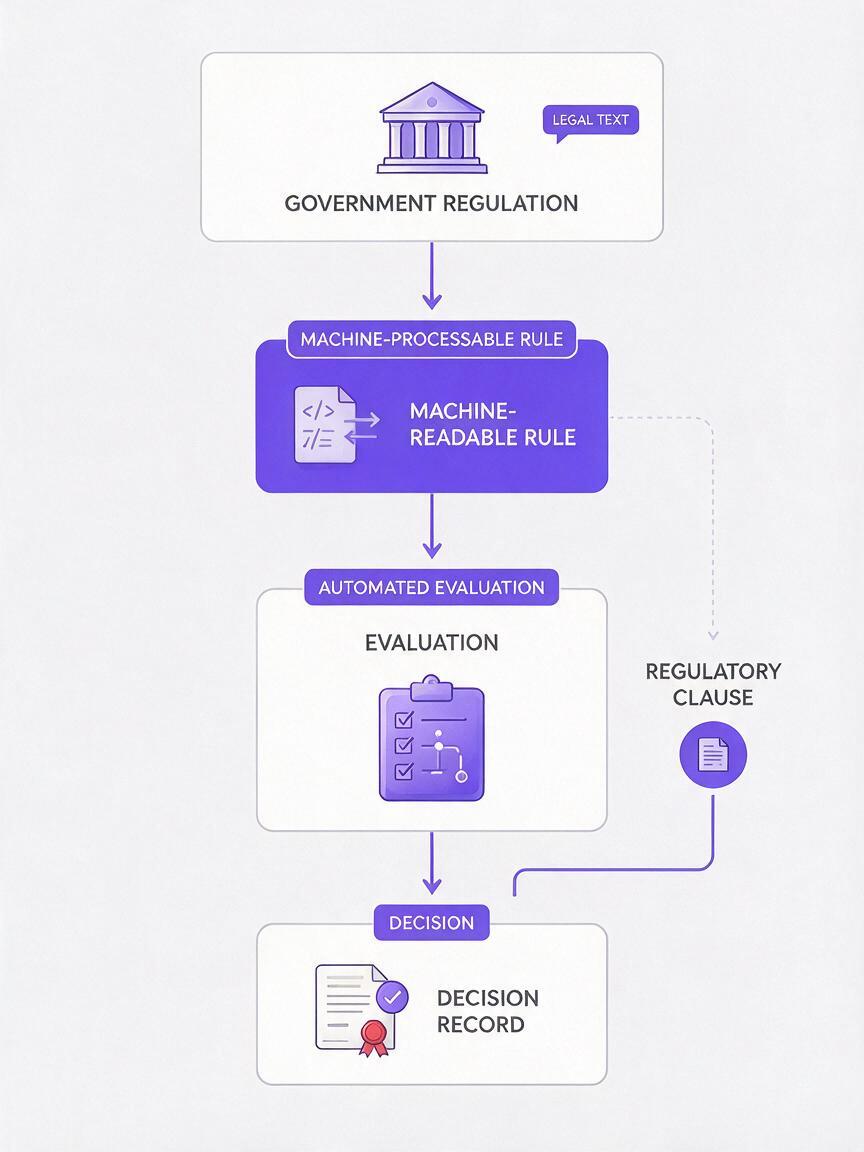
A useful way to understand the design is as a traceable chain:
Government regulation
→ machine-processable rule
→ automated evaluation
→ decision
→ linked regulatory clause
That chain gives reviewers a route back from an outcome to its policy basis. It can also make disagreements easier to identify: scrutiny can focus on the rule, the interpretation or the application rather than treating the AI output as an unexplained final answer.
For an AI assistant, this approach favors bounded operation over open-ended improvisation. For public-sector AI automation, that difference may be essential because a fluent explanation alone does not establish that a decision follows the relevant regulation.
What This Signals for AI Content Workflows
Content production is not government administration, but the underlying workflow lesson travels well. Editorial teams often work under brand rules, platform requirements, campaign briefs and approval policies. If these constraints exist only as scattered documents, an AI workflow may apply them inconsistently or lose their provenance during production.
A more accountable content pipeline keeps the source brief connected to the generated artifact. A claim should remain associated with its approved source. A visual choice should be reviewable against the campaign brief. A revision should preserve the reason it was requested rather than replacing earlier context with an unexplained change.
This principle can support planning with an ai script generator, followed by visual production through an ai video generator. The tools are different from a government policy engine, but the production discipline is comparable: define the controlling material, keep it visible and review outputs before publication.
Provenance Belongs Inside the AI Workflow
Creators frequently focus on the final image, script or video. The Abu Dhabi initiative suggests that the supporting chain deserves equal attention. When source material, prompts, approvals and outputs remain connected, teams can revise content without losing the rationale behind it.
This also reduces dependence on a single opaque result. A multi-model environment can help teams compare outputs while retaining the same approved brief. MagicBoat brings multiple creation capabilities into one account, making it easier to move between formats without rebuilding the entire production context around disconnected services.

Machine-Readable Rules Could Reshape AI Automation
The launch presents a model of AI automation in which policy is structured for machines but remains inspectable by people. It does not frame automation as an excuse to hide decision logic. Instead, every automated decision is expected to point back to a clause.
That combination—processable rules, explicit provenance, controlled inference and defined data ownership—offers a useful reference for any organization deploying an AI agent in a sensitive workflow. The more consequential the output, the more important it becomes to know which authority governed it.
For creative teams, the immediate takeaway is practical: speed should not break the connection between an asset and its source material. Stable, reviewable workflows make it easier to adapt one idea across scripts, images and video while maintaining a consistent brief.
Key Takeaways
- Abu Dhabi and OpenAI launched Machine-Readable Government on November 10.
- The initiative converts regulations into machine-processable rules.
- Every automated decision must link back to a regulatory clause.
- The food-import authority is the program’s pilot setting.
- G42’s Inception42 Policy Adoption Engine supports the pilot.
- Inference runs inside the UAE, and the data remains government-owned.
- The design underscores the importance of provenance in both government AI and creative AI workflows.
Build a More Connected AI Workflow
Machine-Readable Government shows why trustworthy automation needs structure around the model, not just a polished output. To explore a unified environment for scripts, visuals and video production, try these models for free on MagicBoat.
Keywords
machine-readable government, OpenAI Abu Dhabi, government AI, policy automation, AI agent, AI workflow, Inception42