Other Mommy, Verity and Resident Evil Box Office Preview
The North American weekend box office preview puts horror release Other Mommy ahead of expectations, while Amazon MGM’s Verity is tracking toward roughly $14.2 million and Sony’s Resident Evil toward about $8.2 million. The early outlook highlights how positioning, audience recognition and a clearly communicated premise can shape opening-weekend momentum.

Table of contents
Three Films Enter the Weekend With Different Levels of Momentum
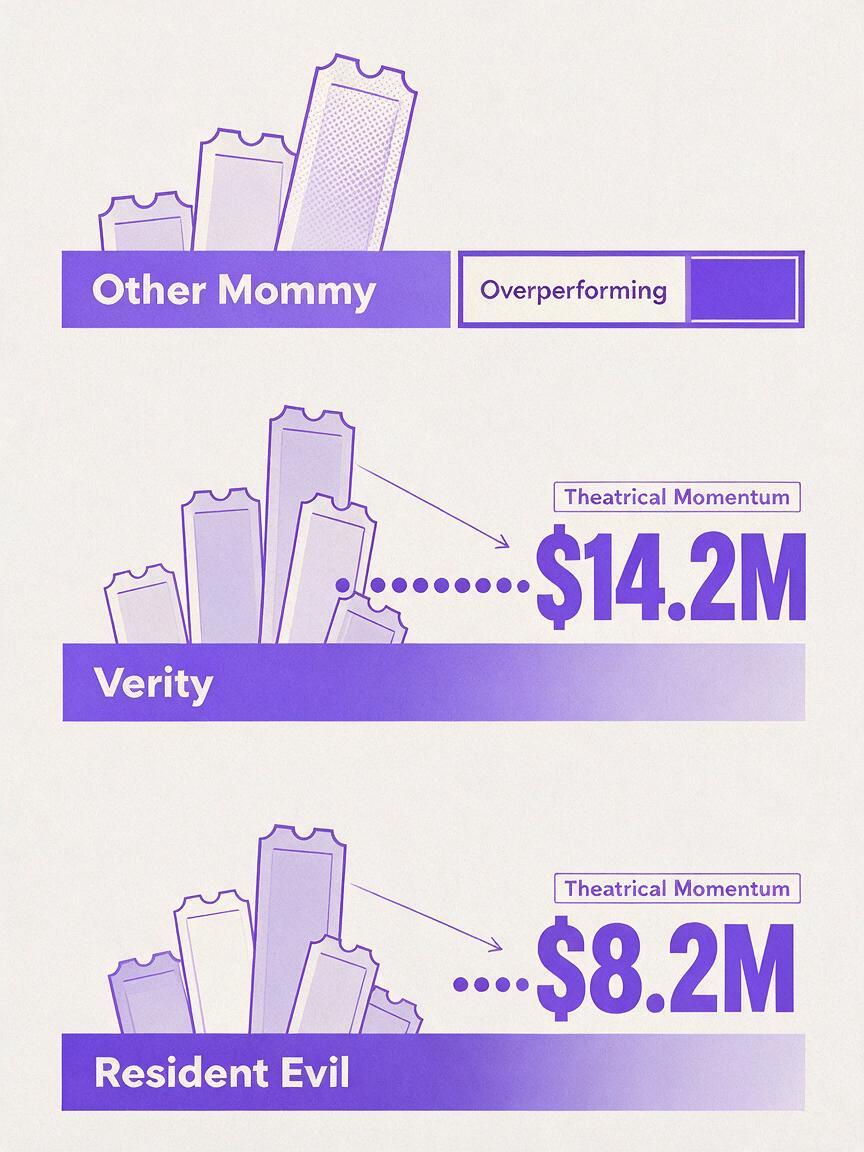
The October 16 North American weekend box office preview points to three notably different commercial positions. The horror release Other Mommy is reported to be overperforming, while Amazon MGM’s Verity is on pace for approximately $14.2 million. Sony’s Resident Evil is tracking toward roughly $8.2 million.
Those estimates make Verity the numerical leader among the two releases with published projections, with a forecast about $6 million higher than Resident Evil. Other Mommy’s significance comes from its movement relative to expectations: the preview characterizes the horror title as an overperformer even without attaching a specific projected total to it.
This is a preview rather than a final weekend report, so the numbers describe expected performance rather than completed ticket sales. Even so, the early picture already offers a useful view of how different films can enter the same theatrical marketplace with distinct forms of momentum: one title is exceeding its initial outlook, another is tracking toward a mid-teens result, and a third is positioned around the high-single-digit range.
For people developing independent entertainment, the important creative lesson is not to imitate any of these properties. It is to understand how quickly an audience needs to recognize a project’s identity, emotional promise and reason to watch.
Why Other Mommy’s Overperformance Matters
Other Mommy is the most open-ended part of the preview because the supplied report does not give it a specific dollar estimate. What it does provide is a meaningful directional signal: the horror film is performing better than anticipated.
That distinction matters. A large forecast can reflect scale, awareness or market expectations, but an overperformance story measures a title against its own commercial baseline. It suggests that the initial assumptions surrounding the release may not have fully captured its immediate audience pull.
Horror is also identified clearly in the preview, giving Other Mommy an immediate genre signal. Viewers encountering the title can quickly understand the broad emotional territory being offered. That clarity is valuable in a crowded release environment where posters, trailers and short promotional clips have limited time to establish tone.
Commercial momentum is not only about being the largest release. A film can become part of the weekend conversation by outperforming the expectations attached to it.
For original AI content creation, the transferable idea is precise positioning. A concept benefits when its title, central image and short description communicate the same dramatic promise. An ai storyboard can help filmmakers examine whether that promise remains coherent across the key images of an original project before a larger production commitment is made.

Verity Holds the Stronger Published Forecast
Amazon MGM’s Verity is projected to earn approximately $14.2 million in the North American weekend preview. Among the two titles with explicit forecasts, that gives it the stronger expected opening.
The number should remain framed as an estimate. Forecasts can change as actual attendance develops, but the $14.2 million outlook gives Verity a clear benchmark for the weekend. It also separates the film from Sony’s Resident Evil, which is projected at approximately $8.2 million.
For entertainment marketers, a forecast of this kind becomes part of the narrative surrounding a release. Before final grosses are available, tracking numbers can influence coverage, audience expectations and the way competing titles are discussed. The projected figure is therefore both a commercial estimate and an early piece of public positioning.
Independent filmmakers rarely operate with the theatrical scale of a major studio release, but they face a comparable communication challenge. A project needs a concise identity that can survive across a logline, thumbnail, teaser and social clip. If those materials imply different genres or emotional experiences, the campaign can become harder to understand.
Resident Evil Tracks Toward About $8.2 Million
Sony’s Resident Evil is projected to reach roughly $8.2 million for the weekend. That places it below Verity’s approximate $14.2 million forecast in the preview, although both figures remain provisional until the weekend’s actual results are reported.
The contrast illustrates why performance should be assessed in context rather than through a single universal threshold. The supplied preview gives different signals for each release: a relative overperformance for Other Mommy, a $14.2 million projection for Verity and an $8.2 million projection for Resident Evil. Each headline describes momentum in a different way.
| Release | Company or category stated | Preview signal |
|---|---|---|
| Other Mommy | Horror | Reported to be overperforming |
| Verity | Amazon MGM | Approximately $14.2 million |
| Resident Evil | Sony | Approximately $8.2 million |
For smaller productions, this comparison is a reminder to define success against the project’s intended audience, format and distribution plan. A compact AI film or AI short drama does not need to communicate the scale of a studio feature. It does need to make a specific promise and deliver a consistent experience to the audience it seeks.
What the Preview Reveals About Audience Positioning
The three-release outlook shows that weekend competition is not a single contest with only one meaningful story. Other Mommy attracts attention by beating expectations. Verity carries the highest stated estimate. Resident Evil enters with a lower but still clearly quantified projection. Those are three different publicity narratives emerging from one box office preview.
That pattern has practical relevance for original entertainment development. A project can be positioned around an instantly understandable genre, a strong central dramatic premise or an established audience category. What matters is that the creative materials support the chosen position instead of obscuring it.
- Genre clarity: The audience should be able to identify the intended emotional experience quickly.
- Visual continuity: Key art, teaser imagery and story scenes should feel like parts of the same project.
- A focused promise: Promotional language should emphasize the central conflict rather than summarize every plot element.
- Contextual goals: Performance should be assessed against the scale and audience originally intended for the release.
This does not mean reducing every story to a formula. It means making the distinctive qualities of an original concept legible. Unexpected ideas still require a clear path into the audience’s imagination.
Connecting Box Office Signals to AI Film Development
AI tools can be useful during the exploratory phase of a project, when filmmakers are testing tone, visual rhythm and promotional direction. With text to video, a team can experiment with original teaser concepts or mood sequences before deciding which creative direction best expresses the story.
The strongest use case is not copying Other Mommy, Verity or Resident Evil. It is developing original material while applying the broader market lesson visible in the preview: audiences respond more readily when a project presents a coherent identity.
MagicBoat brings AI creation options into one platform, making it easier to explore original story concepts, visual treatments and short-form screen ideas without shifting between disconnected creative environments. This can support early concept evaluation for an AI video, an AI short drama or a longer AI film project.
Before publishing a teaser, creators can compare whether its opening image, central conflict and closing beat all point toward the same viewing experience. A coherent package cannot guarantee commercial performance, but it can prevent an original project from losing attention through unclear positioning.

Final Checklist
- Other Mommy is the horror release identified as overperforming in the October 16 preview.
- Amazon MGM’s Verity is projected at approximately $14.2 million.
- Sony’s Resident Evil is projected at roughly $8.2 million.
- The reported figures are forecasts, not final weekend grosses.
- Each release demonstrates a different kind of market narrative: relative momentum, a stronger published estimate or a more modest projection.
- Original projects benefit from clear genre, visual consistency and an easily communicated dramatic promise.
To explore an original concept and compare creative directions in one place, try these models for free.
Keywords
weekend box office preview, Other Mommy, Verity, Resident Evil, AI content creation, AI film, text to video