Oxide Computer Raises $445M for Rack-Scale Private Cloud Servers
The Series D round, led by Eclipse with AMD participating as a strategic investor, directs another major pool of capital toward private cloud infrastructure.
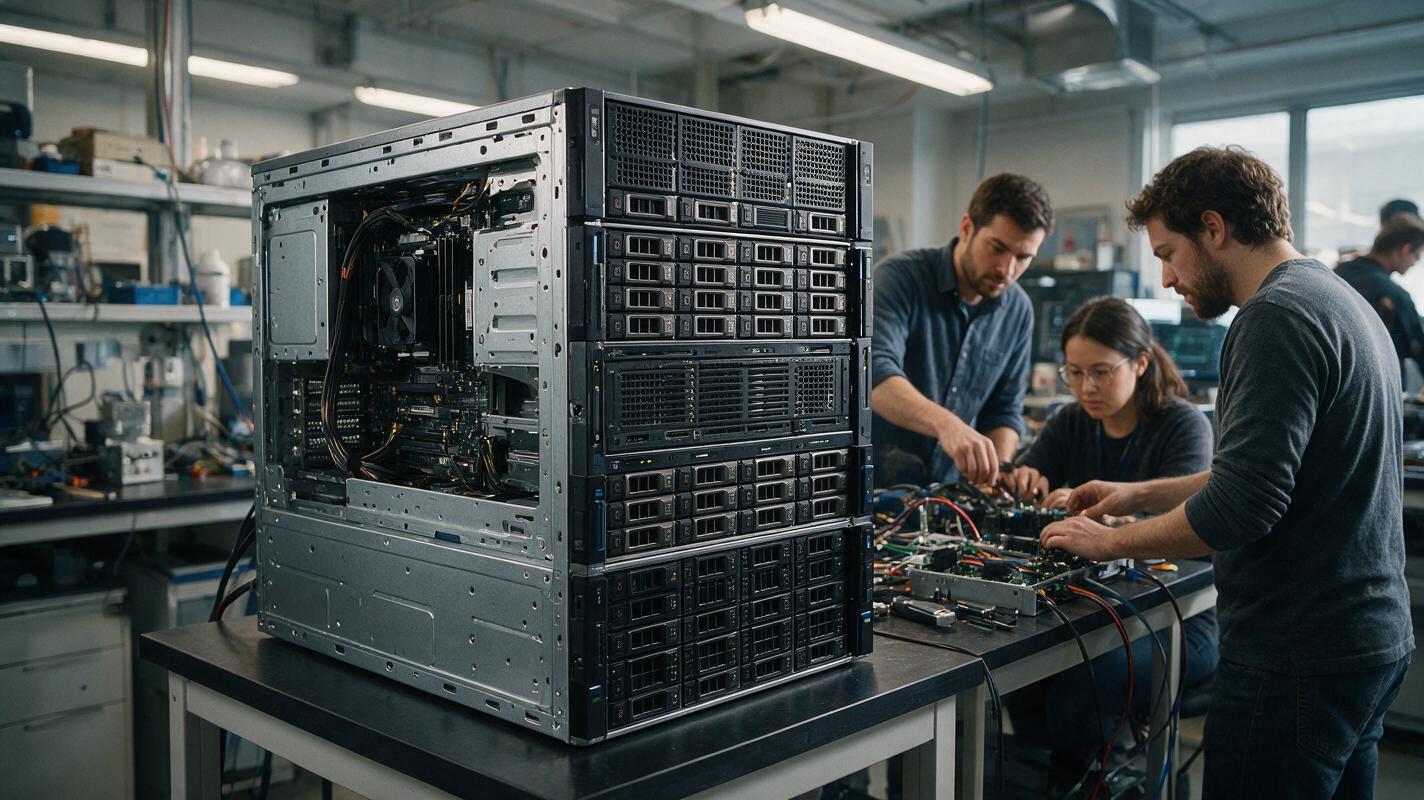
Table of contents
The Series D round, led by Eclipse with AMD participating as a strategic investor, directs another major pool of capital toward private cloud infrastructure.
AI industry news commentary · October 9, 2026
Oxide Computer announced on October 9 that it raised $445 million in Series D funding for its rack-scale private cloud server business. Eclipse led the round, while AMD participated as a strategic investor. The financing places physical computing infrastructure—not only software models—at the center of another substantial technology investment.
The specific target matters. Oxide is focused on rack-scale private cloud servers, an infrastructure category intended to bring cloud-style computing into private environments. The disclosed round does not provide a new model release, benchmark, product price, or creative application. It is fundamentally a capital event tied to the systems underneath modern computing services.
For creators and content teams, that distinction is useful. AI products may appear as simple interfaces, but their availability, responsiveness, and economics ultimately depend on servers and the capital required to deploy them. Oxide Computer’s $445 million round offers a direct view of how infrastructure remains a central part of the AI industry’s investment cycle.
What Oxide Computer Announced
The confirmed details of the funding announcement are concise but significant:
- Company: Oxide Computer
- Financing: $445 million Series D
- Lead investor: Eclipse
- Strategic investor: AMD
- Business focus: Rack-scale private cloud servers
The size of the round makes it a notable AI funding and infrastructure story even though the announcement is not about a generative model. It shows that investors are continuing to commit large sums to the computing layer on which software services can run.
Why Rack-Scale Infrastructure Is Attracting Capital
The Oxide financing highlights an important feature of the current market: building computing capacity is a capital-intensive business. Servers must exist before software teams can deliver processing at scale, and private cloud deployments require organizations to make infrastructure decisions beyond choosing an application or model.
AMD’s participation as a strategic investor adds another infrastructure connection to the round. The announcement identifies AMD’s role but does not specify new products, deployment volumes, technical configurations, or commercial terms. Those details should not be inferred from the investment alone.
A large infrastructure round signals confidence in a market category. It does not, by itself, establish lower AI prices, faster generation, broader model access, or better output quality.
This distinction is especially important when interpreting AI capital expenditure. Funding can expand a company’s ability to pursue its plans, but content teams still need to assess the tools they use through observable production outcomes rather than investment totals.
What the Funding Does and Does Not Tell the Market
| Confirmed by the announcement | Not established by the announcement |
|---|---|
| Oxide Computer raised $445 million. | Future pricing for private cloud capacity. |
| The financing is a Series D round. | Specific performance or efficiency gains. |
| Eclipse led the investment. | A deployment schedule or customer count. |
| AMD participated strategically. | Any new AMD product or hardware configuration. |
| The company focuses on rack-scale private cloud servers. | Direct changes to AI video cost or image-generation pricing. |
The right reading is therefore narrower than a claim that the funding will immediately transform AI services. The round confirms substantial financial backing for Oxide’s infrastructure direction. Any effect on service prices, capacity, performance, or customer adoption would require separate evidence.
The Connection Between Private Cloud Investment and AI Creation
Creative AI sits at the application layer, but every generated image, video, script, or voice asset relies on computing resources. This makes infrastructure investment relevant to content teams even when it does not produce an immediately visible creative feature.
The connection can be understood through three business considerations:
Capacity influences availability
Creative production depends on tools being accessible when campaigns and publishing schedules demand them. Investment in servers reflects the broader market effort to build and control computing capacity, although the Oxide announcement does not promise availability changes for any particular AI service.
Infrastructure contributes to production economics
The cost of computing is part of the economic foundation beneath generative services. A funding event cannot determine the price of an approved video or image, but it reinforces why teams should measure more than subscription fees. Revision volume, processing delays, rejected outputs, and staff review time all contribute to practical production cost.
Deployment choices shape operational control
Oxide’s focus on private cloud servers points to continued demand for infrastructure that organizations can operate in private environments. The announcement provides no creative workflow or model integration details, so its relevance is strategic rather than product-specific: the market is funding alternatives in how computing resources are deployed and managed.
Content Teams Need Production Metrics, Not Funding Assumptions
A $445 million investment is a strong business signal, but it should not become a proxy for the quality of an AI output. Creative teams can respond to infrastructure news by tightening their own evaluation criteria.
- Cost per approved asset: Include unsuccessful generations and revision work, not only the displayed generation charge.
- Time to usable output: Measure the full interval from brief to approval.
- Revision burden: Track how often a tool requires regeneration or manual correction.
- Format suitability: Evaluate whether outputs actually fit the intended campaign, channel, and asset type.
- Service availability: Record whether access or reliability issues disrupt production schedules.
These measures create a practical bridge between AI industry investment and day-to-day production. Infrastructure capital may shape the supply side of the market, while teams remain responsible for validating what each tool delivers in real workflows.
Why Multi-Model Access Matters as Infrastructure Evolves
Large funding rounds demonstrate that the AI market is still changing at multiple layers. Infrastructure companies are raising capital, chip companies are taking strategic positions, and application teams are choosing among a growing set of creative systems. That movement makes flexibility valuable.
MagicBoat gives content teams a single place to explore creative workflows rather than treating one funding announcement or one vendor as a complete production strategy. Teams can compare outputs through an ai image generator and assess motion-focused work with an ai video generator.
The purpose of comparison is not to predict which infrastructure investment will win. It is to identify which available option best serves a specific brief while maintaining alternatives when quality, turnaround time, or availability changes.
A practical interpretation of the Oxide round
For technology leaders, the announcement is evidence of significant capital flowing into rack-scale private cloud servers. For content leaders, it is a reminder that creative AI does not operate independently of infrastructure economics. The most defensible response is to keep model selection tied to tested outputs and measurable production results.
That approach also guards against drawing conclusions the announcement cannot support. Oxide’s round does not establish a new AI video price, a new image model, or a new creative feature. It does establish that Eclipse and AMD are backing Oxide’s private cloud server direction with a Series D financing totaling $445 million.
Turn Infrastructure Headlines Into Better Tool Decisions
AI funding can reveal where companies are placing long-term bets, but your production workflow should still be evaluated asset by asset. Compare creative options, review usable results, and track the true effort behind each approved deliverable.
try these models for free and find the option that fits your next image or video brief.
Key Takeaways
- Oxide Computer raised $445 million in a Series D round for rack-scale private cloud servers.
- Eclipse led the financing, and AMD participated as a strategic investor.
- The announcement is an infrastructure and capital story, not a generative-model release.
- The funding does not establish new pricing, performance figures, deployment volumes, or creative capabilities.
- Content teams should connect infrastructure news to measurable concerns such as availability, revision burden, turnaround time, and cost per approved asset.
- Flexible access to creative tools can help teams compare real outputs without tying production to a single market narrative.
Keywords: Oxide Computer, AI funding, private cloud servers, AMD strategic investment, AI capital expenditure, AI industry, AI video cost