Poppy v1.0 Personal-Agent Protocol Reportedly Goes Live in Meta Muse
Chinese industry digests report that Sierra and Meta have released Poppy v1.0, a proposed personal-agent protocol designed to help websites identify and authorize AI assistants. The reported deployment in Meta Muse and Shopify catalogs points toward a more structured agent ecosystem, although Poppy is not an adopted IETF or W3C standard and the core claims remain second-hand.

Table of contents
Poppy v1.0 Proposes a “Doorplate” for Personal AI Agents
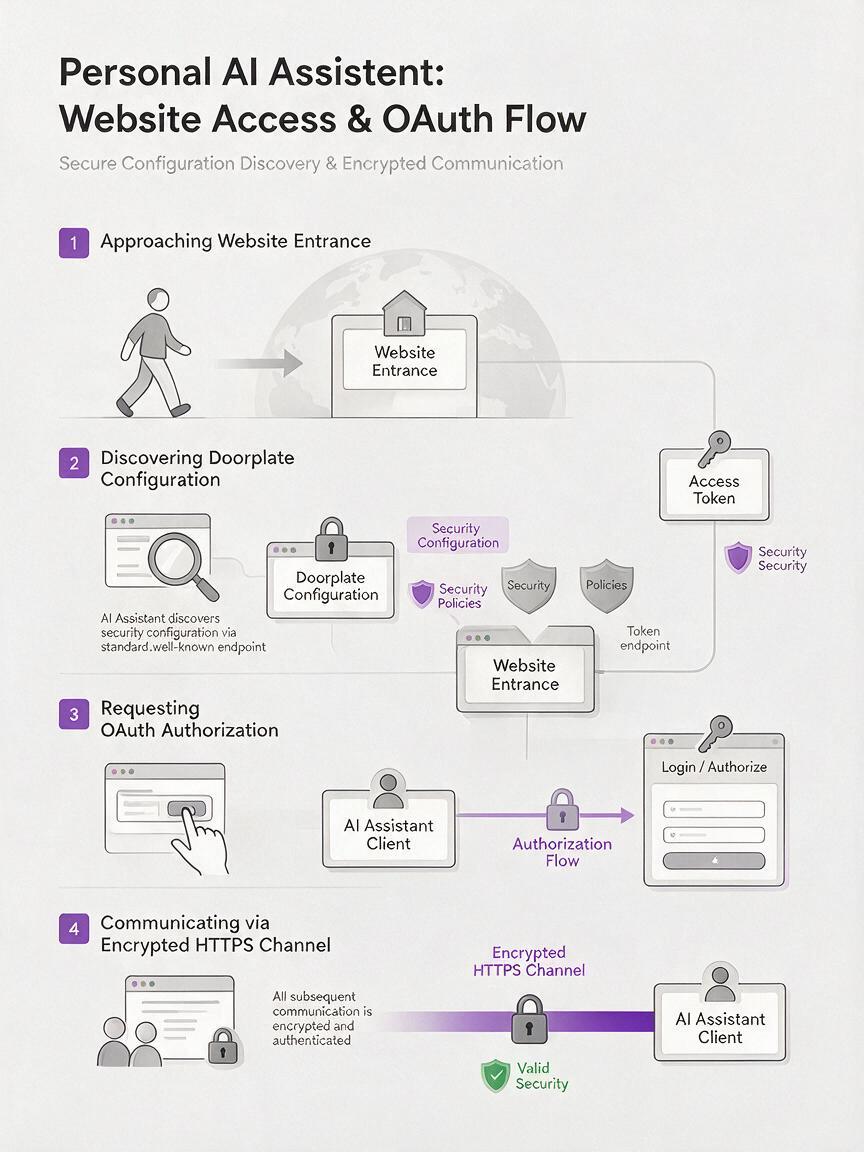
Chinese industry digests reported on November 15, 2026, that Sierra and Meta had released Poppy v1.0, a personal-agent protocol intended to help websites and AI assistants establish mutual trust. Its central idea is a “doorplate” configuration file that tells an approaching assistant how it can identify itself and interact with a site.
The reported protocol combines that configuration file with OAuth authorization and HTTPS encryption. In practical terms, it attempts to answer a basic question facing the emerging AI agent ecosystem: when an automated assistant arrives at a website, how does the site know what it is, what it represents and whether it should be allowed through the door?
The reports say Poppy is already live in Meta Muse and that Shopify is automatically publishing Poppy files across its catalog. The same coverage places it alongside ChatGPT Wallet for agent payments, Cloudflare tools for per-agent traffic analytics and access policies, and IBM Agent Identity and Vault 2.2.
There are important limits to the story. The central release and deployment claims come from second-hand Chinese digest reporting. Meta’s investor-relations and newsroom pages did not show a corresponding announcement between November 14 and November 16; their latest cited updates were November 12 supply-chain agreements and the November 7 Muse App Spaces announcement. Poppy is also a vendor-alliance proposal, not an adopted IETF or W3C standard.
For content teams, the significance is less about one protocol winning immediately and more about the direction of travel. If AI assistants increasingly browse services, request access and initiate actions, identity and authorization could become as important to an AI workflow as model quality.

Why AI Agent Identity Is Becoming an Infrastructure Problem
Traditional web traffic is usually handled as a request from a browser, application or known crawler. A personal AI assistant creates a more complicated relationship because it may be acting on behalf of a specific person while communicating automatically with several independent services.
Poppy’s reported “doorplate” concept approaches this as a trust-negotiation problem. The website publishes machine-readable information at the entrance, while the assistant uses recognized authorization and encrypted transport rather than presenting itself as anonymous traffic.
The key idea is not that every automated visitor should receive access. It is that a website needs a structured way to recognize an assistant before deciding what that assistant may do.
OAuth provides the authorization element named in the reports, while HTTPS provides encrypted communication. The proposed configuration file supplies the discovery layer. Together, these components are intended to make the relationship between websites and personal assistants more explicit.
That distinction matters because agent identity is separate from agent intelligence. A powerful AI assistant may understand a request, but a website still needs policies governing access. Likewise, a recognized assistant should not automatically receive permission to perform every available action.
How Poppy Fits Into the Reported Agent Ecosystem
The industry-digest coverage describes Poppy as one component in a larger collection of services addressing different parts of AI automation. Poppy handles the question of how an assistant identifies itself at a website’s entrance. ChatGPT Wallet is positioned around how an agent pays. Cloudflare’s cited tools cover traffic analytics and access policies for individual agents, while IBM Agent Identity and Vault 2.2 addresses agent identity and protected credentials.
| Reported component | Role described in the coverage | Relevant trust question |
|---|---|---|
| Poppy v1.0 | Doorplate configuration, OAuth authorization and HTTPS encryption | How does an assistant identify itself to a website? |
| ChatGPT Wallet | Agent payments | How does an authorized assistant pay? |
| Cloudflare tools | Per-agent traffic analytics and access policies | How can a site observe and govern agent traffic? |
| IBM Agent Identity and Vault 2.2 | Agent identity and credential infrastructure | How are identities and protected credentials managed? |
| AWS Bedrock AgentCore runtime | Isolated sessions and usage-based runtime operation | How does an agent run in a controlled environment? |
This is not evidence that all these systems form one standardized stack. The reports instead show vendors working on adjacent layers of the same broader problem: agents need identities, permissions, payment mechanisms, execution environments and observable traffic policies.
AWS Bedrock AgentCore Adds Runtime Context
The Poppy reports also reference Amazon’s November 12 update to the Bedrock AgentCore runtime. According to the cited details, sessions can start in under two seconds and run in hardware-isolated environments. The runtime uses usage-based billing and consumes less memory while a session is paused.
Those runtime characteristics address a different layer from Poppy. A doorplate and authorization process govern how an agent approaches an external service, while an isolated runtime governs where and how the agent’s work executes. Both become relevant when an AI workflow moves from generating an answer to taking actions across connected systems.
The distinction also helps prevent inflated interpretations of the Poppy news. The proposal does not, by itself, provide a complete agent platform. It addresses an identification and trust problem, while runtime isolation, billing, analytics and credential storage remain separate infrastructure concerns.
What the Meta Muse and Shopify Claims Could Mean
If the reported Meta Muse deployment is accurate, Poppy would have a direct personal-assistant use case rather than existing only as a technical proposal. The Shopify claim would also give the protocol a broad catalog-facing distribution path because participating storefront resources could publish machine-readable entry information automatically.
However, both claims should remain qualified until first-party documentation appears. Meta had not posted a matching release in the cited November window, and the material does not provide implementation details showing which Muse interactions use Poppy or what Shopify catalog access the files permit.
Automatic publication also does not mean automatic authorization. A configuration file can tell an assistant how to introduce itself, but OAuth policies and site-level access controls still determine whether an action is accepted. This boundary is essential for commerce, where browsing information, accessing an account and initiating a transaction carry very different levels of risk.
What This Means for AI Content Production
Content production is increasingly organized as a connected AI workflow rather than a single prompt. Research, script planning, visual generation, editing and distribution may involve different services, each with separate accounts and permissions. As an ai agent moves between those services, recognizable identity and limited authorization can reduce dependence on opaque, anonymous automation.
For example, a production team may use an ai script generator to structure a concept and an ai video generator to develop the visual output. The creative value comes from the models, but operational reliability also depends on whether connected tools can authenticate safely and remain available.
Poppy does not establish a universal solution today. Its status as a vendor-alliance proposal means teams should not redesign their entire AI automation strategy around it. The more durable lesson is to keep permissions narrow, separate identity from capability and avoid making one unconfirmed protocol a critical dependency.
A multi-model platform such as MagicBoat can simplify the creative side of that equation by keeping multiple generation capabilities within one account. That does not replace external authorization standards, but it can reduce unnecessary service switching when building scripts, images and an ai video workflow.

Open Questions Around Poppy v1.0
- First-party confirmation: Meta had not published a matching November 14–16 release in the cited newsroom and investor-relations pages.
- Implementation scope: The available reporting does not specify which Meta Muse interactions use Poppy or what permissions are exposed through Shopify catalogs.
- Standards status: Poppy is not an adopted IETF or W3C standard.
- Interoperability: The reports describe several related vendor products but do not establish that they operate as one unified system.
- Authorization boundaries: Identification at the door does not automatically grant an assistant permission to access accounts, make purchases or perform other sensitive actions.
These unresolved issues do not make the proposal irrelevant. They show why agent infrastructure needs careful evaluation: a protocol can offer a useful model for trust without yet being mature enough to serve as a universal foundation.
Key Takeaways
- Poppy v1.0 reportedly combines a doorplate configuration file, OAuth authorization and HTTPS encryption.
- Its goal is to help websites and personal assistants establish mutual trust before an agent is granted access.
- Chinese industry digests say it is live in Meta Muse and that Shopify publishes Poppy files across its catalog.
- The proposal sits beside reported payment, analytics, identity-vault and isolated-runtime technologies.
- The core release claims remain second-hand, and Poppy is not an adopted IETF or W3C standard.
- Content teams should treat identity, permission boundaries and platform reliability as core parts of AI automation.
To explore a streamlined multi-model environment for scripts, images and video production, try these models for free on MagicBoat.
Keywords
Poppy v1.0, personal-agent protocol, Meta Muse, ai agent identity, OAuth authorization, Shopify, Bedrock AgentCore