Apple Welcome Home Event Unveils HomeView, HomePod Mini and Apple TV 4K
Apple's Welcome Home event introduced the HomeView smart-home hub, a new HomePod mini and Apple TV 4K, expanding the company's connected-home strategy.
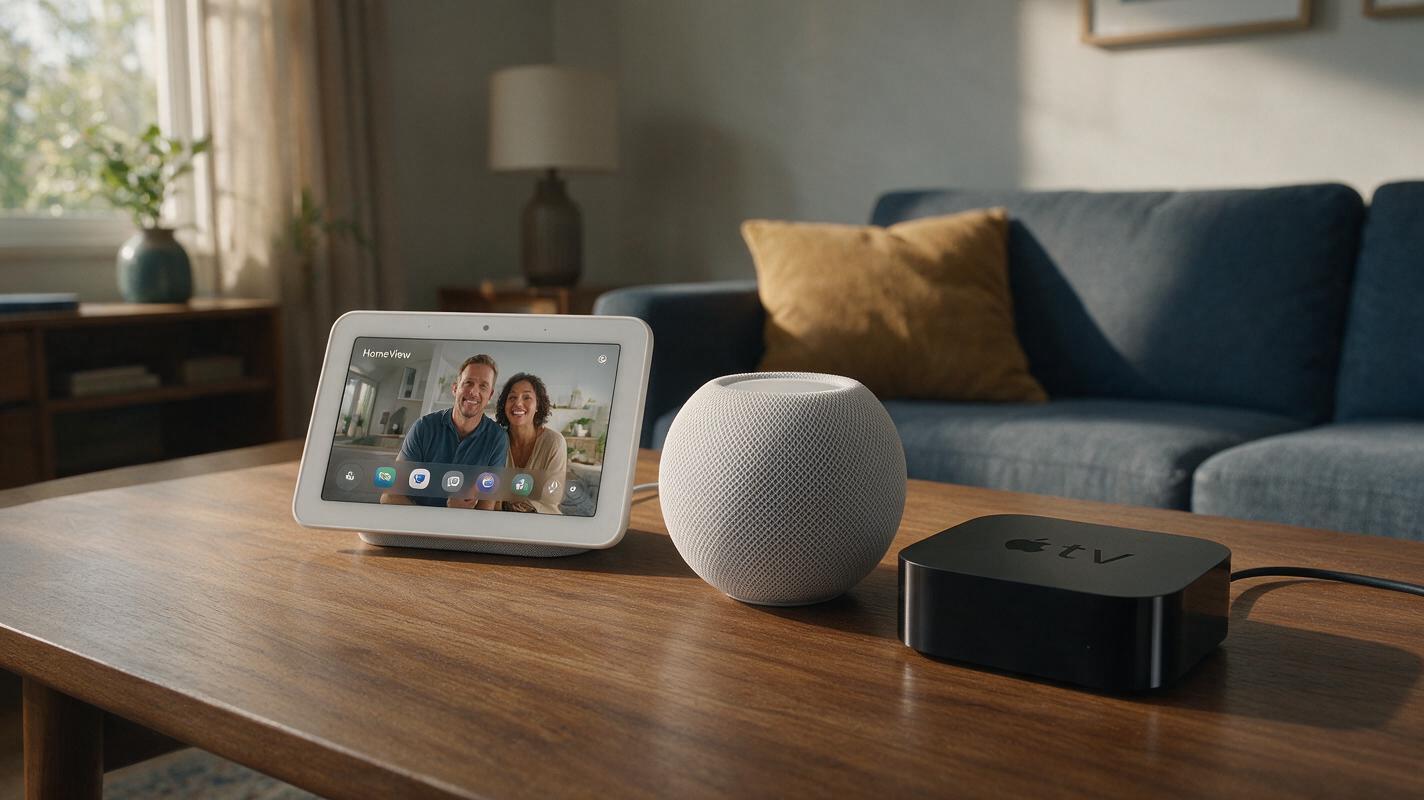
Table of contents
Apple used its October smart-home event to introduce a coordinated device lineup built around the HomeView display hub.
News commentary • October 2026
Apple held its “Welcome home” event on October 13, 2026, presenting a smart-home lineup led by the HomeView hub, a new HomePod mini and a new Apple TV 4K. The event placed HomeView at the center of the announcement rather than treating the connected home as a collection of unrelated accessories.
The following day, Apple launched HomeView as a $299 smart-home hub with a 7-inch square display and Siri AI. Apple also introduced an Apple Home Collection of accessories, extending the event’s focus beyond a single screen. Together, the announcements framed the hub, speaker, television device and accessories as parts of a broader home ecosystem.
The timing is notable for the AI industry because it moves an AI-enabled interface into a shared household setting. Instead of limiting interaction to a phone or computer, the HomeView concept places Siri AI on a dedicated display alongside Apple’s established television and speaker products.
For content teams, the immediate implication is a wider range of screens and contexts in which media may be discovered or consumed. Short, visually clear assets and adaptable production workflows become more valuable when the same campaign may need to work across phones, televisions and compact home displays.
HomeView Becomes the Center of Apple’s Smart-Home Strategy
The event’s structure signals that HomeView is intended to serve as the visible center of Apple’s connected-home push. The 7-inch square display gives the product a different physical format from a television or conventional phone, while Siri AI adds an assistant layer to the hub.
Apple’s wider strategy, as described in related reporting, centers on HomeView alongside HomePod mini, Apple TV and accessories from LG and Schneider. That mix links a display interface with audio, television and third-party home products. It also shows why the event matters beyond one new device: Apple presented a collection that can span multiple locations and forms of interaction inside a home.
| Product or category | Role in the announced lineup | Confirmed event detail |
|---|---|---|
| HomeView | Central smart-home display hub | $299, 7-inch square display and Siri AI |
| HomePod mini | Speaker component of the home lineup | A new model was presented at the event |
| Apple TV 4K | Television component of the ecosystem | A new model was presented at the event |
| Apple Home Collection | Accessory layer around the hub | Introduced with the HomeView launch |
The available event information does not establish detailed performance specifications for the new HomePod mini or Apple TV 4K. It does, however, clearly show Apple presenting the products as a coordinated smart-home portfolio.
Why a Shared AI Display Changes the Content Environment
AI assistants are often discussed as personal tools, but a home hub introduces a shared context. A phone generally belongs to one user; a household display can occupy a common room and sit alongside other connected devices. That distinction can influence the type of content that feels appropriate for the setting.
For brands and production teams, the practical consideration is format flexibility. A composition designed only for a vertical phone feed may not translate naturally to a square display or television. Text size, framing, visual hierarchy and duration can all become more important as a campaign moves among devices.
The Welcome Home event is less about one isolated hardware specification than about Apple creating another destination for AI-assisted interaction and media consumption.
This does not mean that every content team needs to rebuild its workflow around HomeView. The announced details do not specify a new publishing channel or distribution format for creators. The more defensible takeaway is that connected-home hardware is adding another surface to an already fragmented media landscape.
What the Announcement Means for AI Production Budgets
Hardware ecosystems can influence creative demand without directly determining production tools. As campaigns spread across more screen shapes and viewing situations, teams may need additional versions of key art, storyboards and short-form motion assets. That can increase review time and affect AI video cost, particularly when each variation is produced independently.
A reusable visual system can make that workload more manageable. Teams can establish a consistent subject, palette and message, then prepare alternate framing for compact displays, phones and television screens. An ai image generator can support early concept exploration, while text to video can help teams evaluate how an idea translates into motion.
The goal is not to assume capabilities for HomeView that Apple has not announced. It is to prepare creative assets that remain legible and recognizable as consumer attention spreads across more devices. This is especially relevant to product launches, entertainment promotions and visual explainers that may appear in several aspect ratios.
A More Portable Content Approach
- Preserve a clear focal point: Key subjects should remain understandable when a wide composition is adapted to a smaller or squarer frame.
- Keep essential copy concise: Compact displays leave less room for dense text and complex layouts.
- Separate assets from final formats: Maintaining reusable images, scripts and motion elements makes later adaptation easier.
- Review on different screen shapes: A concept that works on television may require different framing for a household display.
MagicBoat Fits a Multi-Format Creative Workflow
Apple’s event demonstrates how quickly the device landscape can expand. Content teams benefit when their production process is not tied to a single screen, application or output format. MagicBoat brings AI creation capabilities into one environment, helping teams move from an initial concept toward image and video assets without organizing a separate toolchain for every experiment.
This matters when a campaign needs several treatments of the same idea. A team might explore visual directions, assess motion concepts and retain the strongest assets for later resizing or editing. The resulting workflow complements emerging hardware ecosystems without depending on unconfirmed device features.
Multi-model access also provides flexibility as the AI industry changes. Hardware announcements, model availability and platform priorities can shift, but a portable creative process makes it easier to maintain brand continuity across those changes.
Key Takeaways
- Apple held its Welcome Home event on October 13, 2026.
- The event featured the HomeView hub, a new HomePod mini and Apple TV 4K.
- HomeView launched at $299 with a 7-inch square display and Siri AI.
- Apple also introduced an Apple Home Collection of accessories.
- The lineup expands the number of connected-home surfaces that content teams may need to consider.
- Flexible image and video workflows can help teams adapt concepts for phones, televisions and compact displays.
Build Content for a Multi-Screen AI Landscape
Explore flexible image, video and story-production options in one place and try these models for free with MagicBoat.
Keywords: Apple Welcome Home event, Apple HomeView, HomePod mini, Apple TV 4K, Siri AI, smart-home hub, AI industry