Samsung-Apple DRAM Deal & Nvidia $390B Supply: What to Know | MagicBoat
Samsung and Apple are in final negotiations on a four-to-five-year DRAM long-term agreement set to take effect in the first half of 2027, ending Apple's status as the only major tech firm without such a supply deal with Samsung. Nvidia's future supply commitments have risen to $390 billion from $279 billion, driven largely by multi-year memory contracts. These deals signal big tech is locking in memory supply to support growing AI infrastructure demand, with direct implications for the reliability of AI creative tools.
Table of contents
Samsung and Apple are in final negotiations on a long-term DRAM supply agreement launching in the first half of 2027, while Nvidia’s future supply commitments have surged to $390 billion — a $111 billion jump driven largely by multi-year memory contracts. For AI content creators, the wave of memory supply locks points to more stable AI infrastructure in the coming years, though building diversified workflows remains a key resilience strategy.
What Happened
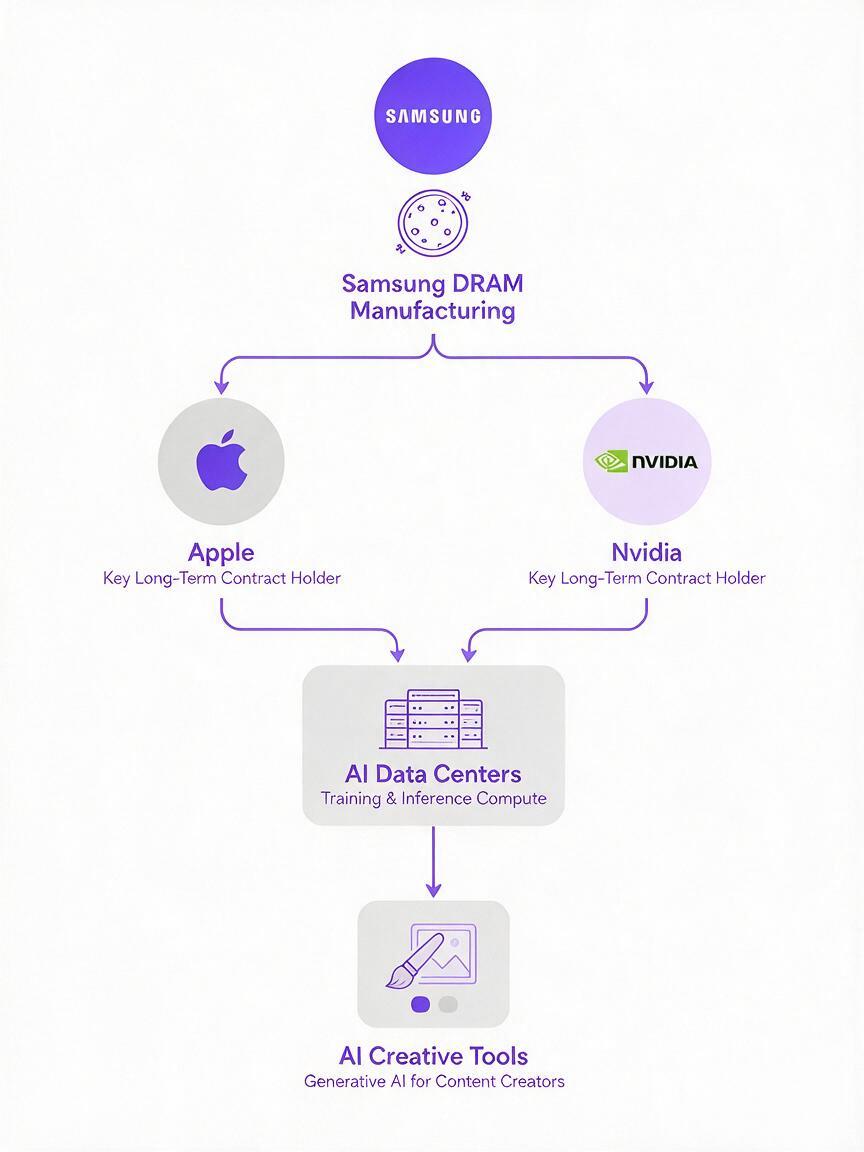
Reported in mid-November 2026, the Samsung-Apple DRAM long-term agreement (LTA) is in its final negotiation stages, with a planned launch in the first half of 2027. The deal will run for four to five years, and includes a supply floor that guarantees a minimum volume of DRAM for Apple, paired with market-linked pricing that adjusts with broader memory market conditions.
Prior to this agreement, Apple was the only major technology company without a formal long-term DRAM supply agreement with Samsung, the world’s largest memory chipmaker. The deal locks in stable supply for Apple’s product lineup, which includes devices used by creators for AI-powered video and image editing workflows.
Alongside the Samsung-Apple news, Nvidia’s future supply commitments have risen to $390 billion from a prior $279 billion, an increase of roughly 40%. The majority of this jump is tied to multi-year memory contracts, as Nvidia secures the high-bandwidth memory and DRAM needed to scale its AI chip and data center business.
Key Figures and Supply Context
The wave of long-term memory agreements comes amid a years-long tight supply environment for AI-grade memory. SK Hynix, another top memory maker, reported in October 2026 that DRAM and high-bandwidth memory (HBM) are effectively sold out through 2029, with more than 50% of 2027-2028 capacity locked in by 14 core customers. Vendor-reported figures have not been independently verified.
Key numbers from the mid-November 2026 updates include:
- Samsung-Apple LTA duration: four to five years, effective H1 2027
- Deal terms: supply floor for minimum volume, market-linked pricing
- Nvidia total future supply commitments: $390 billion, up from $279 billion
- Primary driver of Nvidia's increase: largely multi-year memory contracts
Memory is a critical component of AI data center infrastructure, as both training and inference workloads require large volumes of high-speed memory to process complex models and generate outputs quickly. Supply constraints can lead to longer wait times for AI model access, cloud price increases, or intermittent service disruptions.
What This Means for AI Content Creators
For content creators who rely on cloud-based AI tools to produce work, stable memory supply directly translates to more reliable access to the models that power their projects. Whether you’re using an ai video generator for short-form social content, an ai image generator for concept art, or AI script writing tools for story development, consistent infrastructure stability keeps production schedules on track.
Long-term supply deals like these reduce the risk of sudden supply shortages that could throttle AI model access, raise prices, or cause service slowdowns. By locking in memory capacity years in advance, major infrastructure players are laying the groundwork for more predictable AI capacity growth that can support growing creator demand for high-resolution video and image generation tools.
Even with these positive signals, supply chain risks remain — from geopolitical shifts to production delays — so creators benefit from building resilient ai video workflow pipelines that don’t depend on a single model provider or infrastructure vendor. Multi-model platforms like MagicBoat aggregate tools from multiple providers, so if one provider faces constraints, you can switch to another without losing progress on your project.

Key Takeaways
- Samsung and Apple are finalizing a 4-5 year DRAM long-term agreement set to launch in H1 2027, ending Apple’s status as the only major tech firm without such a deal with Samsung.
- Nvidia’s future supply commitments have jumped to $390 billion from $279 billion, driven largely by multi-year memory contracts.
- The wave of long-term memory deals points to sustained investment in AI infrastructure stability, supporting more reliable access to cloud-based AI creative tools.
- Creators can reduce supply chain risk by using multi-model platforms that aggregate tools from multiple providers.
- You can try these models for free and build a resilient multi-model workflow on MagicBoat today.
Keywords
ai workflow, ai infrastructure, dram supply, ai automation, ai video workflow, nvidia supply commitments, samsung apple dram deal