SGLang Consortium, llama.cpp 1.0 and DeepSeek Ultrafast Lead Open Inference Wave
A wave of open inference infrastructure announcements landed in mid-November 2026, including the launch of the SGLang Consortium with major tech backers, the stable 1.0 release of llama.cpp, and Baseten's open-source DeepSeek Ultrafast inference engine. The releases signal accelerating standardization and cost reduction across the AI serving stack, with direct implications for ai capital expenditure, ai funding needs, and ai video cost for content creators.
Table of contents
The November 2026 Open Inference Infrastructure Wave
A cluster of major open inference-infrastructure announcements landed in mid-November 2026 Chinese industry digests, marking a significant step toward standardization and cost reduction across the AI serving stack. The grouped releases span industry consortia, stable open-source frameworks, optimized model-specific engines, and cloud platform updates, with backing from nearly every major player in the AI hardware and software ecosystem.
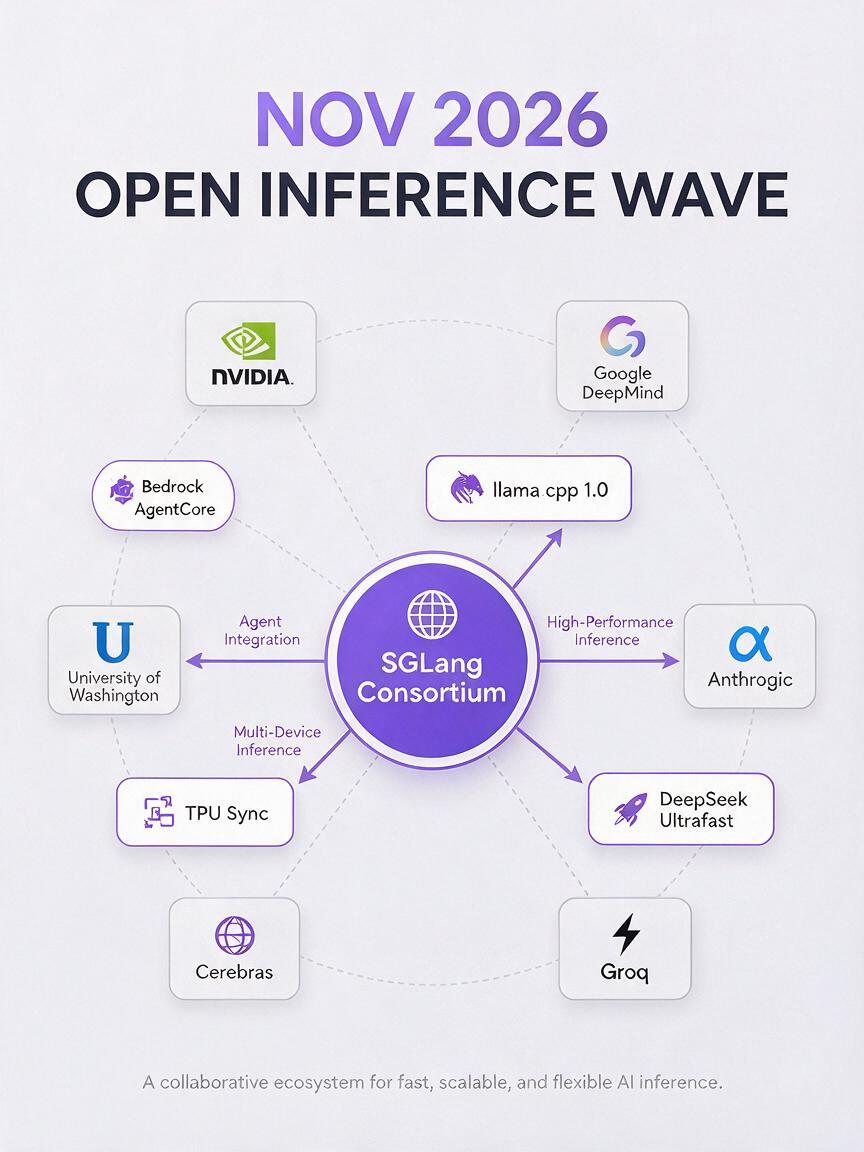
Highlights include the launch of a cross-industry consortium to standardize LLM inference frameworks, the first stable release of the widely used llama.cpp local inference tool, an open-sourced high-speed inference engine for DeepSeek models, and new runtime capabilities for Amazon's Bedrock agent platform. A November 14 availability tracker also reported zero outages across major AI providers including OpenAI, Anthropic, Google Vertex Gemini, Mistral, and Microsoft Azure Foundry.
Most release details come from second-hand industry digest aggregation, with dates potentially merged across several days. The SGLang Consortium's formation represents a pledge to standardize, not a shipped final standard, and the 100% availability figure comes from a single tracker with undisclosed probe frequency.
Key Releases and What They Do
SGLang Consortium: Unified Inference Framework Standards
The SGLang Consortium launched with seven founding members spanning the entire AI hardware and cloud stack: NVIDIA, AMD, Intel, Google, Meta, Cloudflare, and Modal. The group's stated goal is to standardize LLM inference frameworks, reducing fragmentation that has slowed deployment and raised costs for developers and end users alike. Standardized inference interfaces would let models run more consistently across different hardware platforms and cloud providers, without requiring custom optimization work for each environment.
llama.cpp 1.0: Stable Local and On-Device Inference
llama.cpp, the popular open-source library for running large language models on consumer hardware and edge devices, shipped its first stable 1.0.0 release alongside version 1.0.0 of its underlying ggml tensor library. The release includes more than 200 changes, marking a maturity milestone for a tool that has become a cornerstone of local AI development and on-device model deployment. Stable API guarantees mean developers can build production tools on top of llama.cpp without worrying about breaking changes between versions.
Baseten DeepSeek Ultrafast: Open-Sourced High-Speed Serving
Baseten open-sourced its DeepSeek Ultrafast inference engine, a highly optimized serving system built specifically for DeepSeek models. The release gives developers and businesses a free, customizable way to run DeepSeek models at high throughput and low latency, reducing reliance on proprietary serving platforms. This announcement ties into DeepSeek's rapid growth across the global ai industry, following earlier reports of surging API call volume and rising valuation.
Additional Ecosystem Updates
Several other notable releases were included in the digest cluster. Google open-sourced TPU Sync, a tool for coordinating workloads across Google's custom TPU hardware. Amazon Bedrock AgentCore received a new runtime with hardware-isolated sessions, usage-based billing, sub-two-second session start times, and lower memory usage when sessions are paused. Alibaba's open-source code review tool also trended on GitHub, reflecting growing open-source investment across the global AI developer ecosystem.
What This Means for the AI Industry
The wave of open inference releases signals a maturing ai industry where serving efficiency and standardization are becoming top priorities, after years of focus on model capability and raw compute scale. For ai capital expenditure, standardized inference frameworks could reduce the need for custom hardware and software stacks, letting cloud providers and businesses get more performance out of existing GPU and server investments.
Open-source inference engines like DeepSeek Ultrafast also put downward pressure on AI serving costs, as organizations can avoid proprietary serving fees and run models on their own infrastructure or cheaper cloud instances. For AI startups building creative tools, this reduces the ai funding required to launch production-grade services, as teams can leverage pre-built optimized serving engines instead of developing custom infrastructure in-house. This cost reduction flows through to every layer of the AI stack, from enterprise agent deployments to consumer-facing creative tools.
The SGLang Consortium's broad membership is particularly notable: with both the largest chipmakers and biggest cloud providers on board, the standard has a strong chance of widespread adoption, unlike earlier niche inference proposals. That said, consortium formation is only the first step, and actual standard delivery and adoption will take months or years to materialize.

Implications for AI Content Creators
For content creators and creative teams, lower inference costs and more standardized serving directly translate to more affordable and accessible AI creative tools. An ai image generator running on optimized open inference engines can produce higher-quality outputs at a lower per-image cost, while an ai video generator can render longer clips faster without proportional price increases, reducing overall ai video cost for independent creators and small teams.
Multi-model creative platforms like MagicBoat are uniquely positioned to benefit from this wave of open inference innovation. By supporting multiple model backends and inference frameworks, these platforms can quickly adopt new optimized serving engines, pass cost savings on to users, and offer a wider range of model options without being locked into a single vendor's infrastructure.
Improved reliability across major AI providers, as reflected in the November 14 availability tracker, also means creators can count on their AI tools being available when deadlines are tight, without worrying about widespread outages disrupting production workflows.
Key Takeaways
- Major AI hardware and cloud players have formed the SGLang Consortium to standardize LLM inference frameworks, reducing fragmentation across the industry.
- llama.cpp 1.0 marks a stable maturity milestone for local and on-device AI inference, enabling more production-grade edge AI tools.
- Baseten's open-source DeepSeek Ultrafast inference engine lowers the cost and barrier to running high-performance DeepSeek models at scale.
- Open inference standardization is expected to put downward pressure on ai capital expenditure and AI tool costs, benefiting content creators through cheaper, more accessible creative tools.
- Creators can take advantage of these cost savings and expanded model options by using multi-model platforms that integrate the latest open inference advancements. try these models for free
Keywords
deepseek, ai industry, ai capital expenditure, ai video cost, ai funding, open inference, sglang consortium, llama.cpp 1.0