SoftBank Q2 Loss Deepens as OpenAI Stake Tests AI Valuations
SoftBank Group reported a ¥1.1 trillion fiscal Q2 net loss after posting a ¥2.5 trillion profit a year earlier, putting renewed attention on its $64.6 billion investment in OpenAI. The result highlights how debt, collateral values and shifting AI valuations can affect the wider ecosystem supporting AI products and creative workflows.

Table of contents
SoftBank Reports a ¥1.1 Trillion Quarterly Loss
SoftBank Group’s fiscal Q2 result has turned one of the market’s largest AI investments into a closely watched test of confidence in AI valuations.
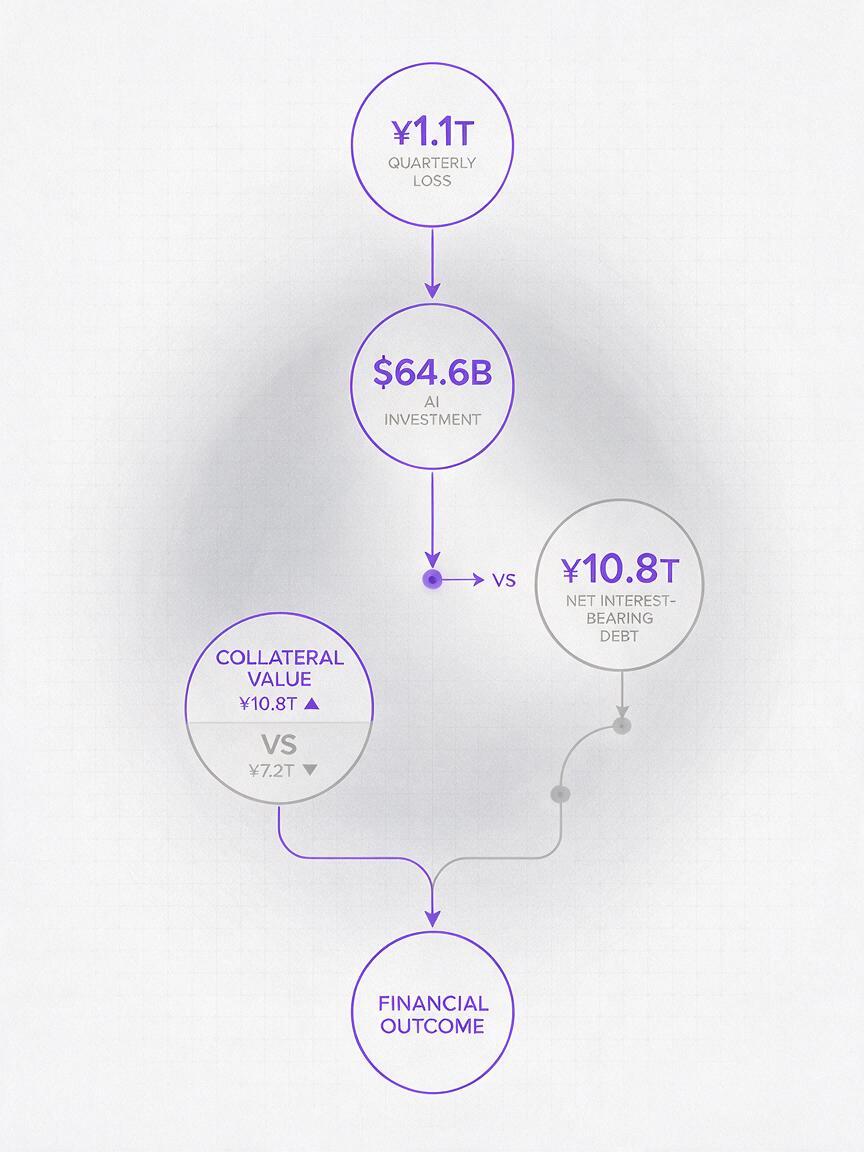
On November 10, SoftBank reported a net loss of ¥1.1 trillion, approximately $7 billion, for the July-to-September quarter. That compares with a ¥2.5 trillion profit in the same period a year earlier, when gains associated with its OpenAI stake contributed heavily to the result.
The loss was substantially worse than analysts expected. The three analysts polled by LSEG produced estimates ranging from a ¥233 billion profit to a ¥113 billion loss. SoftBank’s actual result was therefore roughly ten times worse than the most pessimistic forecast in that range.
Bloomberg attributed the swing partly to concerns about AI valuations weighing on technology stocks. That matters because SoftBank has committed $64.6 billion to a 13% stake in OpenAI, making the group an unusually leveraged public-market proxy for confidence in the AI sector.
For people building content businesses around an AI assistant, ai agent or AI automation, the immediate lesson is not that demand for AI has disappeared. It is that the financial structures behind major AI platforms can become volatile, reinforcing the value of flexible workflows that are not dependent on one company or model.

What SoftBank’s Q2 Loss Reveals About the AI Valuation Trade
SoftBank’s quarterly reversal illustrates the difference between operational adoption of AI and the valuation placed on companies supplying it. AI tools may continue to attract users while the investors financing their expansion face sharper scrutiny over debt, collateral and the timing of future returns.
The scale of SoftBank’s OpenAI position concentrates that exposure. A $64.6 billion investment for a 13% stake means changes in sentiment toward OpenAI and the wider AI market can have an outsized influence on how investors assess SoftBank itself.
SoftBank’s result is a reminder that enthusiasm for AI products and confidence in the financing behind those products are related, but they are not the same thing.
The comparison with the prior year is especially striking. The company moved from a ¥2.5 trillion profit, supported largely by gains on its OpenAI stake, to a ¥1.1 trillion loss. That ¥3.6 trillion swing makes AI valuation risk central to the earnings story rather than a secondary investment detail.
The Balance-Sheet Pressure Behind the Headline
SoftBank entered this period with rising leverage. Net interest-bearing debt stood at ¥10.8 trillion, around $68 billion, at the end of June. A year earlier, it had been ¥6.6 trillion. The cost of insuring the company’s debt also reached a four-year high.
Arm is another important part of the picture because its shares serve as collateral. Arm traded near $175 on the Friday before the result, approximately 60% below its June record. Jefferies warned that an Arm price below $200 would add pressure.
| Indicator | Reported figure | Why it matters |
|---|---|---|
| Fiscal Q2 net result | ¥1.1 trillion loss | Far below the analyst range |
| Prior-year Q2 result | ¥2.5 trillion profit | Was driven largely by OpenAI-related gains |
| OpenAI investment | $64.6 billion for 13% | Concentrates exposure to AI valuations |
| Net interest-bearing debt | ¥10.8 trillion at end-June | Up from ¥6.6 trillion a year earlier |
| Arm share price | Near $175 on Friday | Collateral value adds another pressure point |
SoftBank shares fell 11% on Friday and another 4.2% on Monday, leaving them down 23% for the year. The company was also dealing with China’s decision to block its $5.4 billion acquisition of ABB’s robotics business.
Together, these figures explain why attention is shifting from headline AI exposure to the mechanics supporting it: the price of collateral, debt-servicing conditions, possible asset sales and the market value assigned to major private AI companies.
Key Signals the Market Is Watching
The next focal point is SoftBank’s chief financial officer briefing, particularly any comments concerning debt and potential asset sales. Investors will be looking for evidence of how the group intends to manage its expanded balance sheet while maintaining its OpenAI position.
Arm’s price remains another visible indicator. Because Jefferies identified the sub-$200 level as a source of additional pressure, movements around that threshold may influence perceptions of SoftBank’s collateral position.
Anthropic’s expected initial public offering next week is also on the watchlist. Its reception could offer a broader signal about whether public investors are prepared to support the valuations attached to leading AI companies. The event will not determine OpenAI’s value directly, but it could shape market sentiment toward the category.
- Debt management: Investors want clarity on financing and possible asset sales.
- Arm collateral: Further price weakness could intensify balance-sheet concerns.
- AI market sentiment: Anthropic’s expected listing will provide another valuation reference.
- OpenAI exposure: SoftBank’s 13% stake remains the defining element of its AI strategy.
What the News Means for AI Content Workflows
SoftBank’s result does not provide evidence about any specific AI model’s creative capabilities. Its relevance to content production is instead structural: the models used in an AI workflow depend on companies that require substantial, continuing investment.
When valuations, financing conditions or corporate priorities shift, creators and production teams may eventually encounter changes in model access, capacity, pricing or product direction. Those outcomes are not established by this earnings report, but the concentration risk is worth recognizing when an entire production process relies on one provider.
A resilient creative setup keeps scripts, visual concepts, prompts and approved assets portable. Teams can use an ai script generator for planning and move production into an ai film platform without designing the whole process around a single AI company.
That approach is particularly useful for an ai video workflow involving several media types. The practical goal is continuity: if one model is unsuitable or unavailable for a particular task, the project should remain organized enough to continue through another option rather than requiring a complete restart.

Why Multi-Model Access Matters During Market Volatility
Financial volatility and product quality should not be confused. A company can face valuation pressure while offering widely used technology, just as a well-financed company may not provide the right model for every creative brief. Model selection should therefore be based on the output required, reliability and workflow fit rather than the market narrative surrounding one provider.
MagicBoat supports this more flexible production mindset by bringing multiple creative capabilities into one account. Instead of tying ideation, scripting and production to a single AI assistant, users can organize their work around the content they need to produce.
This reduces unnecessary switching between disconnected services while preserving room to evaluate different creative options. It also makes the workflow itself the durable asset: the concept, script, visual direction and production materials remain central even as the surrounding AI market changes.
Key Takeaways
- SoftBank reported a ¥1.1 trillion fiscal Q2 net loss, compared with a ¥2.5 trillion profit a year earlier.
- The result was roughly ten times worse than the gloomiest estimate among the three analysts polled by LSEG.
- SoftBank has invested $64.6 billion for a 13% OpenAI stake, creating concentrated exposure to AI valuations.
- Net interest-bearing debt rose to ¥10.8 trillion at the end of June from ¥6.6 trillion a year earlier.
- Arm’s share price, the CFO briefing and Anthropic’s expected IPO are important watch points.
- Creative teams can reduce provider concentration by maintaining portable assets and a flexible multi-model workflow.
- Explore MagicBoat and try these models for free.
Keywords
softbank q2 loss, openai stake, ai valuations, softbank debt, arm share price, ai workflow, multi-model ai platform