SpaceX Catches Starship Upper Stage as Tesla Merger Talks Accelerate
SpaceX has caught a Starship upper stage with its launch tower arms for the first time, although the lower-stage recovery failed. The milestone arrived alongside reports of accelerated SpaceX-Tesla merger talks and renewed discussion of reusable launch economics, Starlink deployment and future space-based AI compute.
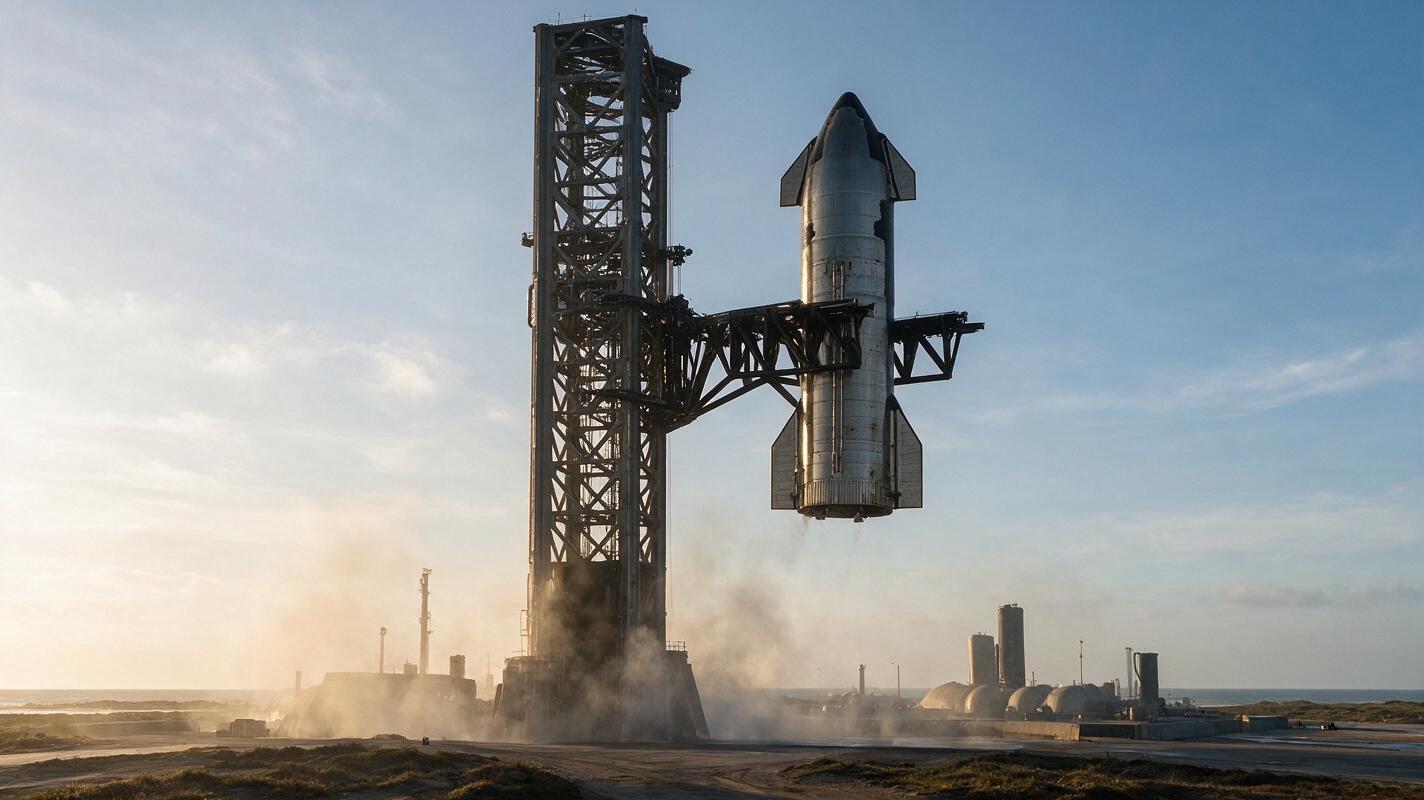
Table of contents
SpaceX Reaches a Major Starship Recovery Milestone
SpaceX has caught a Starship upper stage with its launch tower “chopsticks” for the first time, marking an important but incomplete advance toward full vehicle reuse.
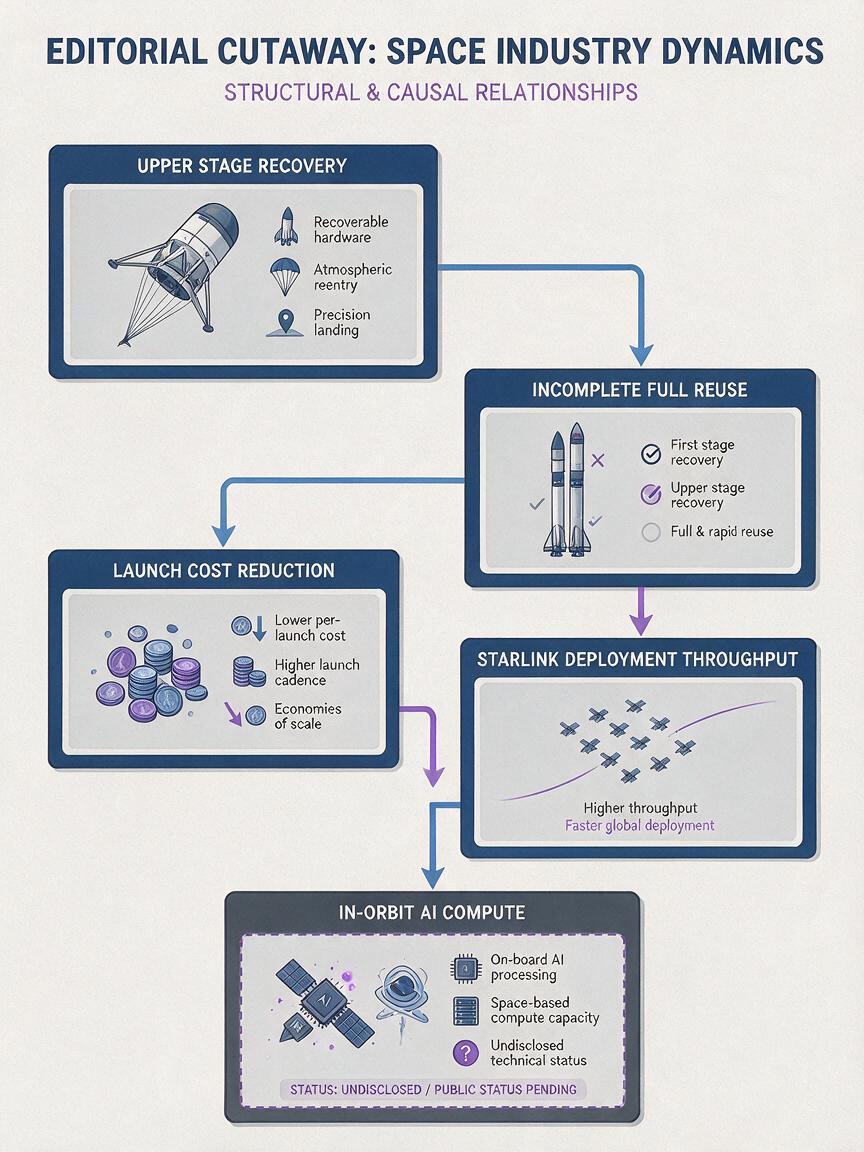
The upper-stage recovery succeeded while the lower-stage recovery failed, leaving SpaceX with a split result rather than a complete demonstration of reusable operations. Even so, Bernstein described the upper-stage catch as the most important development supporting a potential multi-trillion-dollar valuation for SpaceX. The central argument is economic: recovering and reusing more of the launch vehicle could reduce the cost of reaching orbit and increase the rate at which SpaceX deploys Starlink infrastructure.
Morgan Stanley separately argued that the market was underrating the mission. Its analysis said the catch reduces execution risk around commercial reuse and the longer-term possibility of space-based AI compute. That prospect remains speculative in operational terms, however, because SpaceX has not disclosed any public in-orbit compute capacity.
The mission coincided with a Bloomberg report that SpaceX-Tesla merger negotiations have accelerated. An agreement could reportedly be announced as soon as December, while early 2027 has also been discussed as an alternative. Boards and advisers are said to be negotiating transaction terms and post-merger governance, but the companies have not publicly confirmed a deal.
For people producing AI-assisted media, the immediate relevance is not access to orbital computing. It is the growing connection between AI services and the expensive physical infrastructure required to keep digital production available at scale.
What the Starship Catch Actually Proved
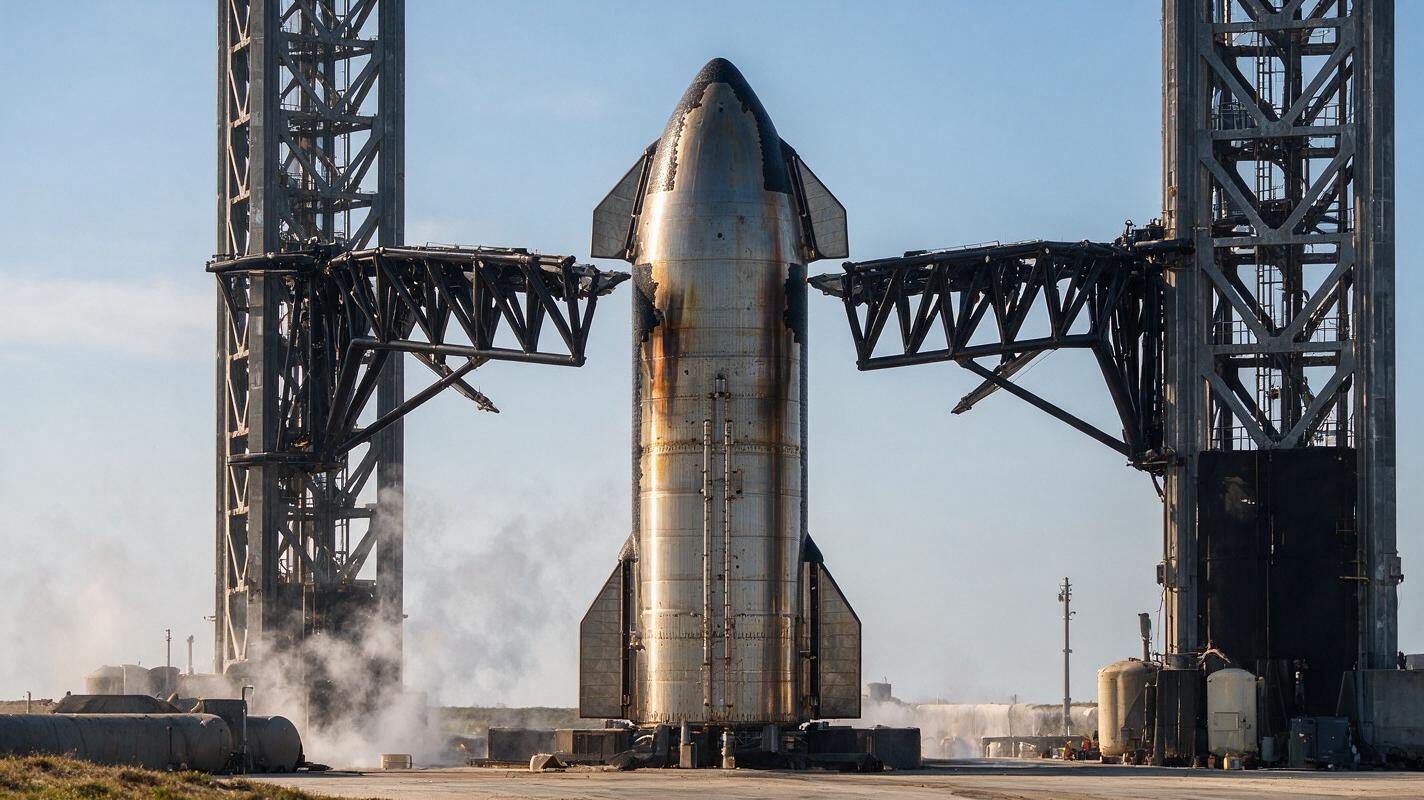
The successful recovery demonstrated that SpaceX can guide a Starship upper stage back to the launch site and place it within the tower arms’ capture envelope. That is a significant engineering result because the upper stage must return from a different flight regime than a lower-stage booster.
It did not demonstrate complete vehicle reuse. The lower-stage recovery failed, and a single upper-stage catch does not establish that the same vehicle can be inspected, prepared and flown repeatedly on an economically useful schedule.
The distinction matters: a successful catch is evidence that one difficult recovery operation can work, not proof that the entire launch system has completed the full-reuse loop.
That caveat keeps the milestone in perspective. The result reduces one category of technical uncertainty, but questions around recovery consistency, turnaround and complete system reuse remain open.
Why Full Reuse Matters for AI Infrastructure
Bernstein connected the catch to SpaceX’s valuation through launch economics. If full reuse lowers the cost per orbit, SpaceX could potentially place Starlink capacity into orbit more efficiently and increase deployment throughput. That is strategically important for a company whose infrastructure ambitions depend on launching large numbers of spacecraft.
Morgan Stanley extended the argument to space-based AI compute. In that thesis, lower launch costs make orbital infrastructure less difficult to deploy and replace. But there is a wide gap between improving launch recovery and operating useful computing capacity in orbit.
| Development | What is supported | What remains unresolved |
|---|---|---|
| Upper-stage tower catch | SpaceX completed the recovery maneuver for the first time | Repeatability and operational turnaround |
| Lower-stage recovery | The mission included a recovery attempt | The attempt failed, so complete recovery was not achieved |
| Full reuse | The upper-stage result advances the underlying objective | One catch does not complete the full-reuse loop |
| Space-based AI compute | Analysts see lower execution risk for a future infrastructure thesis | No public in-orbit compute capacity has been disclosed |
This separation between demonstrated engineering and projected infrastructure is essential. The catch is concrete. The consequences for orbital AI remain an investment thesis rather than an operating service available to AI users.
The SpaceX-Tesla Merger Context
Bloomberg’s merger report adds a corporate dimension to the mission. According to unnamed sources, SpaceX and Tesla have accelerated discussions, with December presented as the earliest possible announcement window and early 2027 as a fallback. Boards and advisers are reportedly working through terms and governance arrangements.
The two schedules are alternatives, not parallel commitments. Neither SpaceX nor Tesla has confirmed that an agreement will be signed, and any report based on unnamed sources can change as negotiations continue.
The market nevertheless reacted. Tesla gained as much as 1.9% intraday, while SpaceX rose 0.5%. As a reference point for the scale of any potential combination, SpaceX’s June initial public offering raised $75 billion on a base basis and about $86 billion after the greenshoe at a $1.77 trillion valuation.
The Starship catch and merger talks therefore point in the same broad direction without proving the same thing. One concerns reusable launch engineering. The other concerns a possible corporate structure joining businesses associated with vehicles, energy, connectivity and future computing infrastructure.
What This Means for AI Content Workflows
AI production can look entirely software-based from the user’s perspective, but every generation request ultimately relies on physical infrastructure: processors, networks, data centers, electricity and cooling. SpaceX’s mission illustrates how far companies may go to expand that physical layer, including exploring infrastructure beyond conventional terrestrial facilities.
That does not mean an AI team should redesign its production process around orbital computing. There is no public SpaceX in-orbit compute service to select. The practical lesson is that infrastructure road maps are uncertain, and ambitious announcements should be separated from capabilities that are available now.
A resilient ai workflow should also avoid unnecessary dependence on one provider or one infrastructure story. If a model becomes unavailable, changes access terms or experiences capacity pressure, teams need room to continue scripting, visual development and production without rebuilding every part of the project.
MagicBoat brings AI creation tools into one account, giving production teams a practical place to develop an ai storyboard and move into an ai video generator workflow. The value is immediate creative continuity rather than a bet on when a future computing architecture might arrive.

Separating the Milestone From the Forecast
The Starship result deserves attention because upper-stage recovery is a difficult, visible component of SpaceX’s reuse strategy. It may strengthen the commercial case for lower launch costs and higher Starlink deployment throughput if SpaceX can repeat it and complete the remaining parts of the recovery system.
At the same time, three boundaries should remain clear. The lower-stage recovery failed. Full reuse has not yet been demonstrated by this result alone. Space-based AI compute does not currently have disclosed public capacity.
The merger report requires similar restraint. Talks may be progressing, but the December and early-2027 possibilities are mutually exclusive alternatives from unnamed-source reporting. Until the companies announce an agreement, the proposed combination remains under negotiation.
Key Takeaways
- SpaceX caught a Starship upper stage with its tower arms for the first time.
- The lower-stage recovery failed, preventing a complete recovery result.
- Bernstein linked full reuse to lower orbital costs, greater Starlink throughput and a possible multi-trillion-dollar valuation.
- Morgan Stanley said the mission reduces execution risk for commercial reuse and potential space-based AI compute.
- No public in-orbit computing capacity has been disclosed.
- SpaceX-Tesla merger talks reportedly accelerated, but neither company has confirmed a deal.
- Flexible, multi-model production remains more practical than depending on an unproven infrastructure forecast.
Build a More Flexible AI Production Pipeline
Infrastructure strategies will continue to change, but creative work still needs to move from concept to finished media. Explore MagicBoat and try these models for free while keeping your production options open.
Keywords
spacex starship, starship upper stage catch, spacex tesla merger, reusable launch, space based ai compute, ai infrastructure, ai workflow