SpaceX Catches Starship Upper Stage With Chopsticks, Merger Talks Accelerate
SpaceX has successfully caught a Starship upper stage using its launch tower 'chopsticks' for the first time, a milestone analysts say reduces execution risk for commercial launch reuse and future space-based AI compute. Concurrently, Bloomberg reports SpaceX-Tesla merger talks have accelerated with a potential announcement as soon as December, though the talks remain unconfirmed and face regulatory and shareholder hurdles.
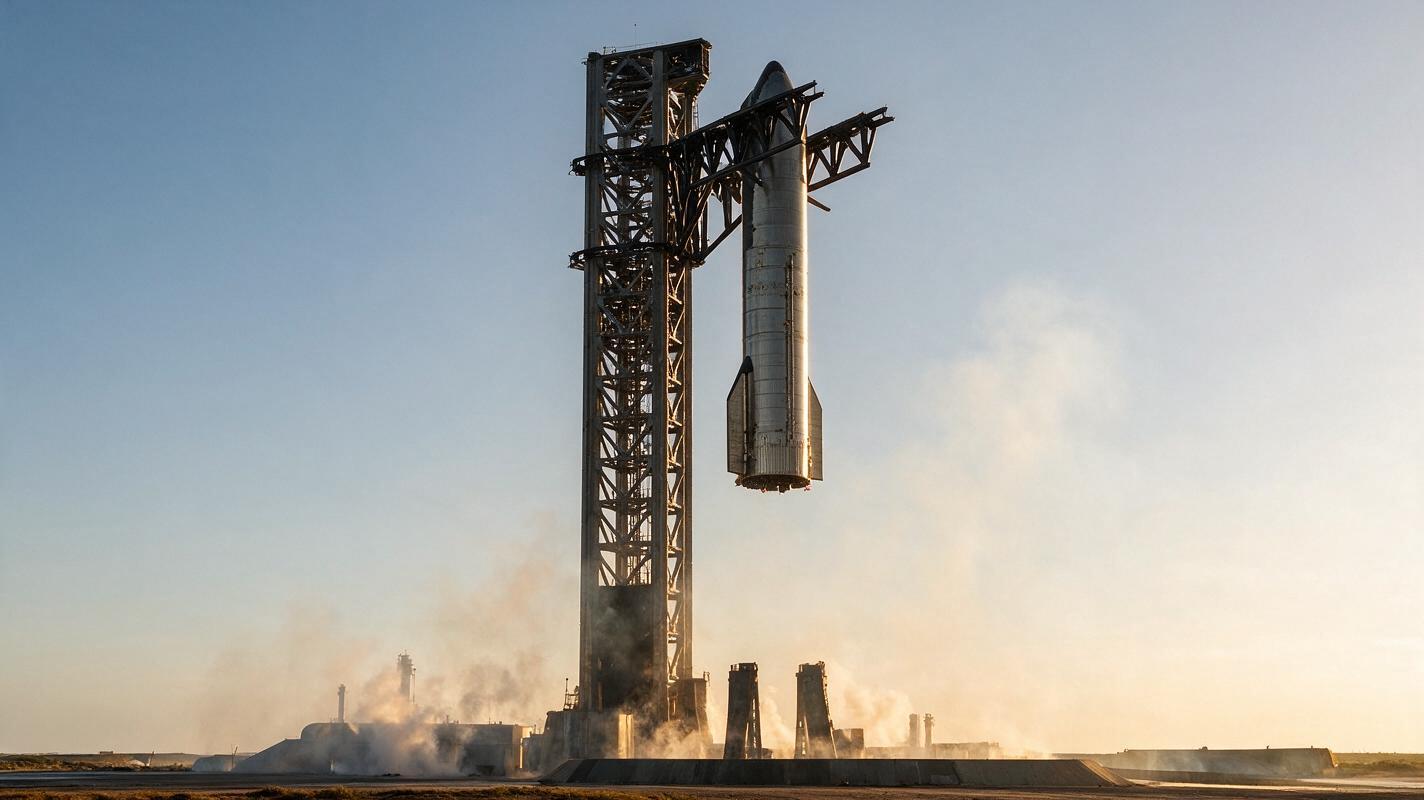
Table of contents
SpaceX’s First Starship Upper Stage Catch: What Just Happened
SpaceX has successfully caught a Starship upper stage using its launch tower "chopsticks" for the first time, a long-awaited milestone for the company’s fully reusable rocket program. The lower-stage booster recovery failed during the mission, but the upper-stage catch is already being framed by analysts as a pivotal moment for SpaceX’s long-term valuation and its ambitions in space-based compute.
Bernstein called the catch the most important step supporting a multi-trillion-dollar valuation for SpaceX, arguing that full launch system reuse would dramatically cut the cost per orbit and accelerate Starlink satellite deployment throughput. Morgan Stanley warned the market was underrating the mission’s significance, noting that it reduces execution risk for both commercial launch reuse and the future of space-based AI compute.
Alongside the launch milestone, Bloomberg reported that SpaceX-Tesla merger talks have accelerated, with a deal potentially announced as soon as December and early 2027 discussed as a fallback timeline. Boards and advisers from both companies are reportedly negotiating terms and post-merger governance structure. Tesla shares rose as much as 1.9% intraday following the news, while SpaceX gained 0.5%. As a reference point, SpaceX’s June 2026 IPO raised $75 billion in base proceeds, or about $86 billion with greenshoe, at a $1.77 trillion valuation.
Why the Milestone Matters for AI Infrastructure
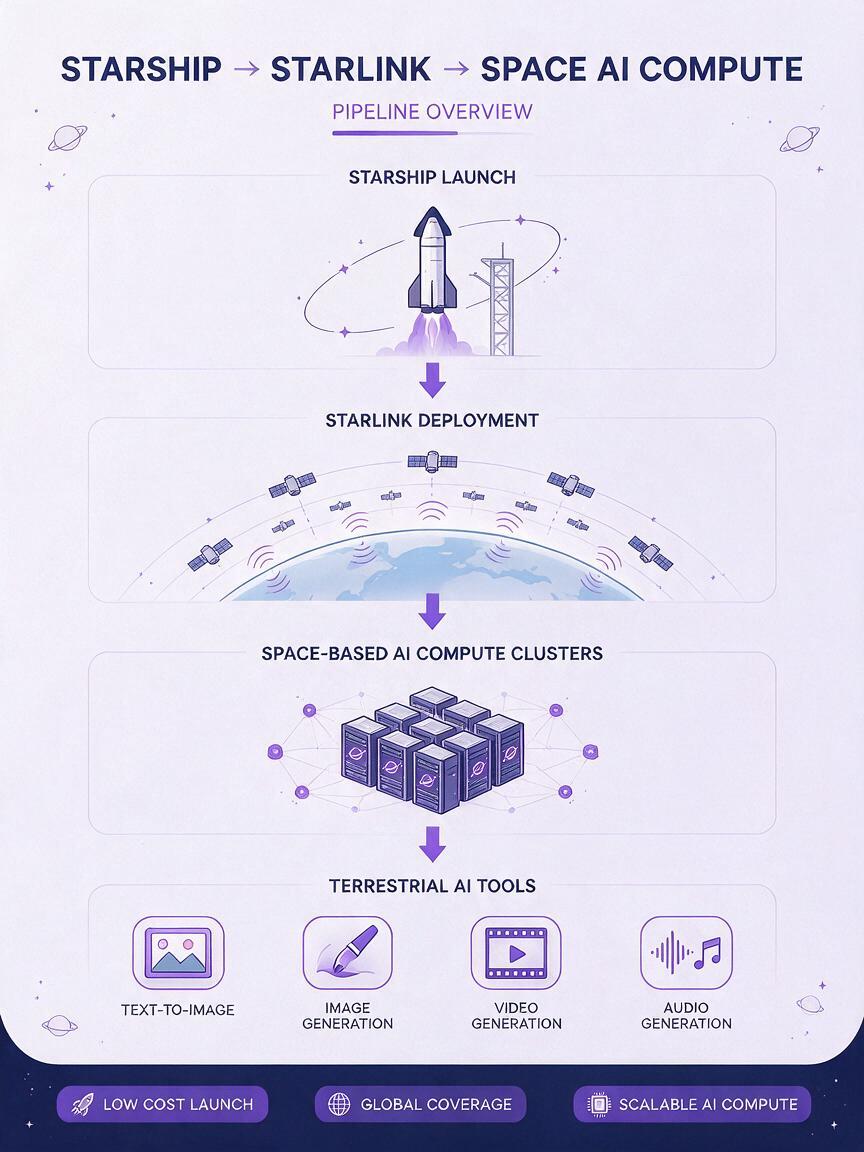
The Starship program’s progress comes as the ai industry grapples with rising ai capital expenditure and constraints on terrestrial data center buildouts. Goldman Sachs has projected that the five largest cloud giants’ AI capex will grow 50% or more to $1.2 trillion next year, as companies race to build enough compute capacity to support booming demand for generative AI tools.
SpaceX has already begun building out its own compute footprint: the company reported Q3 2026 revenue up 161% year over year, with AI revenue nine times higher than year-ago levels, and already rents compute capacity to Google and Anthropic. It also plans a $24 billion gas-fired power plant and supercomputer complex at its Starbase site in Texas, designed to bypass grid interconnection queues.
Fully reusable Starship launches would lower the cost of putting satellites and compute hardware in orbit by orders of magnitude, making the vision of space-based AI compute far more economically viable. Orbital compute facilities could bypass many of the terrestrial barriers to data center expansion, including grid capacity limits, land use disputes and water scarcity concerns that have delayed dozens of U.S. data center projects in 2026.
Merger Talks: Latest Details and Open Questions
The accelerated merger talks reported by Bloomberg build on earlier disclosures that both companies had formed independent director committees to evaluate a potential combination. SpaceX first disclosed its board’s special committee in a prior SEC quarterly filing, and Elon Musk confirmed on SpaceX’s October earnings call that both companies had set up independent committees, citing overlapping work in chips, robotics and orbital data centers.
A combined SpaceX-Tesla entity would rank among the largest corporate combinations in history, but any deal still faces significant hurdles. The reporting is based on unnamed sources, and neither company has officially confirmed the talks or a potential timeline. The two reported timelines — a December announcement versus an early 2027 announcement — are mutually exclusive, adding to the uncertainty. Any final agreement would also require regulatory approval and shareholder votes from both companies.
For the AI industry, a combined entity could deepen integration between Tesla’s custom AI hardware and robotics work and SpaceX’s launch and orbital compute capabilities. But for now, the merger remains unconfirmed and speculative.
What This Means for AI Content Creators
For content teams and individual creators using AI tools, the Starship milestone and broader orbital compute thesis signal long-term shifts in ai video cost and access to advanced generation tools. If space-based compute scales successfully, it could eventually add massive new capacity to the global AI ecosystem, potentially lowering pricing for ai image generator and text to video tools that currently rely on constrained terrestrial GPU clusters.
In the near term, however, the AI infrastructure landscape remains in flux — with shifting capex plans, supply chain constraints and varying provider reliability. That makes flexible, multi-provider creative platforms especially valuable. On MagicBoat, creators can access a wide range of AI creative tools from a single account, without being tied to a single provider’s infrastructure roadmap or pricing changes.
Whether orbital compute becomes a mainstream part of AI content production in five years or ten, creators who build workflows on multi-model platforms are better positioned to adapt as the industry evolves, taking advantage of new capabilities as they emerge without rebuilding their entire stack.
Key Caveats to Remember
- The successful catch only involved the Starship upper stage; the lower-stage booster recovery failed during this mission, so full reuse of the entire launch system is not yet demonstrated.
- Merger talk reporting relies on unnamed sources, with conflicting timelines and no official confirmation from either SpaceX or Tesla.
- There is no public in-orbit AI compute capacity today; space-based compute remains a future thesis, not a current operational reality.
- The $1.77 trillion SpaceX valuation and multi-trillion-dollar projections are analyst estimates, not guaranteed outcomes.
Key Takeaways
- SpaceX’s first Starship upper stage catch with launch tower chopsticks marks a critical milestone toward fully reusable orbital launch, with analysts saying it could support a multi-trillion-dollar valuation and reduce execution risk for space-based AI compute.
- Accelerated SpaceX-Tesla merger talks, if finalized, would create one of the largest corporate combinations in history, with potential synergies across chips, robotics and orbital data centers — but the talks remain unconfirmed and face significant regulatory and shareholder hurdles.
- For AI content creators, long-term expansion of orbital compute could eventually lower ai video cost and expand access to advanced generation tools, while multi-model platforms offer near-term flexibility amid ongoing infrastructure shifts.
- Explore a full suite of AI creative tools across multiple providers and try these models for free on MagicBoat.
Keywords
spacex, starship, ai industry, ai capital expenditure, space-based ai compute, tesla merger, ai funding