SpaceX Tesla Merger Talks Advance: December Announcement Possible
Bloomberg reported on November 12, 2026 that SpaceX and Tesla are advancing merger talks, with a potential agreement announced as early as December and a 2027 announcement option also under discussion. The deal, which would rank among the largest corporate combinations ever, would combine SpaceX's orbital AI infrastructure with Tesla's chip and robotics expertise, reshaping the AI compute landscape. For AI content creators, the proposed merger highlights the importance of building flexible, multi-model workflows that can adapt to infrastructure consolidation.
Table of contents
Bloomberg reported on November 12, 2026 that SpaceX and Tesla are advancing merger talks, with a potential agreement announced as early as December and a 2027 announcement option also under discussion. The deal would rank among the largest corporate combinations in history, though it still faces both regulatory review and shareholder approval before it can move forward.
What the merger discussions entail
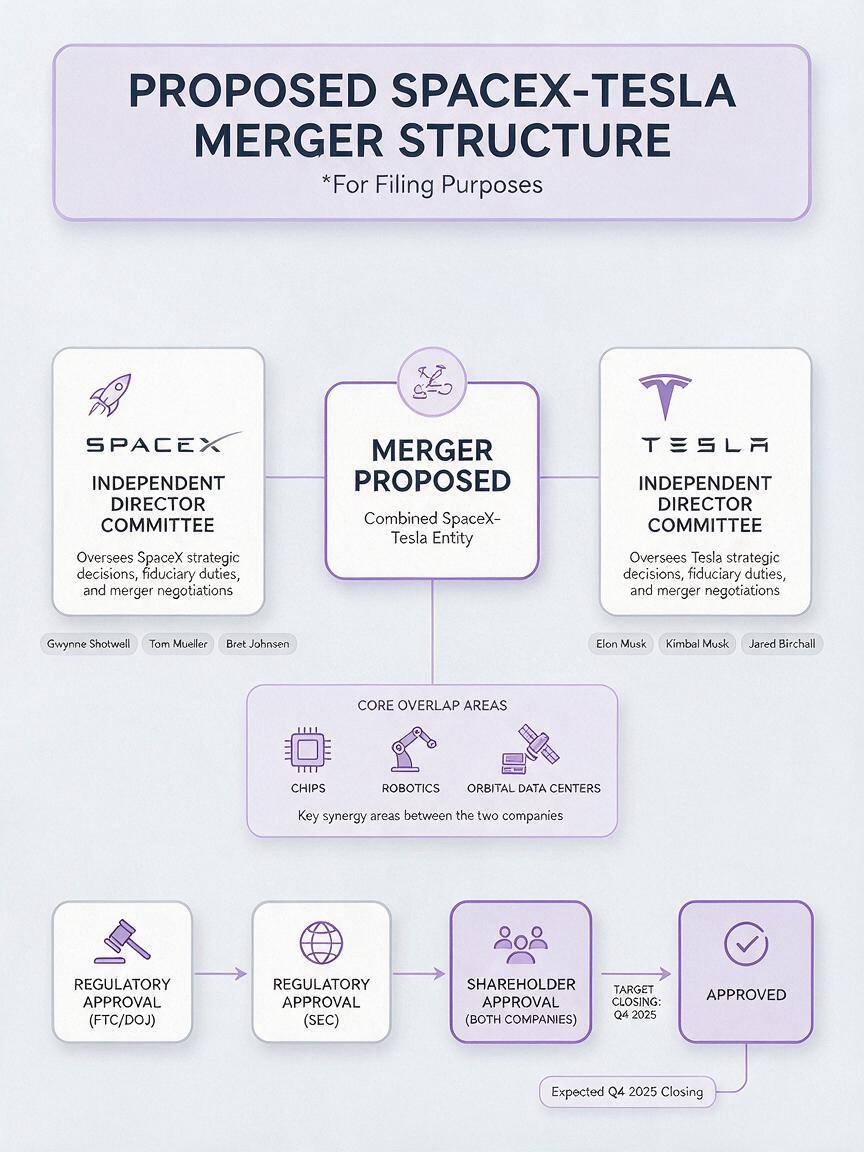
The institutional trail behind the talks is already partially public. SpaceX disclosed in a prior SEC quarterly filing that its board formed a special committee to evaluate a combination with Tesla. Elon Musk confirmed on SpaceX’s October earnings call that both companies had set up independent-director committees to review the deal, citing overlapping strengths in chips, robotics, and orbital data centers as core rationale for the combination.
Context around the proposed deal
The talks come roughly five months after SpaceX’s June public listing, which set records for tech IPOs. This week’s $90.4 billion Anthropic IPO is being compared to SpaceX’s record-setting debut, as investor interest in AI infrastructure and frontier model providers remains high.
On the Tesla side, October retail sales in China came in at just 8,817 units, down 66.1% year over year, with the Model Y falling from the No. 1 sales spot in September to No. 66. Data from Dongchedi attributes the sharp drop largely to September promotion pull-forward, as buyers took advantage of earlier discounts instead of purchasing in October.
All details of the merger talks come from anonymous sources, and neither SpaceX nor Tesla has officially confirmed the discussions.
How the deal could reshape AI infrastructure
A combined SpaceX-Tesla entity would bring together some of the most ambitious AI infrastructure projects in development today. SpaceX has already reported Q3 revenue up 161% year over year, with AI revenue growing nine times compared to year-ago levels, and currently rents compute capacity to major players including Google and Anthropic.
The company is building out 100GW+ of heterojunction solar cell manufacturing capacity to power its Starmind AI satellite constellation, which aims to deliver orbital AI compute that bypasses terrestrial grid, land, and water disputes. SpaceX is also developing a $24 billion gas-fired power plant and supercomputer complex at its Starbase site in Texas, designed to bypass ERCOT interconnection queues and deliver dedicated power for AI workloads.
Tesla brings its own custom chip development, robotics expertise, and vast fleet of edge devices to the table, creating potential for a fully integrated AI stack spanning orbital data centers, terrestrial supercomputing, and edge hardware.
What this means for AI content creators
For creators building ai video generator workflows and other AI-powered content pipelines, the proposed merger highlights both opportunities and risks in the rapidly evolving AI infrastructure space. Orbital AI compute could eventually deliver lower-latency, more reliable access to AI models for creators in regions with limited terrestrial data center coverage, reducing bottlenecks for text to video generation and other compute-heavy tasks.
At the same time, further consolidation of AI infrastructure under a small number of large providers underscores the value of flexible, multi-model AI platforms that don’t rely on a single hardware or cloud provider. A platform that aggregates multiple best-in-class models and tools under one account lets creators adapt quickly to infrastructure shifts, price changes, or availability disruptions without rebuilding their entire workflow from scratch.
Key takeaways
- SpaceX and Tesla are advancing merger talks, with a potential announcement as early as December 2026, though neither company has officially confirmed the discussions.
- The proposed combination would bring together SpaceX’s orbital AI compute and infrastructure projects with Tesla’s chip, robotics, and edge device expertise.
- AI content creators may see long-term benefits from expanded orbital compute capacity, but should build flexible workflows to adapt to ongoing infrastructure consolidation.
- Multi-model AI platforms offer creators a resilient way to access top AI tools without relying on a single infrastructure provider.
If you’re looking to build a flexible, reliable AI content workflow that works no matter how the infrastructure landscape shifts, you can try these models for free on MagicBoat and explore a full suite of AI creation tools in one place.
Keywords
spacex tesla merger, orbital ai compute, ai workflow, ai agent, ai automation, starmind ai satellites, tesla robotics