TSMC October Revenue Jumps 59.7% YoY Amid AI Supply Chain Split
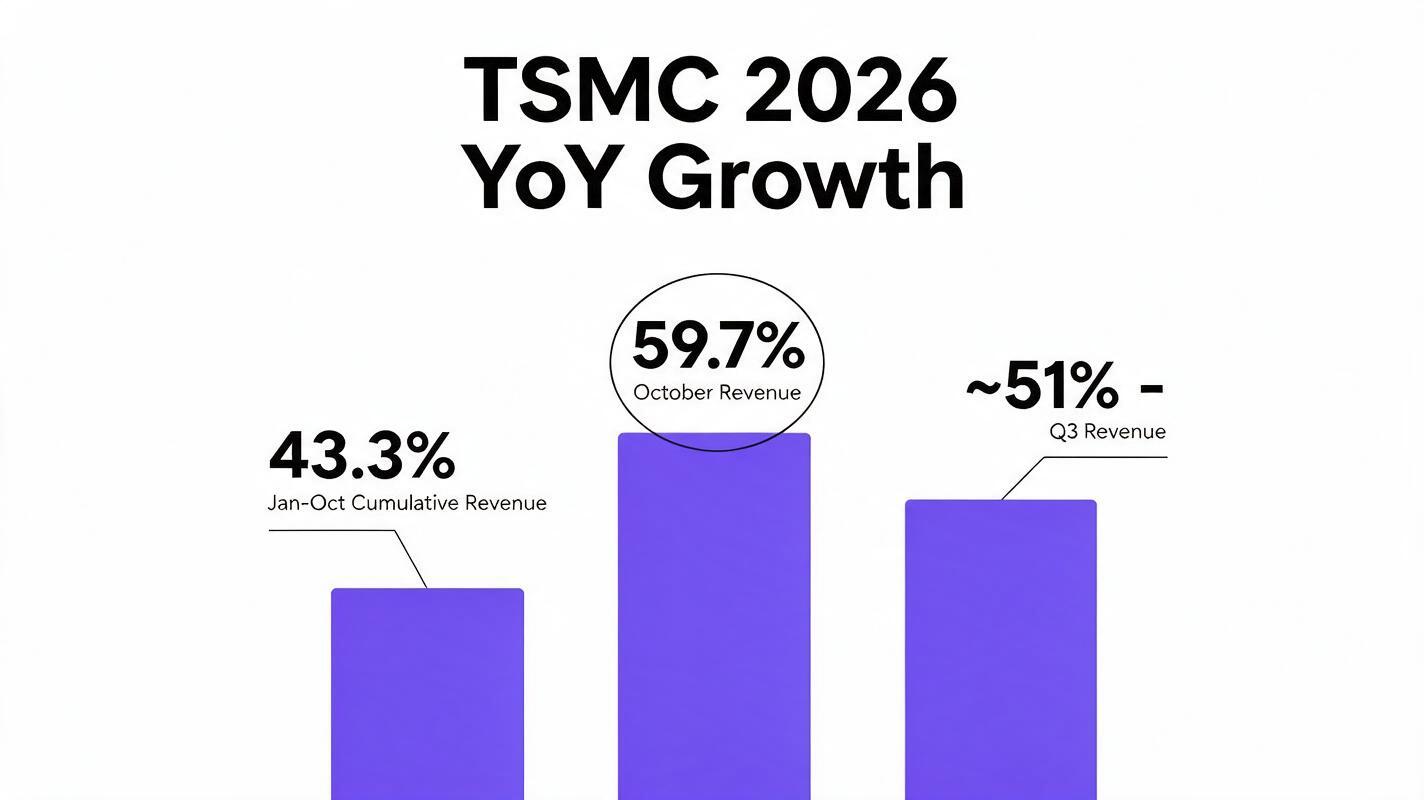
TSMC reported October 2026 revenue of NT$586.89 billion, up 59.7% year-over-year and 14.7% month-over-month, accelerating from the roughly 51% growth posted in Q3 2026. The results highlight a growing split in the AI supply chain, where physical semiconductor layers see steady, prepaid demand while leveraged capital firms face sharp valuation repricing. For AI content creators, the dynamic signals long-term compute expansion alongside short-term provider volatility, making flexible multi-model workflows a key resilience strategy.

Table of contents
TSMC October Revenue: The Full Breakdown
TSMC reported October 2026 revenue of NT$586.89 billion, marking a 59.7% year-over-year increase and a 14.7% month-over-month gain, accelerating from the roughly 51% year-over-year growth the company posted in Q3 2026. Cumulative revenue for the first 10 months of 2026 reached NT$4.49 trillion, up 43.3% from the same period a year earlier.
The strong monthly results come with a noted caveat: monthly growth figures include foreign exchange effects and scheduling shifts, and foundries like TSMC typically feel demand downturns later than other parts of the tech supply chain, as their order books are often booked months in advance.
The AI Supply Chain "Position Split"
When paired with the same day’s volatility across AI-related stocks and infrastructure firms, TSMC’s results highlight a growing “position split” in the global AI supply chain. The physical wafer and semiconductor layer — represented by TSMC and its deep book of prepaid customer orders — continues to accelerate, driven by sustained demand for AI chips.
Meanwhile, the leveraged capital layer of the AI ecosystem is undergoing sharp repricing. Recent weeks have seen neocloud provider CoreWeave lose more than 40% of its share value amid concerns over its debt-heavy balance sheet, SoftBank post a ¥1.1 trillion quarterly loss driven by declines in its OpenAI stake, and Nvidia trade at a governance discount amid a board investigation into its CEO. The market is not punishing AI demand itself, but the heavily leveraged financial structures many firms have built to capitalize on that demand.
Analysts point to Anthropic’s upcoming IPO as a key test of whether the valuation chain between hardware demand and AI firm market value will reconnect, after months of widening disconnect.
What This Means for AI Content Creators
For AI content creators, the split in the supply chain carries both long-term promise and short-term risk. On the positive side, TSMC’s accelerating growth signals that underlying AI compute supply is expanding at a rapid clip, which over time should support more capable models, wider availability, and lower costs for tools like ai video generator platforms and ai script writer tools.
The short-term risk comes from the volatility in the leveraged capital layer. Many AI tools and model providers rely on venture funding, debt financing, or neocloud infrastructure partnerships to operate. If those financing sources dry up or become more expensive, some providers could raise prices, throttle access, or even shut down services entirely with little warning.
For creators who build their entire workflow around a single AI tool or provider, that volatility creates real business risk. A sudden price hike or service outage can derail deadlines, lose clients, and eat into profit margins.
That’s why forward-thinking creators are building flexible, multi-model workflows that don’t depend on any single provider. A platform like MagicBoat centralizes dozens of AI content tools in one place, so you can switch between models for different tasks, adapt to pricing or availability changes quickly, and keep your projects on track even when the broader AI market shifts. If you’re ready to build a more resilient AI content workflow, you can try these models for free on MagicBoat today.

Key Takeaways
- TSMC’s October 2026 revenue rose 59.7% year-over-year, accelerating from Q3’s ~51% growth and reflecting strong underlying demand for AI-related semiconductors.
- The AI supply chain is split between the steady, growing physical hardware layer and the volatile leveraged capital layer, where debt-heavy firms face sharp valuation declines.
- Creators benefit from long-term compute expansion but should build multi-model workflows to protect against short-term provider volatility and service disruptions.
Keywords
tsmc, ai supply chain, ai workflow, ai automation, ai agent, semiconductor revenue, ai compute