Typesafe AI Raises $870M Series A at $7.5B for TypeScript AI Infrastructure
Typesafe AI has raised $870 million in Series A funding at a $7.5 billion valuation, led by Andreessen Horowitz, to build TypeScript-native AI infrastructure centered on its Jev runtime. The round reflects broader investor appetite for developer-focused AI tooling that simplifies application building and deployment. For content teams and creators, the investment signals growing maturity in AI infrastructure that could lead to more reliable creative tools and lower production costs over time.

Table of contents
The Typesafe AI Series A Funding Breakdown
On October 9, Typesafe AI announced it has raised $870 million in Series A funding at a $7.5 billion valuation, with Andreessen Horowitz (a16z) leading the round. The capital is earmarked for expanding the company’s TypeScript-native AI infrastructure, centered on its Jev runtime, which is designed to let developers build and deploy AI applications directly within familiar TypeScript workflows. The round ranks among the largest Series A investments in an AI infrastructure company to date, reflecting intense investor interest in tools that lower the barrier to integrating AI into production software.
Unlike many AI startups that focus on building foundation models or end-user applications, Typesafe AI targets the developer layer of the AI stack. Its Jev runtime aims to solve common pain points for developers building AI-powered tools, including complex model integration, performance optimization, and infrastructure management, all within the TypeScript ecosystem that millions of web and app developers already use daily.
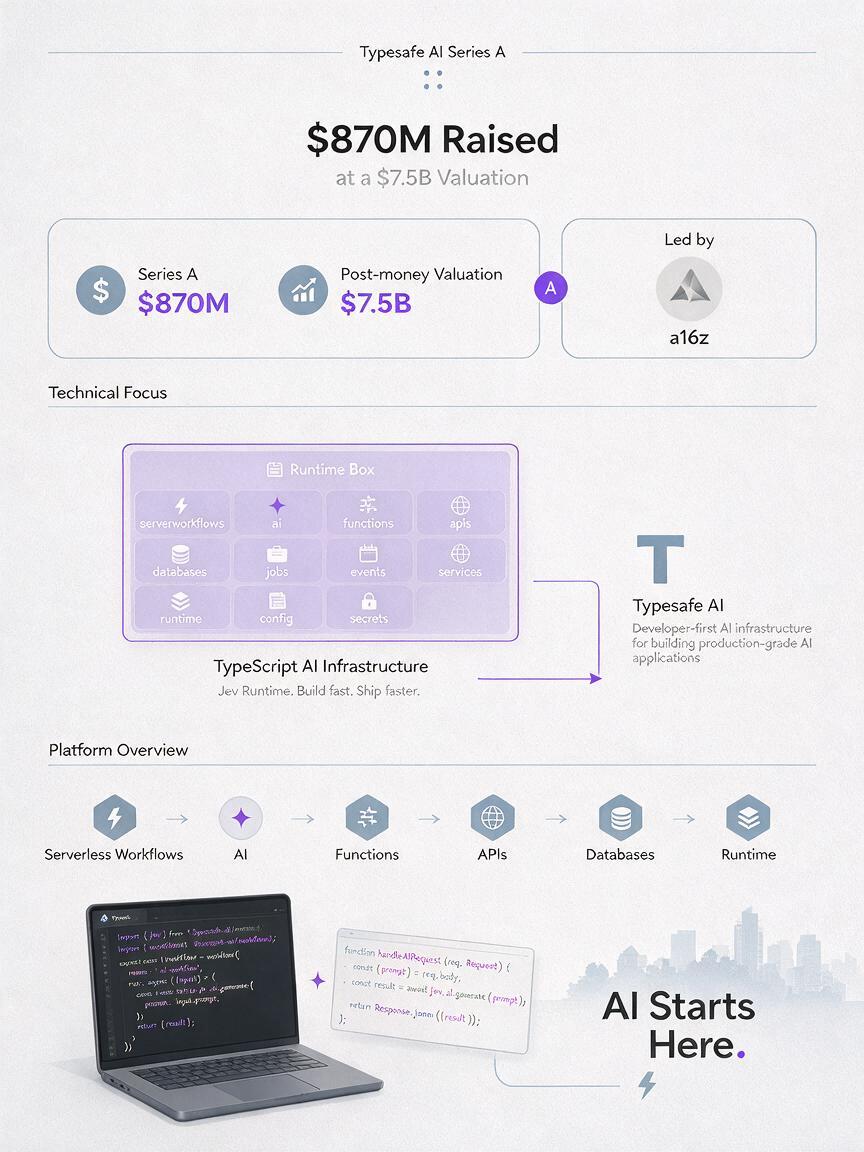
What TypeScript AI Infrastructure Does
TypeScript is a popular superset of JavaScript that adds static typing and other features designed to make large codebases easier to maintain and scale. It is used extensively in web development, app building, and server-side programming, making it one of the most widely adopted programming languages in the tech industry.
AI infrastructure built natively for TypeScript lets developers connect AI models to their applications without having to switch between programming languages, manage separate runtime environments, or build custom integration layers from scratch. This can cut development time, reduce the risk of bugs, and make it easier for smaller teams to add AI capabilities to their products. For end users, this often translates to faster feature rollouts, more stable tools, and better overall performance.
The Jev runtime, at the core of Typesafe AI’s product roadmap, is built to run AI workloads efficiently in TypeScript environments, with support for popular models and integration with common development tools. The funding will be used to expand the runtime’s capabilities, improve performance, and build out additional developer tools and resources.
Why This Matters for the Broader AI Industry
This massive Series A round is part of a broader surge in ai funding and ai capital expenditure flowing into every layer of the AI ecosystem, from foundation model providers to infrastructure builders. Recent analysis from Goldman Sachs estimates that AI capital expenditure from the five largest cloud giants will grow more than 50% next year to reach $1.2 trillion, as companies race to build out the capacity needed to support booming demand for AI services.
Even model providers like deepseek, which has reported annualized revenue of roughly $1 billion and is in the process of raising around $7.5 billion at a $74 billion valuation, depend on underlying infrastructure tools to deliver their services reliably to end users. Without robust developer infrastructure and runtime environments, even the most powerful AI models are difficult and expensive to integrate into real-world applications.
The focus on TypeScript-specific infrastructure also highlights a key shift in the ai industry: as AI moves from a niche technology to a mainstream building block, the most valuable tools may not be the flashiest models, but the ones that make AI accessible to the millions of developers who already build the software we use every day. By meeting developers where they are, companies like Typesafe AI can accelerate AI adoption across every sector, including creative tools and content production.
What This Means for Creators and Content Teams
For creators and content teams, infrastructure funding announcements may feel far removed from day-to-day work, but their impact can be significant over time. Most of the AI creative tools teams rely on — from ai image generator platforms to ai video generator tools — are built using web and app development stacks that rely on TypeScript and similar infrastructure tools.
When the underlying infrastructure improves, tool providers can roll out new features faster, fix bugs more quickly, and run their services more efficiently. Those efficiency gains can translate to lower ai video cost, faster generation times, and more reliable service for end users. Conversely, when infrastructure tools are limited or unstable, creators may face longer wait times, more frequent outages, and higher prices as providers pass on increased development and maintenance costs.
For teams that depend on AI tools for regular content production, infrastructure stability is a critical but often overlooked factor in workflow planning. A single outage or API change can derail a production schedule, lead to missed deadlines, and force teams to scramble for alternative tools at the last minute. This is why many content teams choose multi-model platforms that abstract away much of the underlying infrastructure complexity, letting creators focus on producing content rather than monitoring provider roadmaps and troubleshooting integration issues.

Practical Tips for Navigating AI Infrastructure Shifts
Instead of trying to keep up with every infrastructure funding announcement or predict which tech stack will come out on top, creators can focus on practical, actionable steps to protect their workflows and control costs.
- Track cost per approved asset, not per generation. The real cost of an AI tool includes not just the price per generation, but also the time spent on revisions, reworks, and troubleshooting. A slightly more expensive tool that produces usable output on the first try may be cheaper in the long run than a cheaper tool that requires multiple revisions.
- Prioritize multi-model access. Using a platform that gives you access to multiple AI models from different providers reduces your risk of being locked into a single provider’s infrastructure roadmap. If one model experiences an outage or price increase, you can switch to another without disrupting your workflow.
- Test new tools in a separate environment. It’s always a good idea to test new AI tools and features on non-critical projects before integrating them into your core production workflow. This gives you a chance to evaluate their stability, output quality, and cost-effectiveness without risking deadlines.
- Build flexibility into your workflow. Design your content production process so that you can switch between tools or providers if needed. Avoid building workflows that depend on a single tool’s unique features, and keep backups of your work in accessible formats.
If you’re looking for a stable, multi-model platform that brings together image, video, audio, and script generation tools in one place, you can try these models for free on MagicBoat. The platform’s unified interface lets you switch between models and tools seamlessly, so you can adapt to changes in the AI landscape without reworking your entire workflow.
Key Takeaways
- Typesafe AI has raised $870 million in Series A funding at a $7.5 billion valuation, led by a16z, to build TypeScript-native AI infrastructure centered on its Jev runtime.
- The round reflects broader trends in ai funding and ai capital expenditure, as investors pour money into every layer of the AI stack to support growing demand for AI services.
- For creators, improved AI infrastructure can lead to faster, more reliable creative tools and potentially lower production costs over time.
- Multi-model platforms like MagicBoat help insulate creators from infrastructure shifts, provider lock-in, and unexpected service disruptions.
Keywords
typesafe ai, ai funding, ai industry, typescript ai infrastructure, jev runtime, ai developer tools, series a funding