Typesafe AI Raises $870M Series A at $7.5B Valuation
Typesafe AI raised an $870 million Series A led by a16z at a $7.5 billion valuation for its TypeScript AI infrastructure and Jev runtime. The announcement highlights growing investment in the software layer supporting AI applications while giving content teams another reason to keep creative workflows portable across models and platforms.

Table of contents
Typesafe AI Secures $870 Million for TypeScript AI Infrastructure
Typesafe AI has raised an $870 million Series A at a $7.5 billion valuation, putting substantial new capital behind TypeScript AI infrastructure and the company’s Jev runtime.
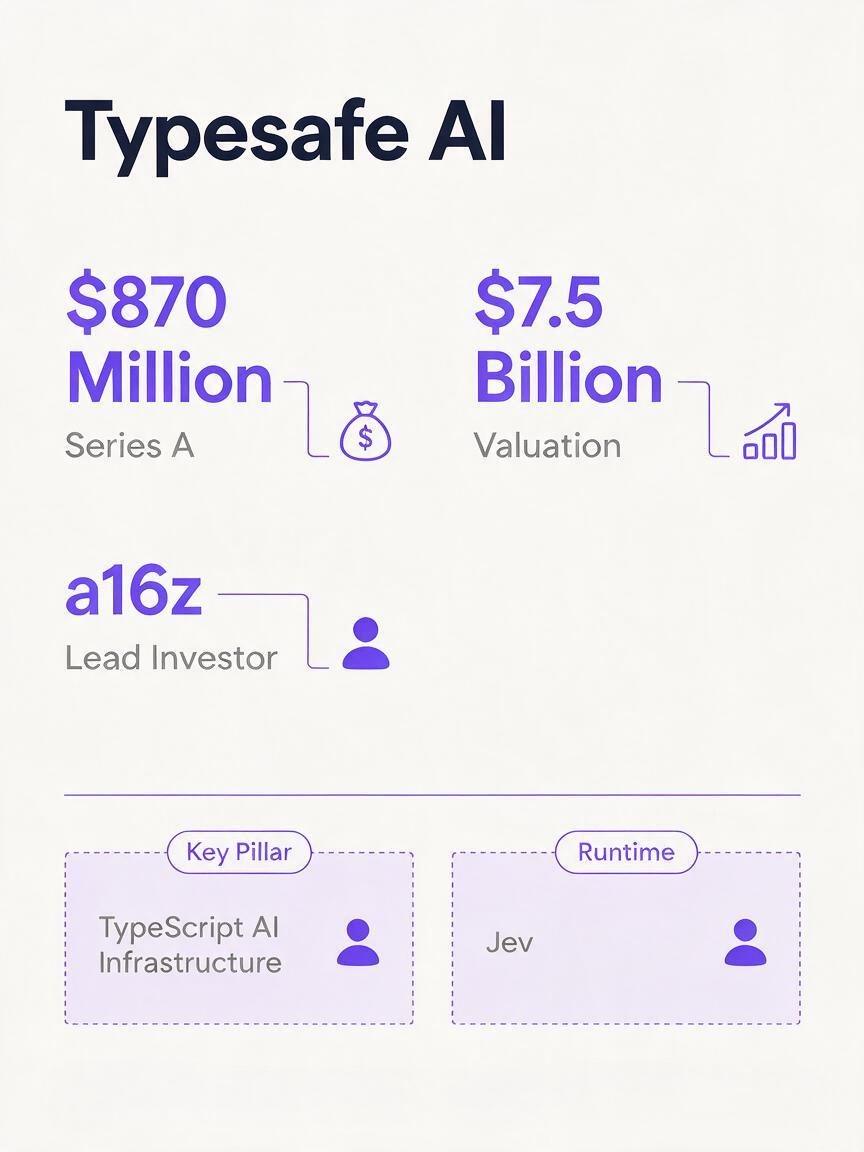
The funding announcement was reported on October 9, 2026. The round was led by a16z and centers on Typesafe AI’s work in TypeScript-based AI infrastructure, with Jev identified as its runtime. Those are the essential disclosed facts: an $870 million Series A, a $7.5 billion valuation, a16z as lead investor, and an infrastructure strategy built around TypeScript and Jev.
The size of the round makes the underlying category especially important. AI competition is not limited to individual models or consumer-facing assistants. Capital is also moving toward the infrastructure used to develop, connect, and operate AI applications.
For content teams, the immediate lesson is not that funding automatically produces better creative output. It is that the software layer around an AI model increasingly affects whether an ai workflow remains maintainable, portable, and easy to supervise as production demands expand.
What the Typesafe AI Funding Announcement Confirms
The Typesafe AI announcement combines a major financing event with a specific technical focus. Rather than presenting another named content model, the company is positioning TypeScript AI infrastructure and the Jev runtime as the foundation of its work.
| Announcement detail | Reported information |
|---|---|
| Company | Typesafe AI |
| Financing | $870 million Series A |
| Valuation | $7.5 billion |
| Lead investor | a16z |
| Technical focus | TypeScript AI infrastructure |
| Runtime | Jev |
These figures communicate investor confidence, but they do not independently establish product quality, reliability, or suitability for a particular production environment. A funding round is a business signal. Creative teams still need to judge tools by their own requirements, including output quality, controllability, availability, review options, and workflow continuity.
Infrastructure matters most when it makes creative work easier to control without making the production process dependent on one irreplaceable component.
Why TypeScript AI Infrastructure Matters Beyond Developers
Infrastructure can sound distant from everyday content production, yet it shapes how an ai assistant fits into a larger operation. A campaign may begin with a brief, continue through script drafting and visual development, and finish with video generation, voice work, review, and publication. The audience sees the final asset, but the production team depends on connections between many tools and decisions.
A TypeScript-centered infrastructure company belongs to the layer where those connections can be organized. The funding announcement does not specify particular creative capabilities for Jev, so it would be premature to assign it features that have not been disclosed. Its relevance lies in the broader direction of the market: AI products increasingly need software architecture around the model, not merely access to model output.
That distinction is useful when evaluating ai automation. A model may generate impressive material in isolation, while a production workflow still struggles with lost context, inconsistent file naming, unclear approvals, or a hard dependency on one provider. Infrastructure can influence whether the system around the model remains understandable when projects become more complex.
Creative Workflows Need Portable Production Context
The Typesafe AI news offers a reason to separate creative intent from technical execution. A durable production record should preserve the information needed to continue a project even if a model, runtime, or service changes.
For an AI content project, that portable context can include:
- The approved brief: audience, message, format, tone, and publication destination.
- Prompt history: the instructions that produced useful scripts, images, or scenes.
- Reference assets: source images, visual direction, and approved character details.
- Editorial decisions: accepted claims, rejected concepts, and human review notes.
- Output records: selected versions and the reason each version was chosen.
- Fallback options: alternative models or tools that can continue the work if availability changes.
This record is valuable whether a team uses an autonomous ai agent, a tightly controlled ai assistant, or a human-led production process with occasional model support. It keeps the campaign’s meaning outside any single system.

Funding Does Not Remove Model Selection Risk
An $870 million round and a $7.5 billion valuation can attract attention, but financial scale should not become a substitute for workflow evaluation. Content teams need to distinguish the company-level announcement from the practical questions that govern daily production.
Relevant questions include whether a tool fits the required media format, whether humans retain publication authority, whether project context can be exported, and whether another model can take over without rebuilding the entire campaign. Teams should also examine how outputs are reviewed before they reach customers or public channels.
This is particularly important for agent-driven production. An ai agent can coordinate more activity than a single prompt, but broader autonomy also raises the cost of ambiguous instructions. The creative brief, approval boundary, and final publishing decision should remain explicit rather than being inferred by an automated system.
The same principle applies to ai automation generally: automation is most useful when it removes repetitive work while preserving human control over brand claims, sensitive material, and final output.
Where MagicBoat Fits Into a Model-Independent AI Workflow
Typesafe AI’s financing highlights the growing value of the infrastructure surrounding AI. For creative teams, a parallel priority is reducing fragmentation across the tools used to turn an idea into finished media.
MagicBoat provides an ai film platform for organizing creative production in one environment. Teams can develop story structure with an ai storyboard while keeping the underlying brief, references, and review criteria consistent across the project.
This platform approach is useful because model availability and project requirements can change independently. A team should be able to retain its narrative, visual direction, and approved materials even when it wants to test another model or revise one part of an ai video workflow.
The goal is not automation for its own sake. It is a production environment in which AI supports ideation and execution while people remain responsible for editorial judgment. That balance lets teams benefit from new infrastructure without handing the identity of a project to one technical dependency.

What Content Teams Should Take From the Typesafe AI Round
The $870 million Series A shows that investors are placing substantial value on AI infrastructure, including infrastructure associated with TypeScript and the Jev runtime. It also reinforces a wider shift in attention from standalone model demonstrations toward the systems that make AI applications operational.
Content teams do not need to adopt every newly funded platform. They do need to recognize that creative output now depends on an expanding stack of models, runtimes, applications, and storage systems. The strongest response is to preserve project context, maintain human approval, and avoid designing an entire production process around one component that cannot be replaced.
MagicBoat offers a practical place to bring creative work together while retaining flexibility across production tasks. To explore a unified environment for AI-assisted storytelling and media development, try these models for free.
AI Workflow Resilience Checklist
- Keep the creative brief separate from any individual model session.
- Save prompts, references, selected outputs, and review notes together.
- Define which actions require human approval before publication.
- Evaluate tools by creative fit and reliability, not financing alone.
- Maintain alternative options for important production tasks.
- Use a unified environment to reduce fragmented creative context.
Keywords
typesafe ai, jev runtime, typescript ai infrastructure, ai workflow, ai automation, ai assistant, ai content creation