US Stocks Close Lower as Apple’s New Products Fail to Impress
CNBC reported on October 12, 2026, that US stocks closed lower on Monday as Apple’s new products failed to impress the market. The reaction highlights why news teams must separate short-term investor sentiment from verified product facts when building AI-assisted content.

Table of contents
US Stocks Close Lower as Apple Products Disappoint
A cool market response to Apple’s new products contributed to a lower close for US stocks, turning product reception into a broader financial-news signal.
On October 12, 2026, CNBC reported that US stocks closed lower on Monday as Apple’s new products failed to impress the market. The central news point was not simply that one technology company faced a muted response. Apple’s product reception became part of the explanation for weakness across the wider US stock market.
The report establishes a clear directional result: stocks finished lower, and disappointment surrounding Apple’s new products was identified as an important part of the session’s narrative. It does not, however, provide percentage changes, individual index results, product sales figures or a quantified measure of investor disappointment. Those distinctions matter because a lower market close is a verified event, while broader claims about long-term demand would require additional evidence.
For creators and editorial teams, this is a useful example of how product, technology and financial coverage can converge in one headline. It also shows why an AI workflow must preserve attribution and separate the confirmed event from interpretation.
What the Market Reaction Does—and Does Not—Show
Financial markets can respond quickly to product announcements, expectations and changing sentiment. In this case, the reported response was negative enough for Apple’s new products to feature in CNBC’s explanation of the lower US market close.
That does not automatically establish that the products will fail commercially. A single trading session reflects the market’s reaction at a particular moment, not a final judgment on future sales, customer adoption or the long-term direction of Apple’s business.
The careful reading: US stocks closed lower, and Apple’s new products failed to impress the market. The report does not support adding unlisted percentages, sales forecasts or long-term product conclusions.
This boundary is especially important when an ai assistant is used to expand a short news brief. Language models can produce plausible explanations, but plausibility is not evidence. A reliable editorial process keeps the confirmed facts visible and labels analysis as analysis.

Why Product Reception Can Influence a Wider News Cycle
Apple product news regularly spans several editorial categories at once. A launch can become a hardware story, an ecosystem story, a consumer-demand story and a stock-market story. When the immediate response is disappointing, that reaction can shape headlines beyond the company itself.
The October 12 report illustrates this connection without establishing a permanent trend. The important relationship is between product reception and market sentiment during that session. Content teams should resist converting that relationship into a stronger claim than the available facts support.
A disciplined article can therefore discuss three layers while keeping them distinct:
- Confirmed event: US stocks closed lower on Monday.
- Reported catalyst: Apple’s new products failed to impress.
- Editorial analysis: Product expectations can affect how technology companies are framed in financial coverage.
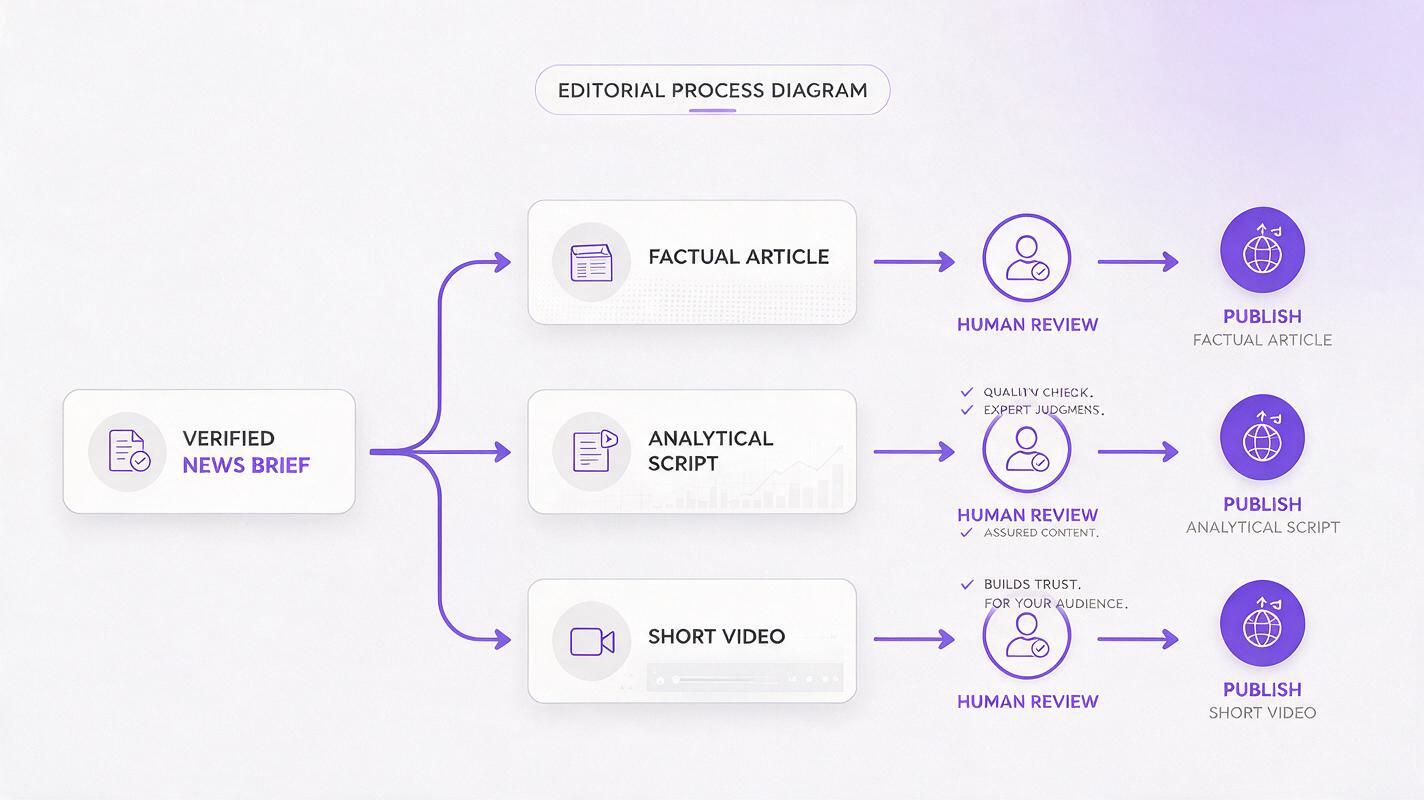
This structure also makes content easier to adapt. The confirmed event can anchor a news article, while the analytical layer can support a newsletter, commentary video or social post without altering the underlying facts.
Translating the News Into an AI Content Workflow
Fast-moving financial stories create pressure to publish quickly, but speed increases the risk of unsupported detail. An effective ai workflow begins with a compact fact sheet containing only the date, publication, market direction, company and reported reason for the reaction.
From there, ai automation can help create format-specific drafts while human editors retain control over claims. A short market brief may emphasize the lower close. A technology commentary may focus on the reception of Apple’s products. A video script may explore the distinction between immediate sentiment and long-term performance.
| Content layer | Safe focus | Editorial risk |
|---|---|---|
| News headline | Lower US stock close and Apple product reaction | Adding unsupported market figures |
| Commentary | Difference between sentiment and long-term results | Presenting interpretation as fact |
| Short video | Product news becoming a market story | Using dramatic claims not found in the report |
| Social summary | Concise attribution to CNBC | Removing attribution for brevity |
Teams developing a script can use an ai script generator to organize the confirmed event, contextual analysis and closing takeaway into separate sections. That separation reduces the chance that an interpretive line will be mistaken for a reported fact.
Where MagicBoat Fits Into Market-Reaction Coverage
A market story may need to become several assets within the same publishing window. MagicBoat provides a one-account AI creation environment that can support script development, visual production and an ai video workflow without requiring the editorial team to rebuild the story’s core context for every format.
For this Apple market-reaction story, the source brief can remain the factual anchor while different outputs adopt distinct creative treatments. A written analysis can explain the limits of a one-session reaction. An ai video generator can support a concise visual summary built around market sentiment, product expectations and careful attribution.
The benefit is not permission to embellish the news. It is the ability to reuse an approved narrative across multiple formats while maintaining consistent language. Human review remains essential, particularly for dates, market direction, company names and causal wording.
Editorial Guardrails for Financial and Technology News
Market coverage should make uncertainty visible rather than smoothing it away. If the available report says products failed to impress, the article should not silently transform that phrase into claims about poor sales, customer rejection or a lasting decline.
Several editorial controls help protect accuracy:
- Keep reported facts and commentary in separate paragraphs.
- Preserve attribution when describing the reason for a market move.
- Avoid percentages, prices and forecasts that are absent from the source material.
- Use conditional language when discussing possible future implications.
- Review every derivative asset against the same approved fact sheet.
These controls are useful beyond financial news. Any ai agent producing multiple assets can drift as a story moves from article to script, script to visual and visual to caption. A shared factual core makes that drift easier to detect.

Key Takeaways
- CNBC reported on October 12, 2026, that US stocks closed lower on Monday.
- Apple’s new products failing to impress was part of the reported market narrative.
- The event reflects short-term market sentiment, not a confirmed long-term judgment on product performance.
- AI-assisted coverage should distinguish verified facts, attributed explanations and editorial analysis.
- MagicBoat can help teams reuse a controlled narrative across scripts and video assets.
- try these models for free to build a fact-controlled, multi-format production workflow.
Keywords
us stocks close lower, apple new products, apple market reaction, ai workflow, ai assistant, ai automation, ai video workflow