US Tech Stocks Plunge as ASML Reports Record Backlog Through 2030
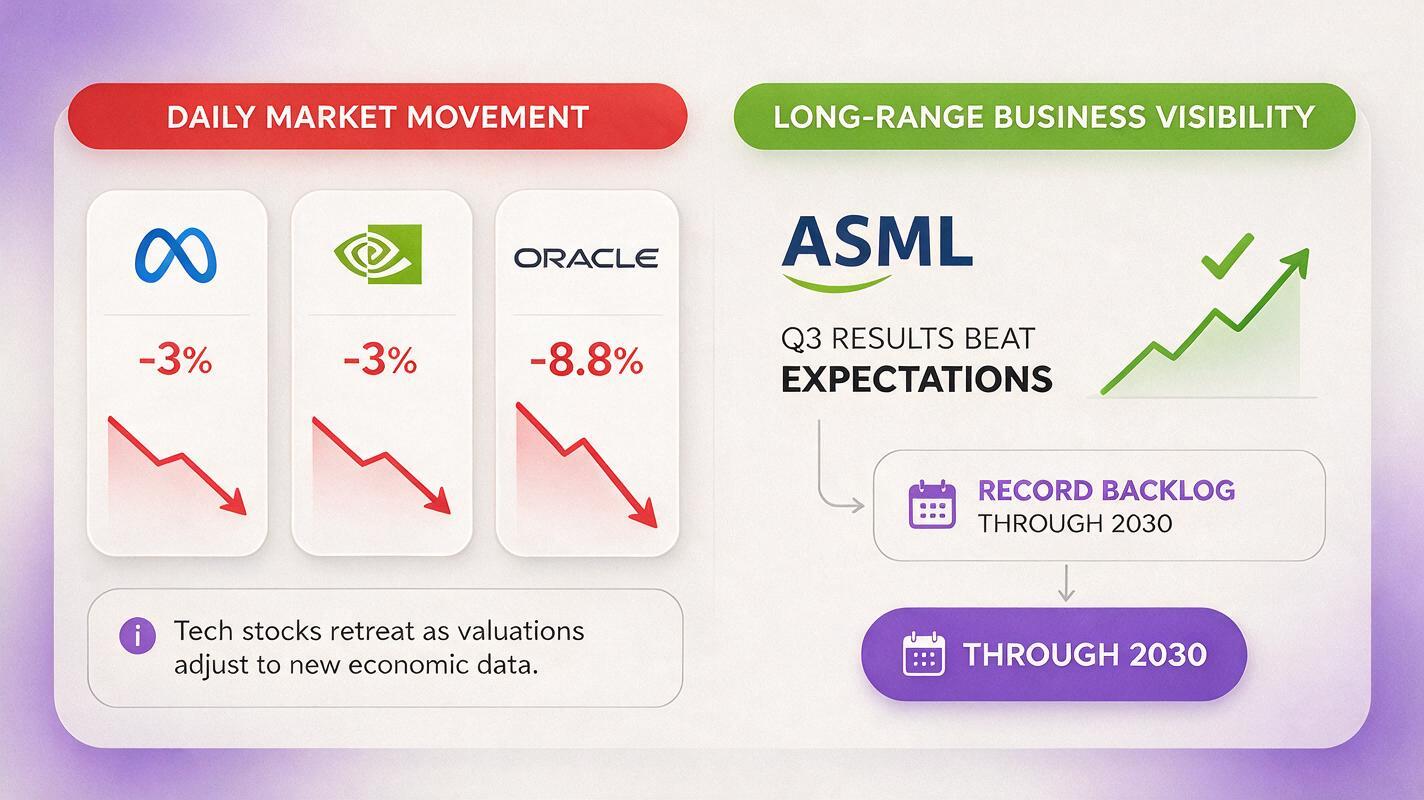
US technology stocks fell sharply on October 15, 2026, with Meta and Nvidia down 3% and Oracle dropping 8.8%. The selloff coincided with an contrasting industry signal from ASML, whose third-quarter performance beat expectations and included a record backlog extending through 2030.
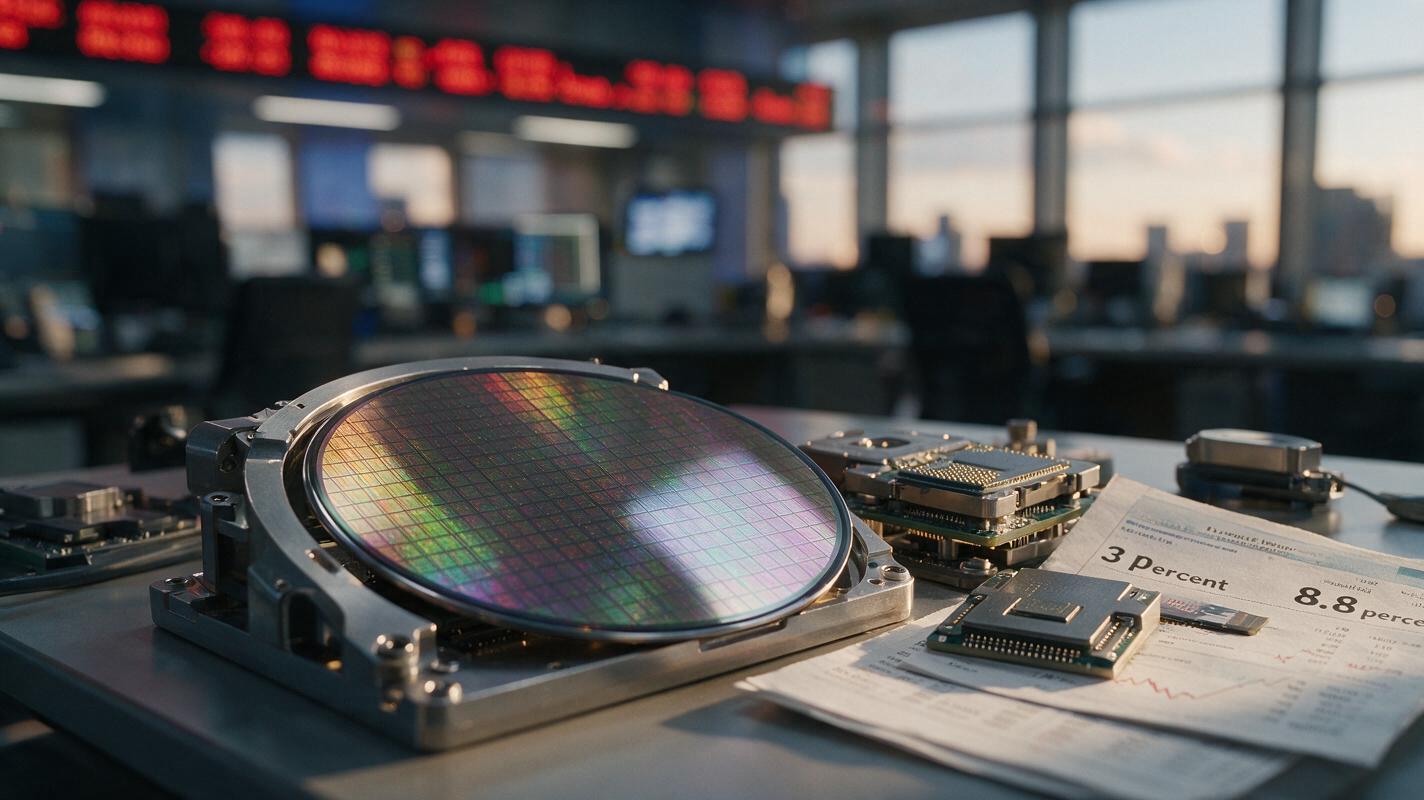
Table of contents
US Tech Selloff Meets a Contrasting ASML Signal
US technology stocks came under sharp pressure on October 15, 2026, producing notable declines across several companies closely associated with the expansion of artificial intelligence infrastructure. Meta and Nvidia each fell 3%, while Oracle recorded a much steeper 8.8% decline.
Those losses formed one side of the day's technology story. On the same date, semiconductor-equipment company ASML reported third-quarter performance that beat expectations and disclosed a record backlog extending through 2030. The two developments presented a divided picture: immediate pressure on major technology shares alongside long-range demand visibility within a critical part of the semiconductor supply chain.
The available figures do not establish that ASML's report caused, prevented or directly explained any of the individual stock movements. They instead show why a single trading session can contain competing signals about current market sentiment and the industry's longer-term direction.
For creators and production teams, this matters because the companies affected are connected to platforms, computing infrastructure and enterprise services used throughout the AI economy. Market volatility does not automatically change an AI workflow, but it can be a useful reminder to avoid building an entire content operation around one company or ecosystem.

What the October 15 Numbers Actually Show
The reported facts are concise but significant. Three prominent technology stocks moved lower, while ASML delivered a stronger operational update with visibility stretching several years into the future.
| Company | Reported development | What can be stated directly |
|---|---|---|
| Meta | Shares fell 3% | The stock participated in the October 15 technology selloff. |
| Nvidia | Shares fell 3% | The stock declined despite its central position in the broader AI market. |
| Oracle | Shares fell 8.8% | Oracle sustained the largest reported decline among the named companies. |
| ASML | Third-quarter performance beat expectations | The company also reported a record backlog extending through 2030. |
The distinction between these data points is important. Share-price movements measure how securities traded during the session. A backlog concerns business already accumulated for future delivery or execution. They describe different time horizons and should not be compressed into a single bullish or bearish conclusion.
A volatile trading day can reflect immediate sentiment, while a multiyear backlog can point to longer-term industry demand. Both signals can exist at the same time.
Why the ASML Backlog Adds a Second Signal
ASML's record backlog through 2030 gives the story a longer horizon than the day's falling stock prices. The third-quarter result also beat expectations, creating a contrast between weakness in publicly traded technology names and reported strength at a semiconductor-equipment supplier.
The backlog does not guarantee how AI markets, semiconductor demand or technology stocks will perform through 2030. It does, however, provide a concrete counterweight to interpretations based only on one session. A careful reading recognizes both the immediate selloff and the forward-looking business visibility without treating either as a complete forecast.
This distinction is particularly useful in AI news, where infrastructure announcements, model releases, capital spending and market valuations are frequently blended together. Each belongs to a different layer of the ecosystem. Stock prices can change rapidly, while hardware capacity and semiconductor supply chains operate across much longer planning periods.
What This Means for AI Content Operations
Meta, Nvidia and Oracle occupy different positions within the technology landscape, but all are relevant to conversations about AI platforms, computing and enterprise infrastructure. Their simultaneous declines illustrate how market sentiment can affect multiple layers of the sector at once.
Creators do not need to react to every daily price movement by changing their tools. The more durable lesson is operational: an AI assistant, generation model or cloud service can sit inside a much larger commercial ecosystem. Changes in investment priorities, product strategy or platform access can eventually influence availability and workflow design, even when a one-day stock move has no immediate production impact.
Facts and interpretation need separate treatment
Market coverage becomes unreliable when reported numbers and editorial conclusions are mixed together. In this case, the defensible factual core includes the 3% declines for Meta and Nvidia, Oracle's 8.8% fall, ASML's expectation-beating quarter and its record backlog through 2030.
Claims about why each stock moved, what investors will do next or whether the backlog guarantees continued AI growth would require evidence beyond those facts. Keeping that boundary visible helps teams produce timely commentary without turning an attributed market report into an unsupported prediction.
Portable production reduces ecosystem exposure
A resilient AI workflow keeps scripts, prompts, visual references and approved assets portable. That structure makes it easier to continue production when a preferred tool changes, an account becomes unavailable or a platform no longer fits a project's requirements.
- Retain source material: Keep original scripts, prompts and reference files outside any single generation service.
- Preserve approved outputs: Store selected images, video clips and copy in reusable project folders.
- Separate creative intent from tooling: Document the desired scene, tone and format so another model can interpret the same brief.
- Review market claims carefully: Preserve the difference between a reported number, an attributed explanation and an editorial inference.
MagicBoat and a More Resilient AI Workflow
MagicBoat supports a production approach in which the creative brief remains central rather than being tied to one technology provider. A team can develop visual concepts with an ai image generator, then carry selected assets into an ai video generator workflow without treating one public company's daily valuation as a creative roadmap.
This matters for fast-moving market stories. A compact production package can contain the verified figures, an attribution-safe script, visual references and multiple output formats. If a tool or model becomes unsuitable, the underlying editorial work remains available for reuse.
For example, coverage of the October 15 session could visually contrast a red market board representing the reported stock declines with semiconductor manufacturing equipment representing ASML's multiyear backlog. That concept communicates the central tension without inventing a causal relationship or pretending that daily trading and long-range orders measure the same thing.

Editorial Guardrails for Volatile Market News
A short fact block can help an AI-assisted newsroom preserve the limits of the source material before generating headlines, scripts or visual briefs.
Confirmed market data:
Meta: down 3%
Nvidia: down 3%
Oracle: down 8.8%
ASML: Q3 beat expectations
ASML: record backlog through 2030

Editorial boundary:
Do not invent causes, forecasts or guaranteed outcomes.
Present the selloff and backlog as distinct signals.
This type of constraint is useful for AI automation because it tells the system what is confirmed and what must remain interpretation. It also helps editors update an article cleanly if additional reporting later supplies a documented explanation for the market movements.
To build a portable content package around this or another fast-moving technology story, try these models for free and keep the verified brief consistent across copy, images and video.
Key Takeaways
- Meta and Nvidia each fell 3% during the reported October 15 technology selloff.
- Oracle declined 8.8%, the largest named drop in the available report.
- ASML's third-quarter performance beat expectations and included a record backlog extending through 2030.
- The stock declines and ASML backlog represent different time horizons and should not be treated as direct equivalents.
- Portable prompts, source files and approved assets can make AI content production less dependent on one company or platform.
- AI-assisted market coverage should clearly separate confirmed figures from causes, forecasts and interpretation.
Keywords
us tech stocks plunge, asml record backlog, meta stock, nvidia stock, oracle stock, ai workflow, ai automation