OpenAI Dissolves Standalone Robotics Research Team
OpenAI has dissolved its standalone robotics research team while keeping its 2027 humanoid demonstration target unchanged. The reorganization moves researchers and applied robotics staff into broader company divisions as GPT-6 Astra influences the strategy.
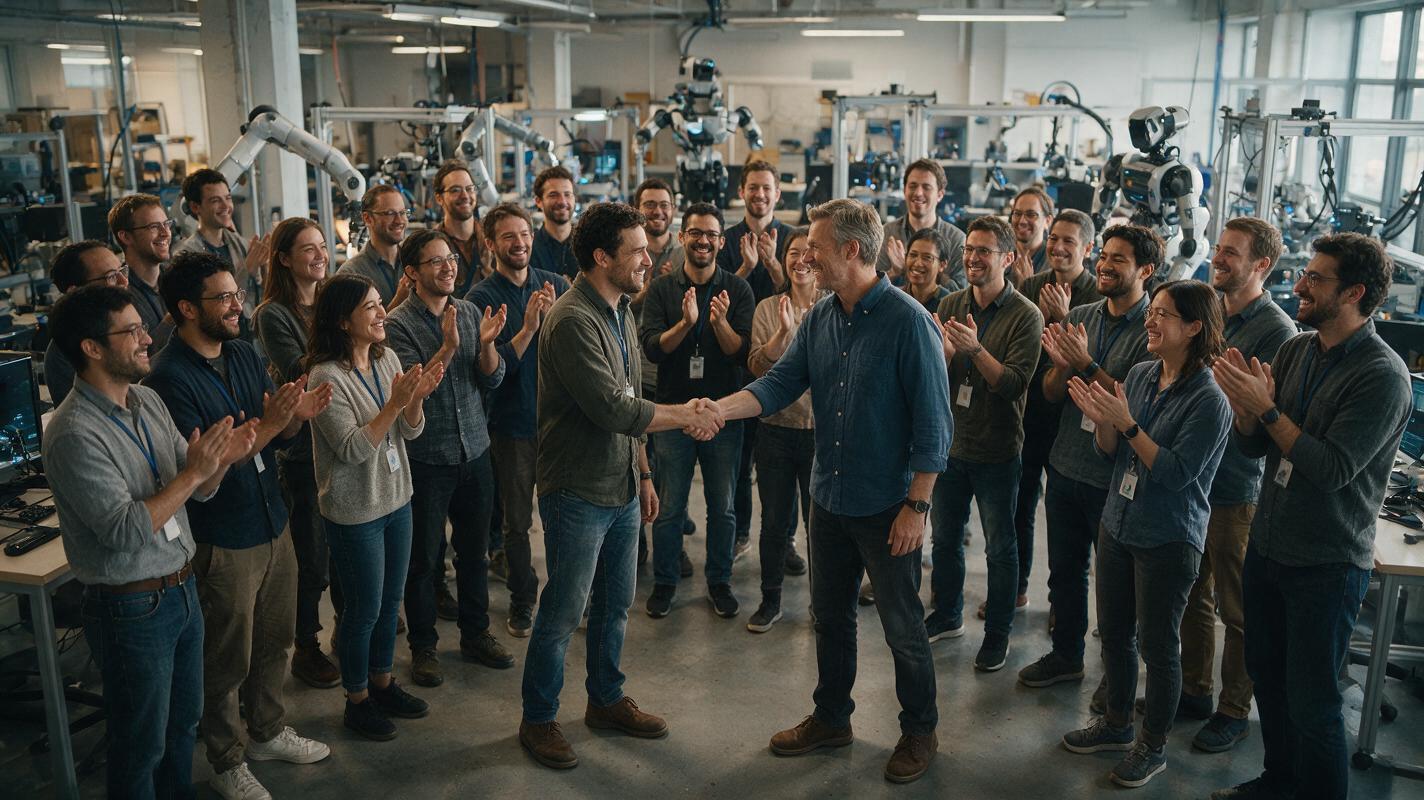
Table of contents
AI Industry Analysis
OpenAI Dissolves Standalone Robotics Research TeamThe company has divided its robotics personnel between core research and applied operations while maintaining its target for a 2027 humanoid demonstration.
Published November 16, 2026
OpenAI confirmed to Fortune on November 13 that it has dissolved its standalone robotics research team. The confirmation followed an unusual scene at the Conference on Robot Learning in Austin, where OpenAI’s booth 208 was left empty. Rather than abandoning robotics, the company is distributing the team’s people and work across two larger organizations.
Researchers from the former robotics unit are moving into OpenAI’s core research group under Chief Research Officer Mark Chen. Applied-robotics and hardware employees are transferring to the broader Applied division led by President Greg Brockman. OpenAI says robotics remains central to its long-term vision, and its target for a humanoid demonstration in 2027 has not changed.
The reorganization is notable because it is the second time OpenAI has dissolved a dedicated robotics group. The original team was disbanded in 2020, rebuilt in 2024 and partnered with humanoid-robot company Figure until February 2025. By the latest restructuring, OpenAI’s San Francisco robotics data-collection lab had expanded more than fourfold to approximately 100 workers operating across three shifts.
That lab used 3D-printed GELLO controllers with Franka robotic arms to gather physical-action data. OpenAI was still recruiting robotics employees as recently as September, offering base salaries of up to $500,000 for some positions. The combination of recent hiring, substantial data operations and another organizational dissolution makes this more than a routine reporting-line change.
For AI video and image creators, the immediate consequence is not a newly released creative tool. The broader signal is that frontier AI companies increasingly see general-purpose models, rather than isolated specialist teams, as the organizing layer for complex work. That shift can affect which models receive investment, how quickly products change and how reliably individual services remain available.
What OpenAI Changed
The robotics program is being reorganized, not publicly canceled. Research personnel will join Mark Chen’s core research organization, while applied robotics and hardware personnel will operate within Greg Brockman’s Applied division.
| Area | Reported change | What remains unchanged |
|---|---|---|
| Robotics research | Researchers move into the core research group under Mark Chen | Robotics remains part of OpenAI’s long-term vision |
| Applied robotics and hardware | Personnel move into the Applied division under Greg Brockman | Physical-world development continues within a larger organization |
| Humanoid program | No new public schedule was announced | The 2027 humanoid demonstration target is unchanged |
| Dedicated team structure | The standalone unit has been dissolved | Its staff and functions are being reassigned rather than described as eliminated |
This structure could place robotics work closer to the teams developing frontier models and the divisions responsible for turning research into deployed products. OpenAI has not provided detailed public milestones for the 2027 demonstration, so the organizational chart reveals more than the current product roadmap does.
Why GPT-6 Astra Is Central to the Interpretation
The reorganization is widely being read as evidence that GPT-6 Astra can serve directly as a general-purpose robot policy model. Under that interpretation, OpenAI may no longer view robotics intelligence as a separate model-development track. A frontier model could instead provide the reasoning and policy layer while specialized teams focus on physical data, hardware and deployment.
Chinese brokerage notes have cited a 74.8% task-success result for GPT-6 Astra, compared with 51.0%, on an Nvidia RoboLab-120 simulation benchmark. Those figures require considerable caution: the comparison has no identified first-party source and has not been independently verified.
Important context: OpenAI has not publicly established that a benchmark result caused the team’s dissolution. The connection between GPT-6 Astra and the restructuring is an industry interpretation, while the personnel changes and unchanged 2027 target are the confirmed elements.
This distinction matters because organizational news can easily be mistaken for a product announcement. OpenAI did not announce that GPT-6 Astra is publicly available as a robot-control system, nor did it publish a new commercial robotics service as part of this confirmation.
A Second Dissolution Signals a Different Robotics Strategy
The historical pattern gives the news additional weight. OpenAI closed its first robotics team in 2020, rebuilt the operation in 2024 and worked with Figure until February 2025. The latest decision again removes the standalone structure, but it does so after the company built a much larger physical-data operation.
The San Francisco lab’s growth to around 100 workers across three shifts suggests that physical demonstration data remained a meaningful investment. Its use of GELLO controllers and Franka arms also shows that the work involved real-world data collection rather than simulation alone.
Moving that activity into larger research and applied organizations may indicate that OpenAI wants robotics data, frontier-model development and hardware deployment to operate within a shared program. It could also reduce organizational boundaries between a model’s development and its physical applications. The company’s unchanged humanoid target supports the view that this is a change in execution strategy rather than a retreat from the field.
What the Reorganization Means for AI Content Production
The robotics story is relevant to creative production because it illustrates how quickly AI providers can reorganize around general-purpose models. A model may begin as a reasoning system and later become the coordinating layer for coding, scientific work, agents or physical machines. Product priorities and access policies can change along with that expansion.
Creative teams should not assume that every frontier-model advance will translate directly into a better ai video generator. Robotics policy, visual generation and image editing are different workloads, and this announcement contains no claim that GPT-6 Astra gained direct video-generation capabilities.
The useful lesson is operational. When a campaign depends on one provider, a reorganization, access change or model transition can disrupt planning even when the underlying technology is improving. Teams working across concept art, storyboards, short-form video and product imagery benefit from keeping their assets portable and avoiding unnecessary dependence on a single model family.
Model reliability is part of creative quality
Visual quality is only one criterion when selecting an AI system. Availability, predictable access and continuity matter when a project has deadlines, client reviews and multiple deliverables. A powerful model that is restricted, reorganized or temporarily unavailable may be less useful than a dependable combination of models suited to different parts of production.
A stable, one-account multi-model environment such as MagicBoat can reduce that exposure. Teams can keep moving from planning to an ai image generator and onward to video production without making the entire workflow dependent on one laboratory’s organizational direction.
Key Takeaways
- OpenAI confirmed on November 13 that its standalone robotics research team has been dissolved.
- Researchers are joining the core research group under Mark Chen.
- Applied-robotics and hardware staff are moving to Greg Brockman’s Applied division.
- OpenAI says robotics remains core to its long-term plans and its 2027 humanoid demonstration target is unchanged.
- The former robotics operation had expanded its San Francisco data lab to roughly 100 workers across three shifts.
- Claims that GPT-6 Astra achieved 74.8% task success on RoboLab-120 lack a first-party source and remain independently unverified.
- For creative teams, the main lesson is to treat model availability and platform continuity as production requirements.
Keep Your Creative Workflow Flexible
Frontier-model strategies can change quickly even when companies remain committed to the underlying technology. MagicBoat brings creative AI options into one account so image and video projects are less exposed to changes at any single provider.
Primary keyword: OpenAI robotics team. Secondary keywords: GPT-6 Astra, OpenAI humanoid robot, robotics research, AI model reliability, AI video model, multi-model platform.