Amazon Prime Video’s AI Lip Sync Is Here — How It Works and Why It Matters
Prime Video is using AI and VFX to align actors’ mouth movements with human-dubbed dialogue. The rollout shows that multilingual video is moving beyond translated audio toward visually synchronized speech.
文章目录
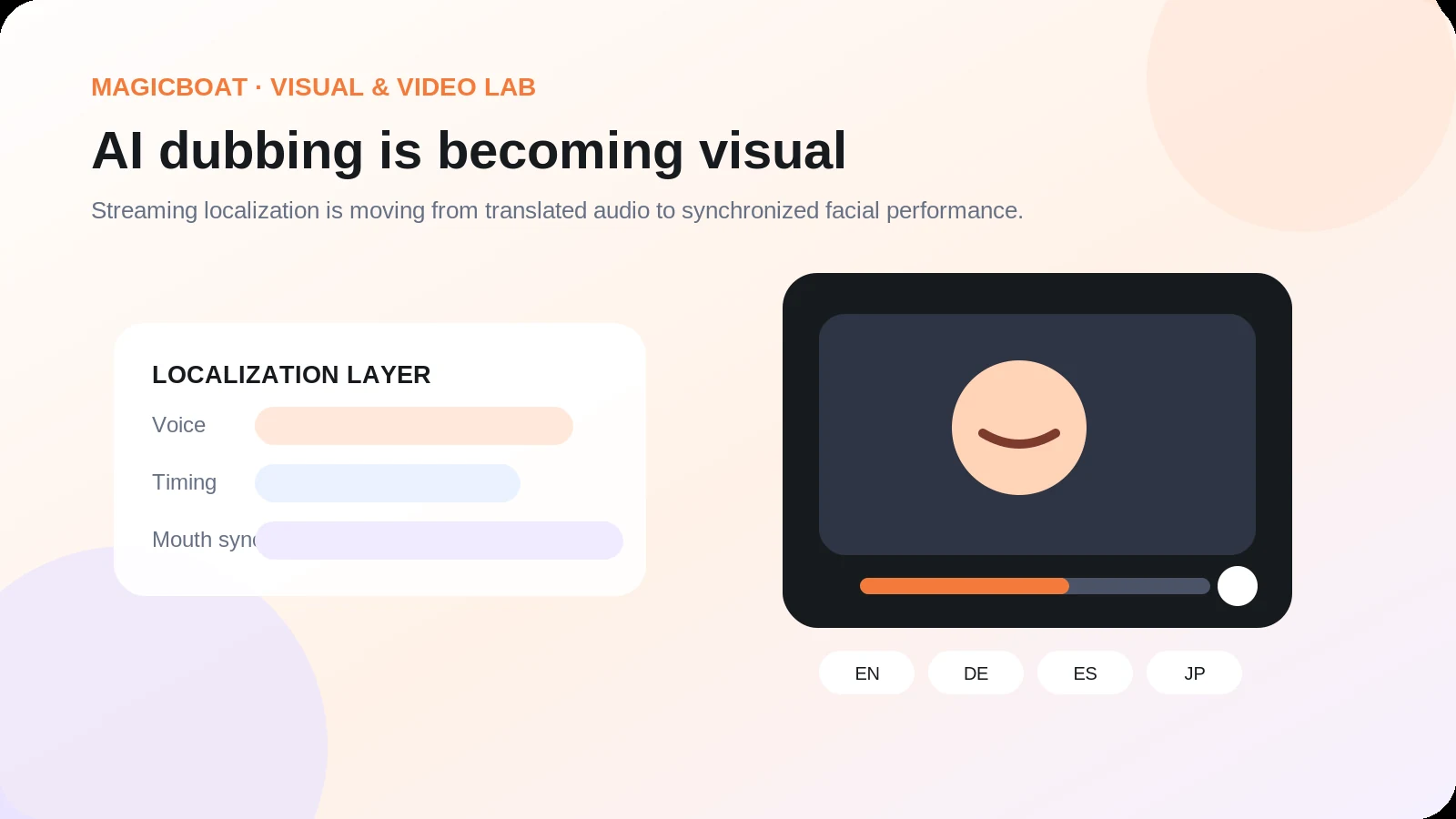
How Prime Video’s visual dubbing is different
Prime Video’s implementation is not positioned as a self-service creator tool. It is a platform-side production workflow for finished streaming titles, combining human dubbing with AI and VFX.
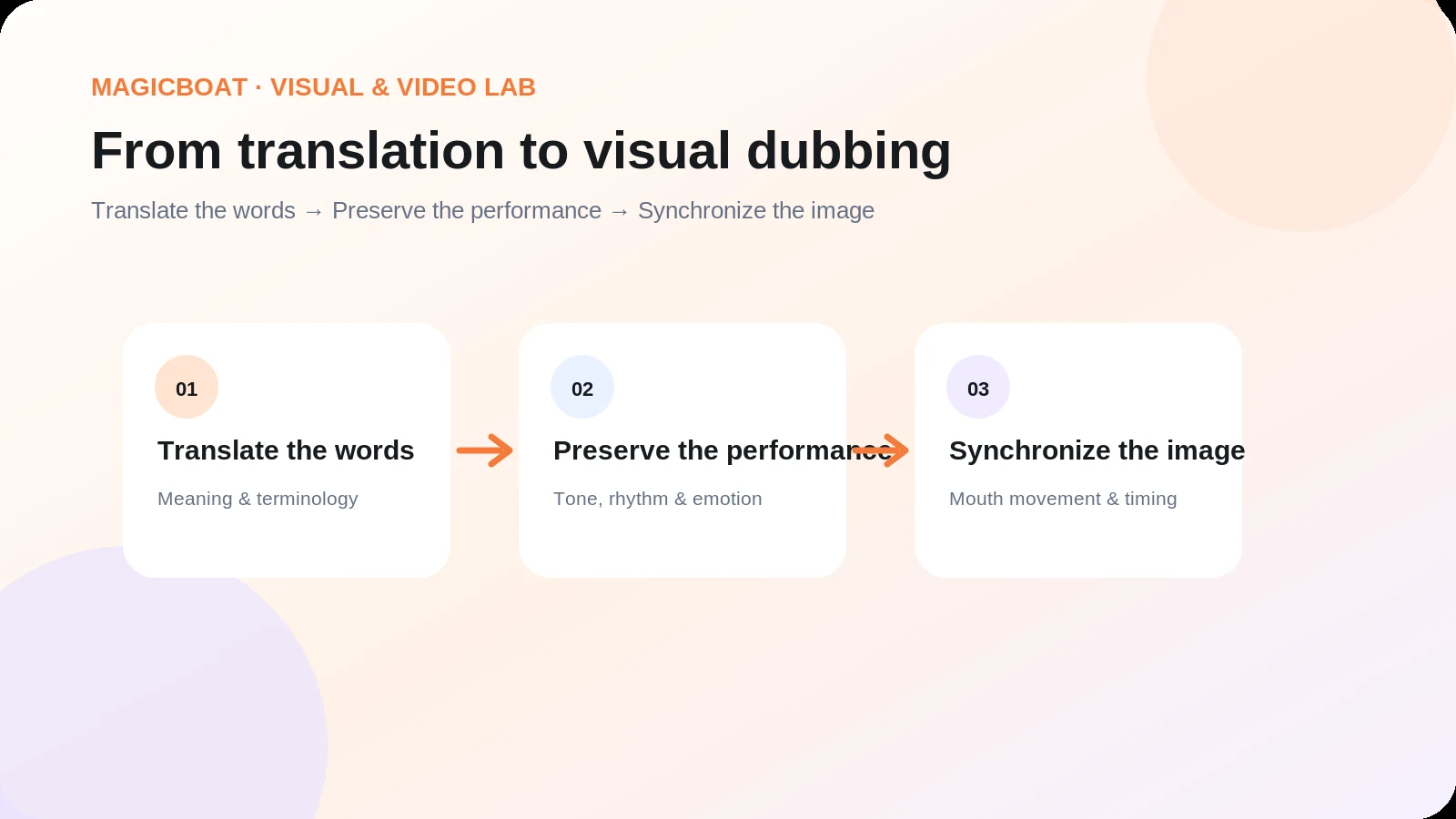
That distinction matters. A studio localization team starts with a completed show and asks, “How do we make this performance feel native in another language?” A social creator may start with an existing short and ask, “How do I reach viewers in another market?” An AI-video creator may start even earlier with an idea and ask, “How do I generate the character, voice, lip sync, edit, and translated variants in one production flow?”
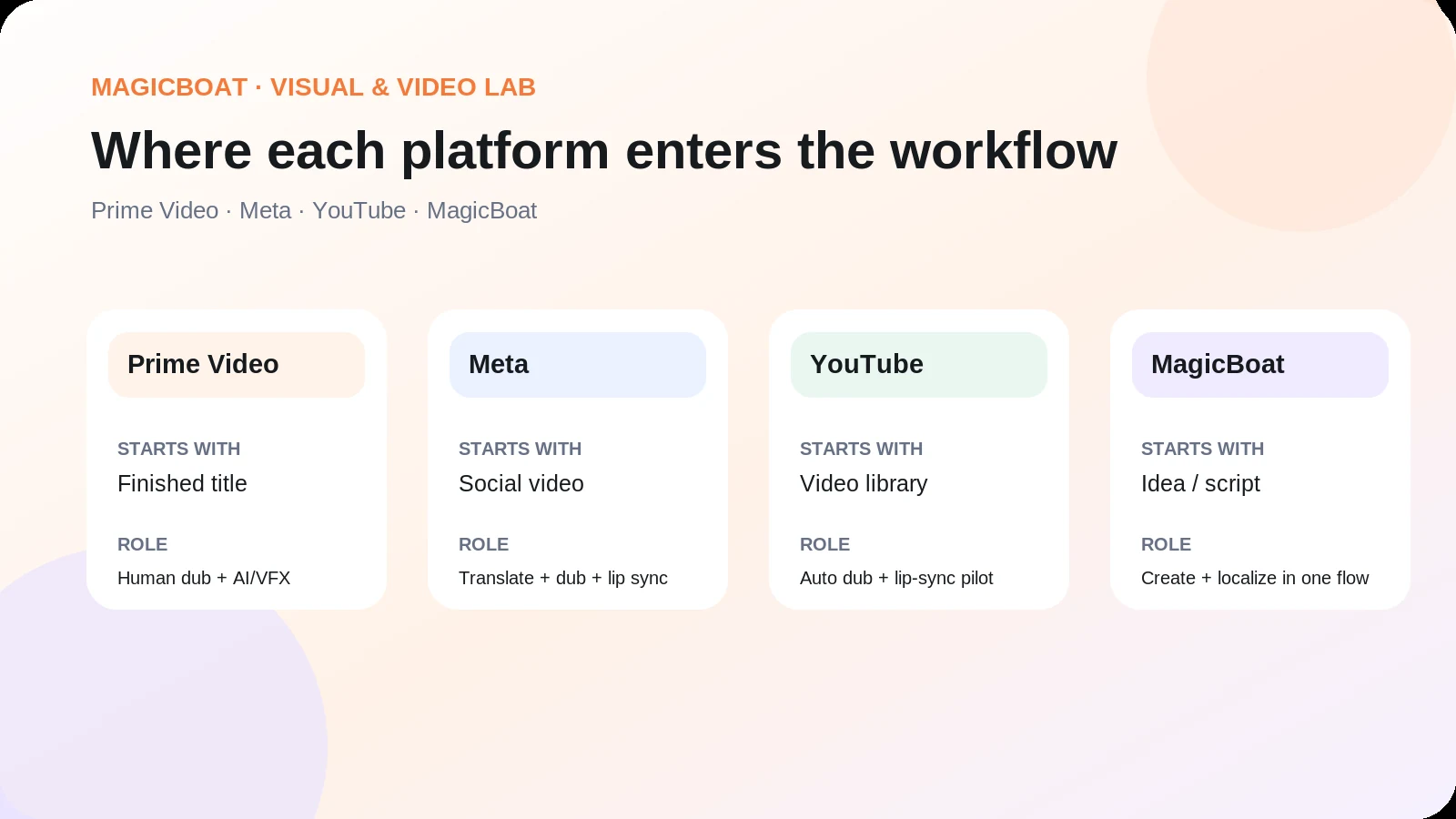
Prime Video vs Meta vs YouTube vs MagicBoat
| Platform | Where it enters the workflow | Lip-sync / dubbing role | Best fit |
|---|---|---|---|
| Prime Video | Finished streaming title | Human dub plus AI/VFX mouth synchronization | Premium film and TV localization |
| Meta Reels | Published or publish-ready social video | AI translation, dubbing, and optional lip sync | Expanding Reels reach across languages |
| YouTube | Channel video library | Auto dubbing plus a lip-sync pilot | Scaling multilingual versions of YouTube content |
| MagicBoat AI | Idea, script, storyboard, or existing creative assets | Voiceover, subtitles, lip sync, editing, and multi-step AI video creation | Building and localizing an AI video from the production stage |
There is no single winner for every task. Prime Video owns the streaming distribution context. Meta and YouTube reduce friction after a creator already has a video. MagicBoat is the stronger starting point when the goal is to create the video itself and keep script, visuals, characters, voice, lip sync, subtitles, and editing in the same production workflow.
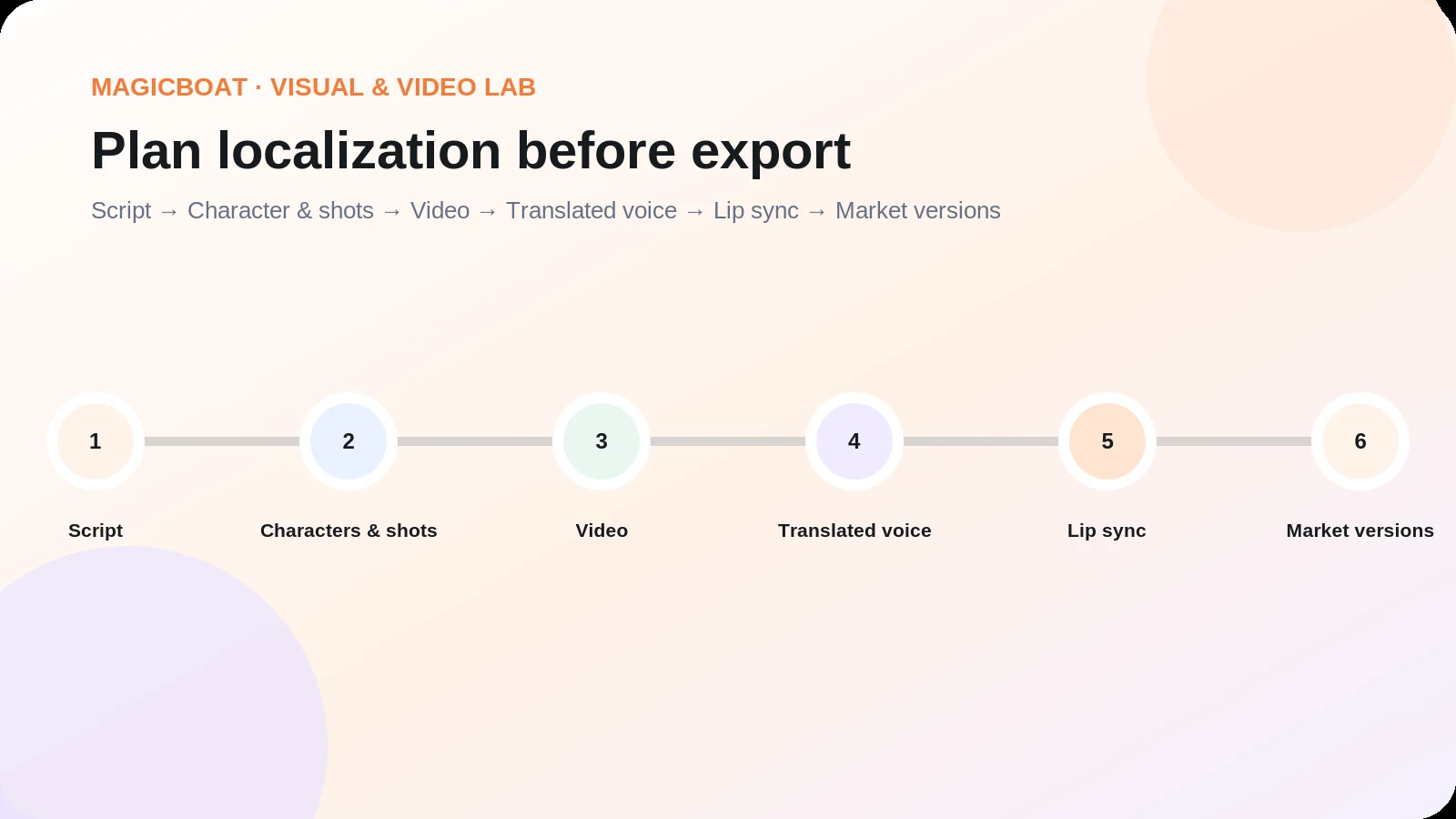
That distinction becomes more important as localization moves upstream. If teams know from the storyboard stage that a video needs English, Japanese, Korean, or Spanish versions, they can plan dialogue length, shot size, facial visibility, subtitle safe zones, and alternate voice tracks before the final export.
What AI lip sync changes for creators
1. Localization can be designed before the final edit
Traditional localization often happens after picture lock. AI-native production makes it possible to think about language variants while the project is still editable.
For a talking-head clip, digital human, short drama, or branded character, this means creators can avoid shots that are unnecessarily difficult to translate. A tight close-up with very fast dialogue may require more visual correction than a medium shot with controlled pacing.
2. Voice quality is only half of the realism problem
A convincing translated voice can still feel artificial if the mouth movement is clearly wrong. This is why the largest video platforms are combining speech generation with visual synchronization.
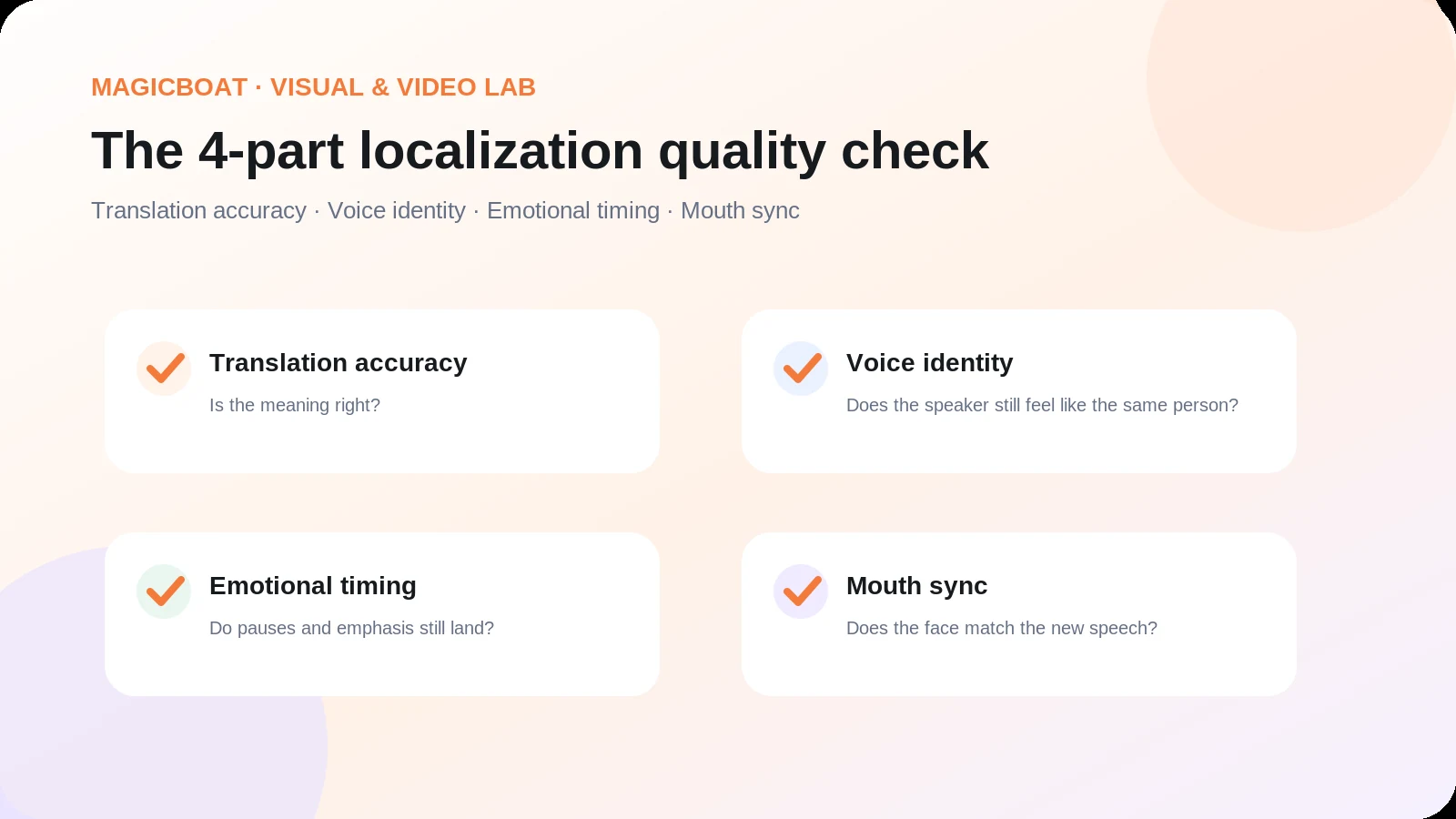
When testing a localized video, review at least four things separately: translation accuracy, voice identity, emotional timing, and mouth synchronization. A pass in one category does not guarantee a pass in the others.
3. One master video can support more markets
The economic appeal is clear: instead of recreating an entire shoot for every language, teams can preserve more of the original visual asset and change the language layer around it.
For creators, that can mean turning one short drama, ad concept, or digital-human episode into several market-specific versions. The useful metric is not “How many languages can the tool output?” It is how many localized versions are good enough to publish without manual repair.
A practical multilingual AI-video workflow in MagicBoat
MagicBoat AI is built around the full film-and-video workflow: idea, script, storyboard, visuals, voiceover, editing, and final video. Its public feature set also includes controllable characters, multilingual prompts and voice workflows, subtitles, and AI lip sync.
A practical process looks like this:
Step 1: Write the source script for translation
Avoid jokes, idioms, or sentence structures that only work in one language unless they are essential. Mark brand terms, names, and phrases that must not be translated.
Step 2: Lock the character and shot plan
Keep reusable character assets and define where close-ups are really needed. If a scene will be localized into several languages, build enough visual flexibility for speech timing to change.
Step 3: Generate or assemble the video
Create the approved visuals and motion, then keep each speaking shot identifiable in the project. This makes alternate voice and lip-sync passes easier to manage.
Step 4: Create the translated voice track
Review meaning and performance before lip sync. A visually perfect mouth match cannot rescue a bad translation or flat delivery.
Step 5: Run lip sync and subtitle review
Check consonant-heavy moments, pauses, laughter, overlapping dialogue, and profile angles. These are common places where a localized version can feel less natural.
Step 6: Export market-specific versions
Do not only swap the language. Also adapt captions, title cards, on-screen text, calls to action, and aspect ratios for the destination platform.
What creators should watch next
Prime Video’s rollout suggests that visual dubbing is moving into mainstream entertainment, not staying as an experimental creator feature. The next competitive questions are likely to be less about whether a platform can dub a video and more about quality, controllability, cost, language coverage, and how much of the original performance survives the transformation.
For AI-video tools, that creates a broader opportunity. The winning workflow will not just generate a translated voice. It will help creators manage the entire chain: script adaptation, character continuity, voice, facial performance, captions, edits, and exports.
That is where MagicBoat AI has a natural advantage over single-purpose dubbing features. It is designed as a production workspace rather than a distribution-only translation switch, so localization can be planned as part of the video instead of added at the very end.
Build the workflow, not just the clip
MagicBoat AI brings script, storyboard, characters, generation, voice, lip sync, subtitles and editing into one connected AI-video workflow.
Explore MagicBoat AI →FAQ
What is Prime Video’s new AI lip-sync feature?
It is a visual-dubbing system that uses AI and VFX techniques to adjust actors’ mouth movements so they align more closely with human-dubbed dialogue.
Which show is using Prime Video AI lip sync?
Amazon says the feature debuted on Maxton Hall Seasons 1 and 2 and will also be available for Season 3, scheduled to premiere December 9.
Is Prime Video replacing human dubbing with AI voices?
Amazon’s announcement describes the system as synchronizing mouth movements to human-dubbed audio. The AI and VFX layer is used to improve the visual match.
Does Meta offer AI dubbing with lip sync?
Yes. Meta offers AI translation and dubbing for Reels with optional lip sync in supported languages and markets.
Does YouTube have AI lip sync?
YouTube has expanded auto dubbing and says it is testing a lip-sync pilot to make translated speech visually match a speaker’s mouth movements.
Can MagicBoat be used for multilingual AI video production?
MagicBoat’s public workflow supports scripts, storyboards, visuals, voiceover, subtitles, lip sync, editing, and multilingual content creation. It is best suited to creators who want to build and localize the video inside one broader production workflow.
Sources
- Amazon — Prime Video introduces new lip-sync technology on Maxton Hall: https://www.aboutamazon.com/news/entertainment/prime-video-lip-sync-technology
- The Verge — Amazon Prime Video’s new AI tech matches lips to dubbed audio: https://www.theverge.com/tech/991809/amazon-prime-video-ai-lip-sync-dubbing
- Meta — Discover Reels From Around the World With Meta AI Translation: https://about.fb.com/news/2025/10/discover-reels-around-world-meta-ai-translation/
- YouTube — Unlocking a global audience with auto dubbing: https://blog.youtube/news-and-events/youtube-auto-dubbing-expressive-speech/
- MagicBoat AI — product and feature overview: https://www.magicboat.net/